
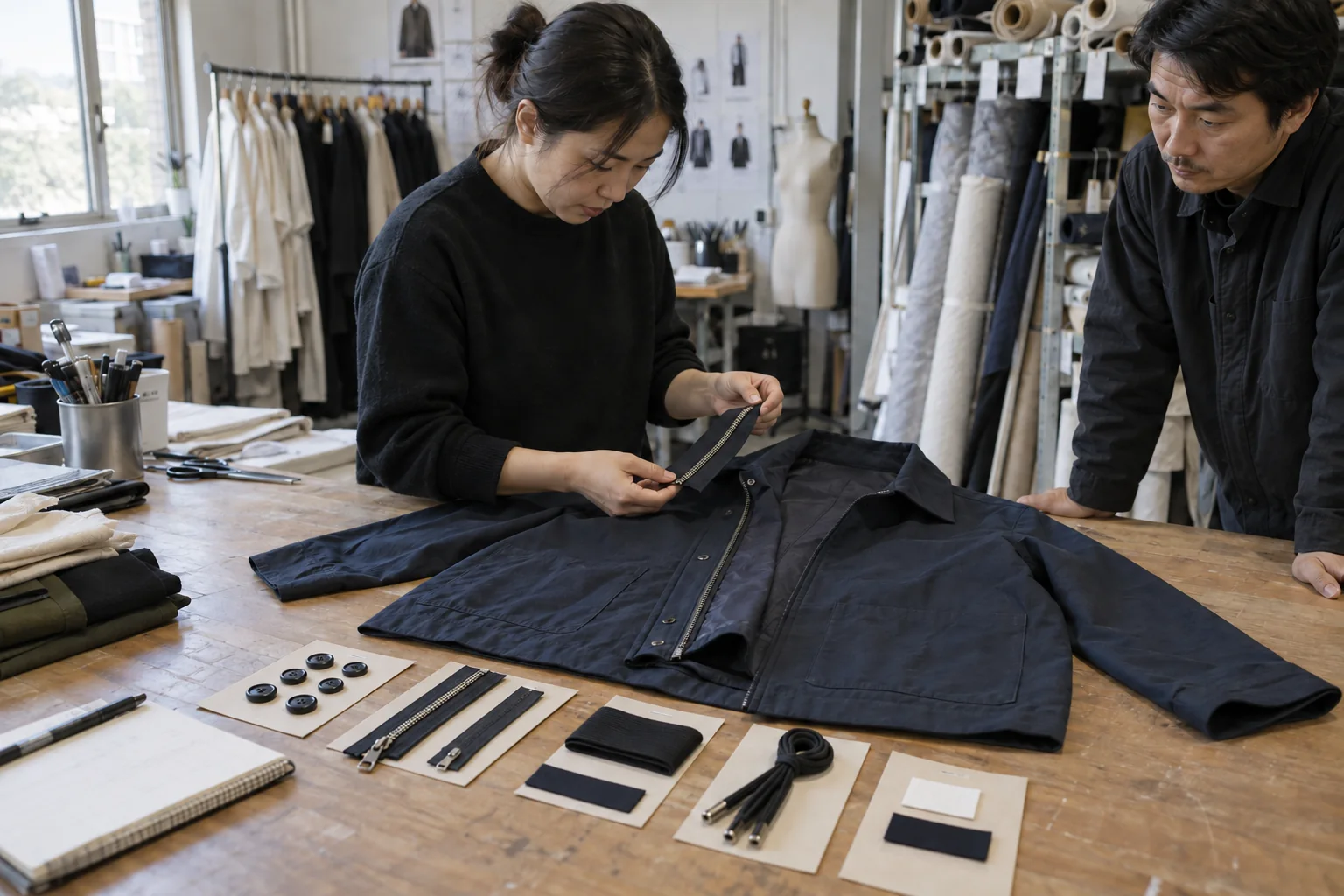
Quick answer
Approve apparel trims as controlled components, not as a mixed bag attached to one garment sample. Give every zipper, button, snap, elastic, drawcord, label, patch, interlining and packaging item its own identifier, material or construction requirement, color and finish reference, dimensions, placement, supplier or source status, test plan where required, and approved bulk sample. Then verify compatibility on the garment, track production lots, and prevent substitutions without written approval.
Who should use this checklist
This guide is for overseas brands, retailers and product teams developing private-label apparel with an external supplier. It is especially useful when the main fabric and fit sample are approved but the trim package is still moving between temporary, nominated and production-ready components.
Trims are small, but they control visible and functional details. A zipper affects opening and drape, elastic changes fit, and interlining changes shape. Some components also require product- and market-specific safety or compliance review.
The objective is traceability: every party should know which component is approved for each style, color and revision.
Build a trim register before approval
Create one row for every controlled item. Do not group “all labels” or “all hardware” into a single line if the components have different specifications or approval status.
| Register field | Buyer decision | Evidence to retain |
|---|---|---|
| Trim ID | Stable identifier linked to style and bill of materials | Controlled BOM and approval sheet |
| Description | Component type, intended function and exact location | Technical sketch or placement image |
| Construction | Material, structure, finish and relevant manufacturing detail | Supplier specification and physical sample |
| Dimensions | Measurement points and permitted variation | Approved drawing and measurement record |
| Color or finish | Physical master, approved range and viewing condition | Protected reference and bulk-lot comparison |
| Compatibility | Required fit with fabric, seam, opening or mating component | Garment trial and first-piece evidence |
| Source status | Nominated, factory-sourced, buyer-supplied or temporary | Written responsibility and approved supplier record |
| Bulk status | Development sample, approved sample, bulk approved, held or rejected | Dated decision and retained production sample |
| Verification | Visual, dimensional, functional or product-specific test requirement | Approved method and result for the actual order |
The register should show open items. Hiding temporary trims inside a sample creates false confidence before production.
Separate appearance, construction and performance
A trim can look correct but still be wrong for the garment. Review three questions.
Appearance: Does the color, texture, gloss, shape and visible finish match the approved reference and garment design?
Construction: Is the trim made from the approved material and structure, with the correct dimensions, teeth, tape, coating, backing, attachment holes, weave or layer build?
Performance: Does the component perform its intended function after it is attached to the production fabric and construction?
Performance is product-specific. A zipper may behave differently after sewing; elastic can change after heat or finishing; and a snap can distort fabric if reinforcement or setting is wrong.
Do not invent a universal pull force, cycle count, shrinkage limit or durability claim. Define the method and acceptance rule for the actual product with qualified technical input.
Approve the trim in context
Loose-component approval is necessary but incomplete. Review the trim on the intended fabric, seam, reinforcement and garment location.
For zippers, check length basis, tape color, teeth or coil appearance, slider, puller, top and bottom stops, opening direction and sewing compatibility. For buttons and snaps, review the complete mating set, attachment method, reinforcement, alignment and surrounding fabric response. For elastic, confirm width, thickness, color, hand feel, recovery direction and the finished measurement after assembly.
For drawcords, toggles and ends, control material, dimensions, finish, routing and attachment. Product safety and destination rules may require specialist review, particularly for products intended for children.
For interlining, shoulder pads, tapes and other hidden structure, approve identity, weight or construction, location and bonding or attachment method. A hidden substitution can change silhouette, drape, comfort and finishing behavior even when the outer garment initially looks similar.
Treat labels and artwork as controlled data
Brand, size, care, composition, origin, hangtag, sticker and packaging labels should each have a current artwork file and a physical production reference. The garment sample may show placement, but it does not prove that the printed or woven content is correct.
Control:
- exact artwork revision and language version;
- dimensions, folds, seam allowance and placement;
- base material, print or weave method and color;
- readable orientation after attachment;
- style, size and color mapping;
- barcode or machine-readable data verification where applicable; and
- responsibility for confirming destination-market content.
Never create regulatory, composition, care or origin content by copying another product. The buyer and qualified compliance resources must approve the information for the actual garment and market.
Control color as a trim-to-garment decision
“Black” is not one production standard. Zipper tape, thread, elastic, buttons, labels and fabric can each reflect light differently. Agree which items should match, which should coordinate and which are intentionally contrasting.
Compare trims against the protected physical reference and the actual bulk fabric under the agreed viewing condition. Review adjacent materials together because texture and gloss affect perception. Keep bulk-lot samples and do not assume that a repeat trim order matches the previous batch because the supplier uses the same color name.
If a tolerance or instrument reading is used, control the instrument, settings, preparation, measurement location and calculation method. Numeric data can support the decision, but it does not replace visual review of the assembled garment.
Approve bulk before the factory consumes it
Development samples may come from sample-room stock. Bulk production must use released production trims.
A practical sequence is:
- Supplier submits representative bulk trim samples linked to the trim ID and lot.
- Buyer or authorized reviewer compares them with the approved reference and current garment.
- Compatibility or product-specific checks are completed where required.
- The decision is recorded as released, held, conditionally released or rejected.
- A retained bulk sample is protected and linked to the order.
- Released and held lots remain physically and digitally separated.
- The first production garment is checked to confirm correct installation and appearance.
Do not let urgency convert “submitted” into “approved.” If the factory consumes an unapproved lot, the buyer loses an important control point and may face finished-goods rework.
Prevent substitutions and lot mixing
When a trim is unavailable, the factory may offer an “equivalent” component. Treat that as a change request. Compare appearance, construction, dimensions, compatibility, price, lead time and required verification before approval.
The change record should state which styles, colors, sizes, quantities and purchase orders are affected. Update the BOM and inspection reference. A chat approval without scope can be misapplied to another color or repeat order.
Lot identity should remain visible through receiving, storage, line issue, work in process and packing. Keep a reliable internal link between the component used and the released record.
Inspect trims at four production gates
- Incoming: identity, lot, quantity, appearance and released status.
- First piece: correct trim, placement, attachment, alignment and interaction with the garment.
- Inline: repeated workmanship, damage, mixing, orientation and function at the relevant operation.
- Final: correct style/size/color mapping, visible appearance, operation, labels, accessories and packing.
At each gate, define the item checked, sample selection, decision owner and evidence. A final inspection can find the wrong zipper or label, but it cannot make late replacement easy.
Red flags before production release
- The BOM says only “zipper,” “button” or “label” without an identifier.
- Sample-room trims are treated as bulk-approved components.
- Loose trims were approved without trying them on the intended garment.
- A temporary label contains unverified production text.
- Color is approved from phone photographs alone.
- One approval is reused across several sizes or colors without defining scope.
- The trim supplier changes but the component is not revalidated.
- Held and released lots share storage without status control.
- The factory substitutes a component to protect the ship date before buyer approval.
- Inspection documents do not identify the current trim revisions.
Buyer’s trim-release checklist
- Every trim has a stable ID, description and garment location.
- Appearance, construction and performance requirements are separated.
- Physical references and artwork revisions are controlled.
- Source responsibility and bulk approval status are visible.
- The trim is reviewed on actual bulk fabric and garment construction.
- Color and finish are compared under agreed conditions.
- Product-specific verification is defined where needed.
- Bulk lots are approved and retained before consumption.
- Substitution, lot-mixing and change-control rules are written.
- Incoming, first-piece, inline and final checks use the same current references.
Next step
If you are preparing a private-label apparel order, send ZWC the garment sketch or tech pack, current BOM, fabric status, trim list, sample stage, quantity by style and color, target market and required date. We can help identify missing supplier, approval and production-control decisions before bulk release.
AI assisted with research organization, drafting and creation of the illustrative hero image. Buyer-specific technical, legal and commercial decisions still require verification for the actual product and order. The image is illustrative and does not depict a named ZWC client, supplier or verified project.