
Quick answer
A chef-footwear enquiry should identify the actual work areas, floor surfaces, likely contamination, cleaning arrangements and wearer tasks before suppliers propose shoes. Then connect each proposed model to relevant evidence and manufacturer instructions. This is a procurement-information framework, not a specific shoe recommendation, PPE selection, test threshold or workplace safety approval. The employer and appropriately qualified advisers must make those decisions for the actual site and market.
The same shoe description can conceal different buying questions
A quotation says “oil-resistant, non-slip chef shoe”. The buyer wants one model for a cooking line, wash-up area and deliveries. What has actually been specified: resistance to material damage, performance on a particular contaminated surface, or simply a category name?
Those meanings cannot be exchanged. HSE's footwear guidance distinguishes oil resistance from slip resistance and stresses the relevance of surfaces and contaminants. Neither a rubber label nor an aggressive-looking tread establishes suitability for the kitchen you are buying for.
This guide is for procurement teams and footwear developers organising an enquiry. It does not evaluate an offered product or replace a site risk assessment. No kitchen has been audited and no shoe has been tested for this article. Do not use it to prescribe protection against hot liquids, chemicals, falling objects or other hazards.

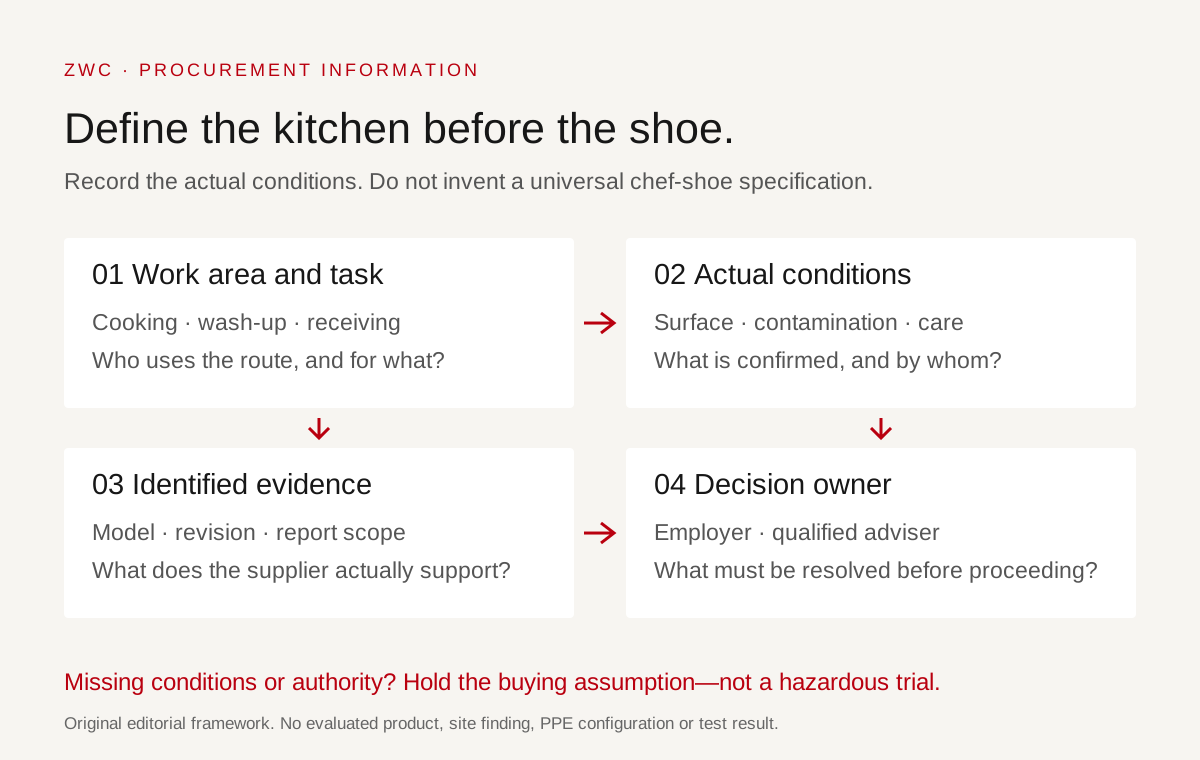
Map the working route before asking for a sole material
Start with the employer's current assessment and the people responsible for operations, cleaning and safety. Ask them to identify actual work areas, not just the restaurant address. A site may have different surfaces and conditions along one person's working route.
The following is an original information-gathering register. The entries are questions, not findings about your kitchen or instructions to expose anyone to a hazard.
| Work area to confirm | Inputs to record | Evidence question for the enquiry | Site owner to identify |
|---|---|---|---|
| Preparation and cooking | Floor identification and condition; actual food or liquid contamination; movement and carrying tasks | Which declared conditions does the supplier's proposed evidence cover, and which remain outside it? | Operations and competent safety adviser |
| Wash-up and cleaning | Surface, water/cleaner exposure, cleaning schedule and access arrangements | Do the evidence and care instructions address the identified conditions rather than a generic wet-floor claim? | Cleaning lead and safety adviser |
| Stores and receiving | Route, transitions, indoor/outdoor movement and relevant tasks | Does the proposed model's intended-use scope cover this route, or is separate assessment needed? | Receiving lead and safety adviser |
| Shared routes | Changes in level, mats, damaged areas and circulation constraints | Which issues need site controls rather than an attempted footwear solution? | Facilities and operations |
HSE's catering guidance treats food spills, leaks, floor damage, obstacles and cleaning as distinct concerns. A footwear purchase does not close those issues. Record who owns outstanding site actions instead of placing every unresolved problem in the shoe specification.
Treat the tread as part of a system, not a photograph
The contact situation includes the sole, the floor and whatever is between them. Pattern and compound therefore need to be considered together. HSE notes that food debris can clog tread and that performance can change with wear. Its guidance also warns that performance in wet conditions does not automatically establish performance with oil or sticky food.
For purchasing, this means asking for the identified outsole and proposed whole-shoe model, not accepting a similar-looking sample as a substitute. Request clear component references, the current revision, manufacturer instructions and the exact scope of the supporting documents. A change in outsole design or material should prompt a question about what evidence still applies; the buyer should not decide equivalence from colour or outline.
Do not turn that observation into an unsupported recipe. This article does not prescribe a rubber formulation, hardness, tread dimension or manufacturing setting. A material name is not a complete specification, and a close-up cannot reveal a compound's formulation or verify its behaviour.
Read the report conditions before comparing the result
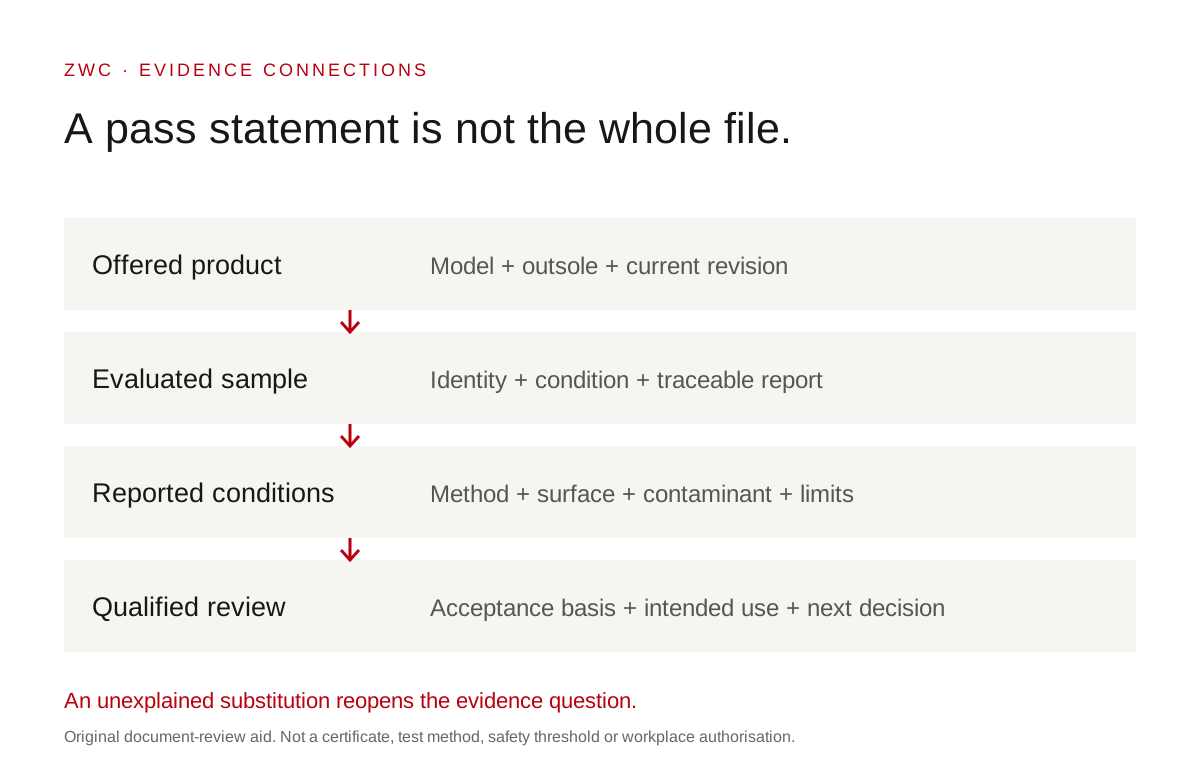
A report can be genuine yet answer a narrower question than the purchase enquiry. Ask the supplier to connect it to the offered revision, then let the relevant qualified reviewer assess the method, conditions and acceptance basis. Do not rank unrelated test numbers as if they came from one controlled comparison.
| Report field | What to connect | Reason to pause the comparison |
|---|---|---|
| Product identity | Offered model, outsole reference and revision to the evaluated sample | Another family, a marketing name alone or an unexplained revision |
| Method and edition | Actual method, edition and scope, with a named technical reviewer | A logo or claim without the relevant report and scope |
| Test conditions | Surface, contaminant, sample condition and other conditions reported by the method | An unreviewed assumption that the test represents the actual kitchen |
| Results and basis | Complete results and the acceptance criteria chosen by the responsible reviewer | An isolated pass statement or selected number without context |
| Intended use and care | Manufacturer limitations, cleaning instructions and applicable exclusions | The proposed use extends beyond the supplied instructions |
The linked HSE procurement page still contains older standards and marking explanations. We use its condition-based purchasing principles, not those passages as a current standards checklist. The applicable market, product classification and current requirements must be verified for the real enquiry. No old marking is presented here as universal approval.
Fit and maintenance need their own records
Slip evidence does not tell you whether the proposed size range, fastening or fit will work for the intended wearers. Ask the employer to define how those questions will be assessed, by whom and under what controlled arrangements. Keep subjective feedback separate from test evidence: a wearer saying a shoe feels comfortable does not certify its slip performance.
WorkSafe Queensland's footwear guidance highlights fit, tread condition, contamination and maintenance. Use those as questions to resolve, not a universal specification imported from another jurisdiction. Request the manufacturer's care instructions and ask the site to confirm whether they are practical within its operations.
Record model, size, date, task, condition, feedback and the person reviewing it. For maintenance, name the inspection owner, cleaning arrangements and process for responding to damaged or worn footwear. Do not invent a fixed replacement interval without product and site evidence. WorkSafe's floor guidance also frames slip risk as an interaction of conditions rather than one universally safe friction value.
Any workplace evaluation must be authorised and risk-controlled by the employer and appropriate professionals. Never create an oil spill, wet a walking route, carry hot liquid or stage a slip demonstration to compare shoes. A supplier's dramatic demonstration is not a substitute for a properly defined evidence package.
Decide what the next payment will resolve
Before paying for a sample programme or larger order, use a short decision record. “Continue” means proceed to the next defined procurement step—not permission to issue shoes for work.
| Decision | Required position | Next action |
|---|---|---|
| Continue the enquiry | Site inputs, product identity and evidence-review owner are named | Obtain the specific missing documents or samples under an agreed scope |
| Revise the scope | Different work areas or wearer needs remain unresolved | Separate the buying questions; obtain the responsible parties' decisions |
| Hold | Missing identity, unsupported suitability claim, unexplained substitution or no competent decision owner | Resolve the gap before expanding expenditure or treating the product as accepted |
To discuss China-side supplier coordination, share the destination, employer-approved task brief, proposed quantities, size range, development stage and unresolved evidence question through ZWC's footwear sourcing page. Do not send personal medical information. Supplier availability and specialist capability need project-specific confirmation; this guide does not establish ZWC as a certified PPE supplier, test laboratory or safety adviser.
For broader development inputs, see our footwear supplier requirements guide. That general checklist does not replace the site-specific decisions above. A useful first outcome is a precise enquiry and a named next decision—not an unsupported promise that one chef shoe solves every kitchen condition.
Primary sources
- HSE: slip-resistant footwear, accessed23October2026; page displays update5August2025, with older standards passages not adopted as current requirements.
- HSE: catering slips and trips, accessed23October2026; UK guidance, not a global compliance opinion.
- WorkSafe Queensland: footwear, accessed23October2026; jurisdiction-specific guidance used for bounded procurement questions.
- WorkSafe Queensland: floor and ground surfaces, accessed23October2026; not a recommended test threshold or floor approval.
AI assisted with research organisation and text. Two additional preparation/wash-up scenes were AI-generated and labelled individually; they show fictional workplaces and generic shoes, not ZWC projects, recommended products or safety evidence. The historical hero photograph is not AI-generated. Kitchen photo: Raysonho @ Open Grid Scheduler / Grid Engine, RestaurantKitchen.jpg / Wikimedia Commons, CC0 1.0, resized/compressed. Historical illustrative restaurant context only—not ZWC personnel, a client, a footwear recommendation, a workplace assessment or evidence of safe/unsafe conduct. Incidental brands do not imply endorsement. Both diagrams are original explanatory SVGs, not product tests or workplace instructions.