
Quick answer
Photograph the evidence needed to reconstruct how the supplier would make, control and pack your product after you leave. Capture the production route, critical processes, material identity, work-in-progress, approved references, quality controls, nonconforming-product area, finished goods and packing flow. Link every image to a location, date, product, question and follow-up action. A large photo gallery without context proves very little.
Who should use this factory-visit photo checklist?
This guide is for overseas buyers, private-label brands, importers and sourcing teams visiting a potential or current supplier. It is most useful when the visit must support a real decision: shortlist a factory, approve a pilot order, investigate a delay, prepare a quality plan or decide whether volume can increase.
Photography should be agreed with the supplier before the visit. Some processes, customer products, documents, screens and restricted areas may be confidential or unsuitable for photography. Ask permission, respect posted restrictions, avoid recording workers unnecessarily and agree how sensitive evidence will be stored and shared.
Begin with the decision, not the camera
Before arriving, write down the questions the visit must answer. For example:
- Does the named supplier control the relevant production steps?
- Can the proposed product follow a credible route through this site?
- Which process is likely to limit output or quality?
- How are materials, approved samples and production lots identified?
- What happens when a unit fails an inline check?
- Can finished quantities, packing status and shipment readiness be reconciled?
Turn each question into an evidence request. This prevents the visit from becoming a tour of clean areas chosen for presentation. It also makes the resulting report useful to colleagues who were not present.
The eight-part factory visit photo sequence
The exact evidence depends on the product and visit scope, but the sequence below creates a practical baseline.
| Photo group | What to capture | What the image should help answer | Common weak evidence |
|---|---|---|---|
| 1. Site and identity | Permitted exterior, reception identity, building or unit reference | Is this the site visited, and how does it relate to the entity being evaluated? | A cropped sign or showroom image with no location context |
| 2. Production route | Wide views of each relevant stage in process order | Can the team reconstruct the actual route from incoming material to packing? | One attractive line photo with no indication of preceding or following steps |
| 3. Critical process | Machine, fixture, workstation, input and output together where permitted | Is the important process present and suitable for the proposed product? | Close-up machine photo with no product, setup or operating context |
| 4. Bottleneck and load | Queues, changeover area, shared equipment, work-in-progress and line status | Where may output be constrained, and what other work competes for the resource? | An empty line presented as “available capacity” without a time or plan |
| 5. Materials and traceability | Material containers, lot separation, permitted identification and storage conditions | Can inputs be connected to an approved source, version or production lot? | Unidentified loose material or a label photographed without the material |
| 6. Quality control | Inline check, reference used, checking method, result record and segregated failures | What is checked, against what reference, and what happens after failure? | A person holding a gauge for the camera without a defined characteristic |
| 7. Finished goods | Product by style or variant, quantity status, hold/release separation | Can the reported finished quantity and status be supported? | Stacked cartons that cannot be linked to the buyer's product |
| 8. Packing and dispatch | Inner packing, carton contents, count method, marks and staging area | Will the correct units reach the correct cartons and documents? | One perfect presentation sample that does not represent bulk packing |
Do not force a photograph when the supplier declines permission. Record the refusal, reason and alternative evidence offered. A written observation, verified document, live demonstration or buyer-approved third-party check may be more appropriate.
Photograph the production route in order
Start with a wide contextual image, then move closer only when needed. A useful sequence might show incoming material storage, preparation, forming or cutting, assembly, finishing, inline control, final verification and packing. Product categories differ, so the route should match the actual manufacturing method rather than a generic checklist.
For every stage, record four things beside the image:
- the process name;
- the input entering the stage;
- the output leaving it; and
- the control or approval that allows work to proceed.
This makes gaps visible. If a key stage is said to occur elsewhere, ask who performs it, where it occurs, how the material moves and how quality is controlled. Do not label a third party as unauthorized or unacceptable without checking the purchase terms; the immediate objective is to make the production chain explicit.
Capture capacity evidence without pretending one visit proves capacity
A busy line does not prove available capacity, and an empty line does not prove spare capacity. Photographs can support a capacity review when combined with a time, product, shift, output record, current order load and known bottleneck.
Capture the workstation or equipment that limits the proposed route, the work waiting before it and the output after it. Where permitted, connect the image to the supplier's production plan or live status discussion. Ask what happens during changeovers, maintenance, rework and material shortage.
A photograph is a snapshot. It cannot verify sustainable output on its own. Treat any capacity conclusion as a reconciliation of observed process, demonstrated output and documented load—not a visual estimate of floor size or headcount.
Make quality-control photographs meaningful
The best quality photograph shows a relationship: product characteristic, approved reference, checking method, result and disposition. It should answer “what decision is being made here?”
For footwear, that could mean a color comparison under the agreed viewing condition, a bonding-process control, a size or fit reference, or a workmanship check against the approved sample. For handbags, it might be material shade, hardware finish, seam construction or finished dimensions. For apparel, it might be approved trims, stitch construction, measurement points or shade grouping. The required control must come from the buyer's approved specification and quality plan.
Avoid staged images of a worker repeatedly measuring an arbitrary point. If the characteristic has no defined method, tolerance or decision rule, the photograph demonstrates activity rather than control.
Also ask to see how nonconforming material or product is identified and separated. Photograph only with permission and avoid exposing another customer's product or confidential information. Record whether the item is awaiting review, rework, return or disposal; do not infer the status from a colored bin or sign alone.
Link each image to a question and follow-up
Rename or index photographs soon after the visit. A simple evidence log can use these fields:
- image ID;
- date and approximate time;
- permitted location or department;
- product, style, material or process;
- visit question addressed;
- what was directly observed;
- supplier explanation, clearly labeled as an explanation;
- missing evidence or contradiction;
- owner and due date for follow-up; and
- sharing or confidentiality restriction.
Keep observation separate from interpretation. “Three cartons were open in the packing area” is an observation. “The factory has weak packing control” is a conclusion that needs more evidence. This distinction makes the report more credible and easier to review.
What not to photograph or claim
Do not photograph restricted areas, personal records, access credentials, private screens, other customers' branded products or workers' faces without appropriate permission. Do not move guards, interrupt machinery, enter marked areas or ask staff to perform unsafe actions for a better image.
Avoid claims that a photograph cannot support. A factory exterior does not verify ownership. A machine does not verify capacity. A certificate image does not verify validity. A clean sample room does not verify bulk quality. A group photo does not prove who controlled the order.
Legal, privacy, labor, security and customer-confidentiality requirements vary. The buyer and supplier should confirm the applicable rules and visit protocol before capturing or distributing images. Keep sensitive images in a controlled evidence file, limit access to the people who need them for the sourcing decision and avoid reusing visit photographs outside the agreed purpose.
Pre-visit checklist
- [ ] Define the decision the visit must support.
- [ ] Map the proposed product's expected production route.
- [ ] Agree permitted and restricted photography in advance.
- [ ] Prepare an evidence list linked to specific questions.
- [ ] Assign one person to take notes while another observes where possible.
- [ ] Capture context before close-ups.
- [ ] Record missing, refused or contradictory evidence.
- [ ] Separate direct observation from supplier explanation.
- [ ] Protect confidential images and limit distribution.
- [ ] Issue follow-up actions with owners and dates.
Planning a supplier visit in China?
Send ZWC Sourcing your product, supplier status, proposed order, visit purpose and the decisions you need to make. We can help turn the visit into a focused evidence plan covering production, quality, packing and follow-up.
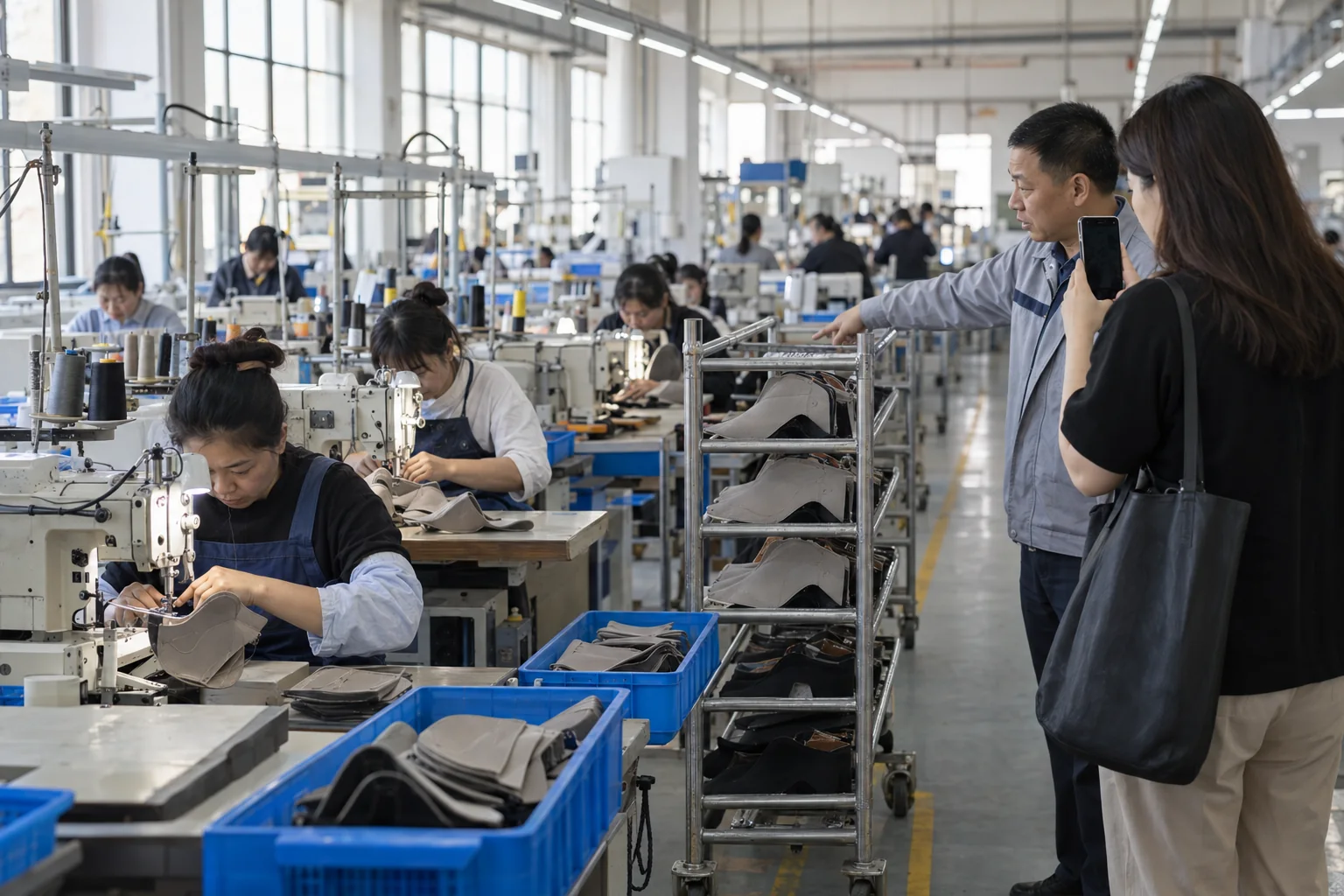
AI assisted with research organization, drafting and creation of the illustrative hero image. Buyer-specific technical, legal and commercial decisions still require verification for the actual product and order. The image is illustrative and does not depict a named ZWC client, supplier or verified project.