

Quick answer
Treat a proposed bag-hardware substitution as a controlled change, not a fresh color approval. Identify the original and replacement parts, their interfaces, the affected production lots and the evidence that must be renewed. Hold the affected stock separately while the named buyer and technical owners decide. Release must state exactly which parts, assemblies and orders it covers; a new sample does not automatically approve goods already made.
The expensive question is what has already been assembled
A replacement hook can look close to the approved one while creating a much larger decision than its purchase price suggests. Is it still loose in a carton, already attached to straps, or inside packed bags? Those are different release problems. Approving the appearance of a loose part does not resolve the disposition of finished goods containing it.
For private-label bag buyers, the useful starting point is therefore not “Does it look the same?” It is “What changed, where has it been used, and who can authorize the next step?” This guide proposes a change-control record for that decision. It is not a report of a ZWC customer incident or a universal testing specification.
The broader handbag quality-control plan covers normal production gates. This worksheet addresses the exception: the supplier proposes changing an already approved component.
Name the change before judging equivalence
Give both parts an identity that survives outside the chat thread. Record supplier references, drawings or dimensions, material declarations, finish references and the approved bag revision. Keep the original physical component and the proposed replacement side by side. A photo can document the comparison, but it cannot establish the underlying metal, coating system or performance.
Separate the visible finish from the part underneath it. If a supplier describes both finishes as “light gold,” ask whether the material, finishing route, protective layer or source has changed. An unknown answer remains an open question; matching color names do not close it.
Also distinguish a new delivery of the approved part from a genuinely different part. A replenishment lot still needs the agreed incoming checks. A different component source or construction needs an explicit review of what the existing approval actually covers.
| Change-record field | What the buyer should request | Decision it supports |
|---|---|---|
| Original and proposed identity | Part references, revision, source, declared material and finish | Establishes what is being compared |
| Reason and timing | Shortage, discontinuation or other stated reason; proposed first use | Separates a proposal from an unauthorized implementation |
| Interface differences | Mating parts, dimensions, movement, attachment and surrounding construction | Identifies what must be assembled and checked |
| Affected scope | Styles, colors, purchase orders, component lots and production states | Defines the containment boundary |
| Evidence gap | Existing reports and samples, their identities, and proposed additional checks | Prevents unsupported carry-over of approval |
| Written disposition | Named approvers, conditions, effective lot and treatment of existing stock | Creates an executable release or hold |
Review the interface, not only the replacement part
A strap hook meets a ring, and the ring meets a tab and reinforcement. A revised hook needs to be reviewed with those actual mating parts, not just against the outline of the original hook. Ask whether attachment tooling, strap folds, clearances or the assembly sequence also change. The supplier should identify the complete affected interface.
The same discipline applies to decorative zipper pulls. YKK's accessory-slider guidance specifies compatible pull arrangements for particular slider families and warns that unsuitable pulls can damage the mechanism. That is manufacturer-specific guidance, not evidence that every similarly sized pull will fit. Obtain confirmation for the actual zipper assembly rather than transferring compatibility by appearance.
Have the responsible technical person define the assembled comparison, intended-use checks and acceptance criteria. Do not invent a load limit or cycle count from a catalogue photo. A first assembly can reveal a fit issue; it cannot by itself establish long-term durability.
Separate finish appearance from performance evidence
Review visible hardware together on the bag: hook, ring, buckle, zipper pull and any feet or logo plate. Record which pieces must match and which differences are deliberately accepted. Use retained physical references and agreed viewing conditions; a phone screen should not become the only finish standard.
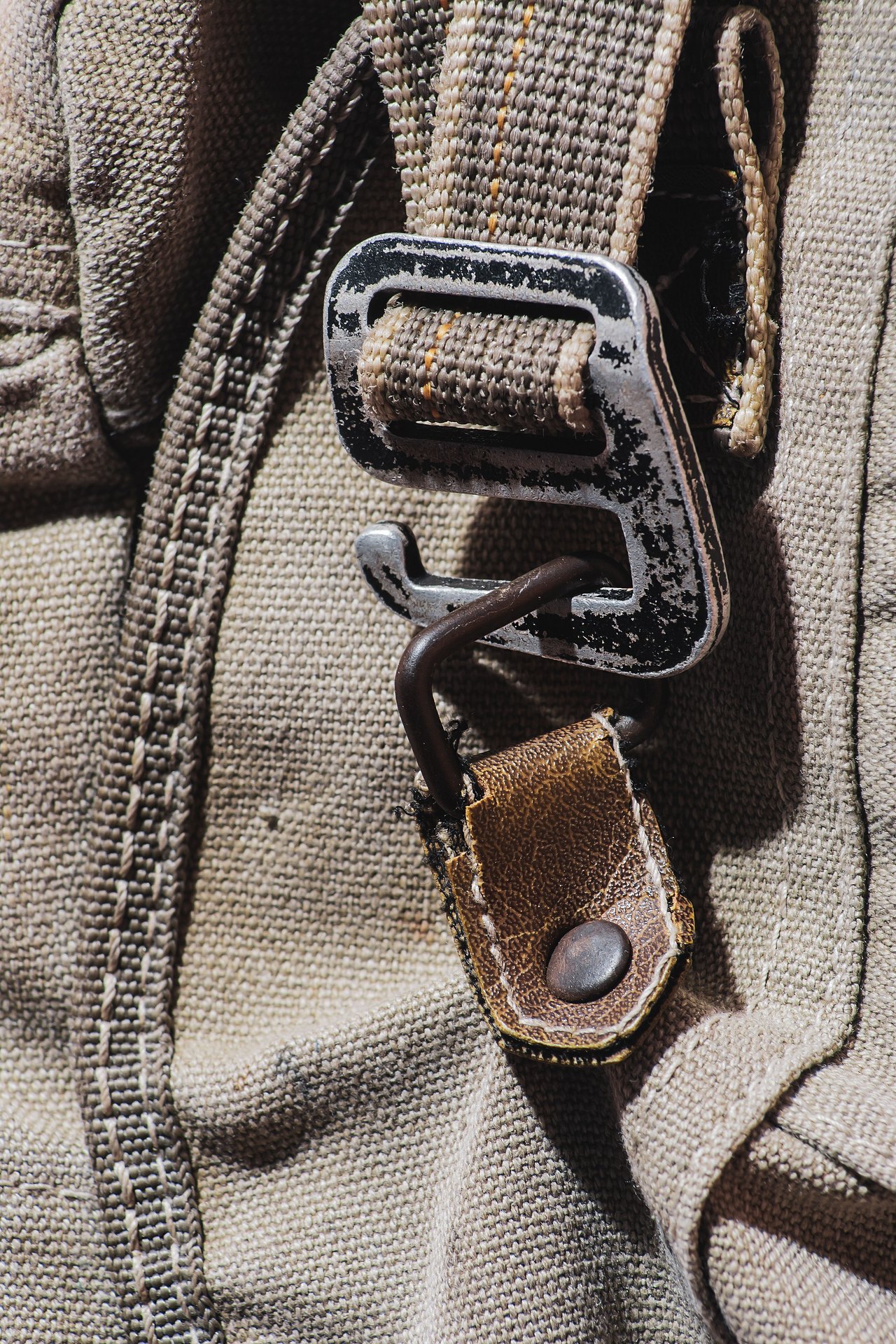
The weathered hardware photograph accompanying this guide is context, not a controlled test result. Its appearance cannot tell the reader the metal composition, coating process, service history or cause of wear. It is not evidence that a particular supplier's finish failed.
For functional evidence, check the specimen identity and construction behind each report. SATRA TM244's public scope, dated June 2007, concerns load-bearing luggage fittings and their attachments. It illustrates why a loose-component observation and an attachment-strength assessment answer different questions. The published scope is not a universal pass level or a test instruction for every handbag. Let a competent laboratory and the responsible product specialist agree applicability, specimens and criteria for the actual design.
Map stock by state before authorizing use
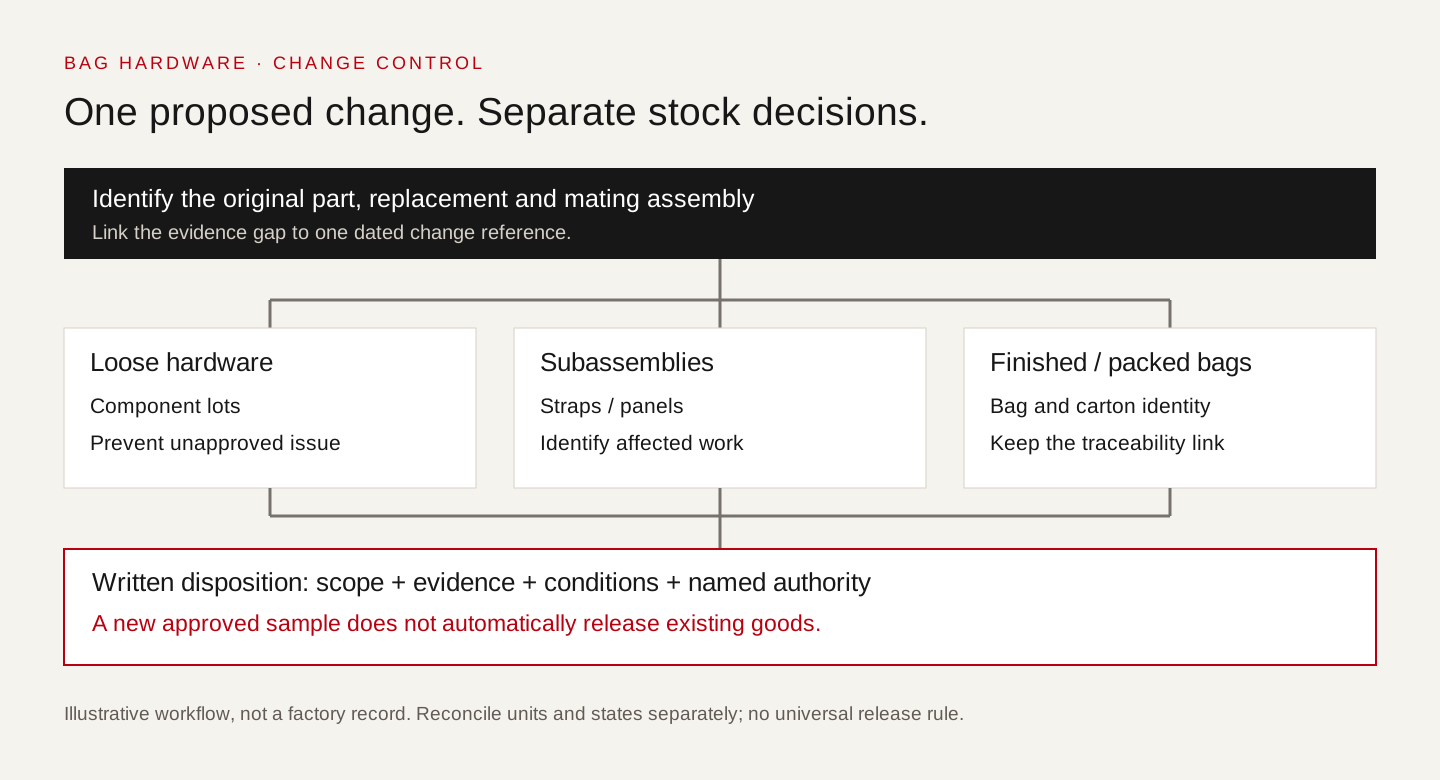
Ask the factory to reconcile quantities at the component, subassembly and finished-bag levels. Do not add them together as if a hook and a bag were the same unit. Include stock at the component supplier and any subcontracted assembly stage. Link the map to a dated change reference.
| Where the proposed part is now | Immediate control | What a written disposition must address |
|---|---|---|
| Not ordered or not yet shipped | Keep the proposal separate from approved purchasing instructions | Whether procurement may proceed and against which revision |
| Received as loose hardware | Identify and segregate the lot; prevent automatic line issue | Incoming comparison, required evidence and permitted applications |
| Attached to straps or panels | Identify affected subassemblies and stop mixing with released work | Assembly review and any agreed rework or replacement route |
| Built into finished bags | Trace affected styles, variants and quantities | Finished-product assessment and individual lot disposition |
| Already packed | Preserve the link between bags, cartons and component lots | Whether cartons remain held, are inspected, reopened or otherwise dispositioned |
If the factory cannot identify where the replacement was used, the uncertainty becomes part of the hold boundary. Do not narrow the affected quantity simply because only one replacement sample was submitted. Agree how traceability will be recovered before deciding which goods can be released.
Make approval prospective and bounded
An approval should state the part revision, matching assembly, intended styles and variants, effective lot, evidence reviewed and remaining conditions. Identify the buyer's commercial approver and the technical authority where relevant. Receiving a sample, approving its appearance and authorizing shipment are separate decisions.
If the replacement is accepted only for a particular order, say so. Update the bill of materials, component purchasing instruction, retained reference and inspection criteria for that scope. Keep the previous revision available so goods made under it remain identifiable. Record what happens to unused original stock rather than allowing it to reappear in a later replenishment without explanation.
Where a change was implemented before approval, a subsequent acceptable sample does not retroactively release all affected goods. Review the existing stock separately. Rework, replacement, sorting and shipment decisions need named owners, verified quantities and agreed commercial treatment. This guide does not allocate contractual liability.
Send a change brief, not an unqualified yes
Before replying to a substitution request, check that you can identify:
- the original part and the exact proposed replacement;
- the mating assembly and any changed process or attachment;
- the affected quantities, lots, locations and production states;
- the evidence that carries over and the evidence still missing;
- the approvers, permitted scope and effective revision; and
- the treatment of stock already assembled or packed.
For a China-side bag-sourcing discussion, send ZWC the bag reference, component comparison, destination market, order stage and unresolved approval question through our project contact page. We can discuss a supplier-coordination and follow-up scope. Component availability, testing, technical acceptance, commercial terms and any rework responsibilities require project-specific confirmation. No supplier substitution is approved merely by submitting an enquiry.
Primary sources
- YKK Japan: accessory sliders and after-attached pulls. Undated manufacturer guidance, checked 17 October 2026. Specific pull/slider interfaces; not generic interchangeability or a ZWC supply relationship.
- SATRA TM244: luggage fittings attachment strength. Public scope dated June 2007, checked 17 October 2026. Scope only; no full paid method reproduced, prescribed pass limit or laboratory result claimed.
AI assisted with organizing text, not generating these photographs. Photos by Nishant Aneja and Arturo Añez. / Pexels are used under the Pexels License. Both are illustrative stock images, not ZWC products, approved samples or supplier/test evidence; no endorsement is implied. The third visual is an original explanatory vector workflow, not generated photography.