
Quick answer
When a supplier reports a delay, stop negotiating around a single revised ship date. Rebuild the order as a critical-path recovery plan: actual completion by operation, material and tooling constraints, remaining good quantity, daily output at the bottleneck, rework load, inspection readiness, packing and transport cutoffs. Assign an owner and evidence requirement to every recovery action, then update the forecast from actual progress.
Who should use this guide
This guide is for overseas buyers managing a private-label order that has missed—or may miss—a material, sample, production, inspection or shipment milestone.
A supplier saying “we need seven more days” is a status message, not a recovery plan. Identify what is late, the cause, the controlling operation, safe parallel work and evidence of progress.
Establish the facts before choosing a response
Ask for a dated order snapshot. Keep physical completion, good output and packed output separate; they are not interchangeable.
| Recovery input | Question to answer | Evidence to retain |
|---|---|---|
| Order identity | Which purchase order, style, color, size or SKU is affected? | Controlled order and product references |
| Required quantity | What quantity remains by variant, not only in total? | Quantity reconciliation by SKU |
| Material status | What is received, inspected, released, missing or rejected? | Material ledger, photographs and issue record |
| Tooling and sample status | Which tools, approvals or deviations remain open? | Current approval and corrective-action records |
| Operation completion | How many good units passed each major process? | Dated route-level output record |
| Bottleneck | Which operation limits the revised completion date? | Demonstrated output and work-in-process position |
| Quality loss | What is held, rejected, reworked or awaiting decision? | Defect and disposition record |
| Packing readiness | What can be packed and what labels, cartons or inserts are missing? | Pack-out status and approved artwork reference |
| Inspection readiness | When will the agreed quantity and assortment be available? | Readiness evidence against inspection scope |
| Logistics cutoff | What booking, consolidation or departure decision depends on completion? | Forwarder-confirmed schedule and cutoff |
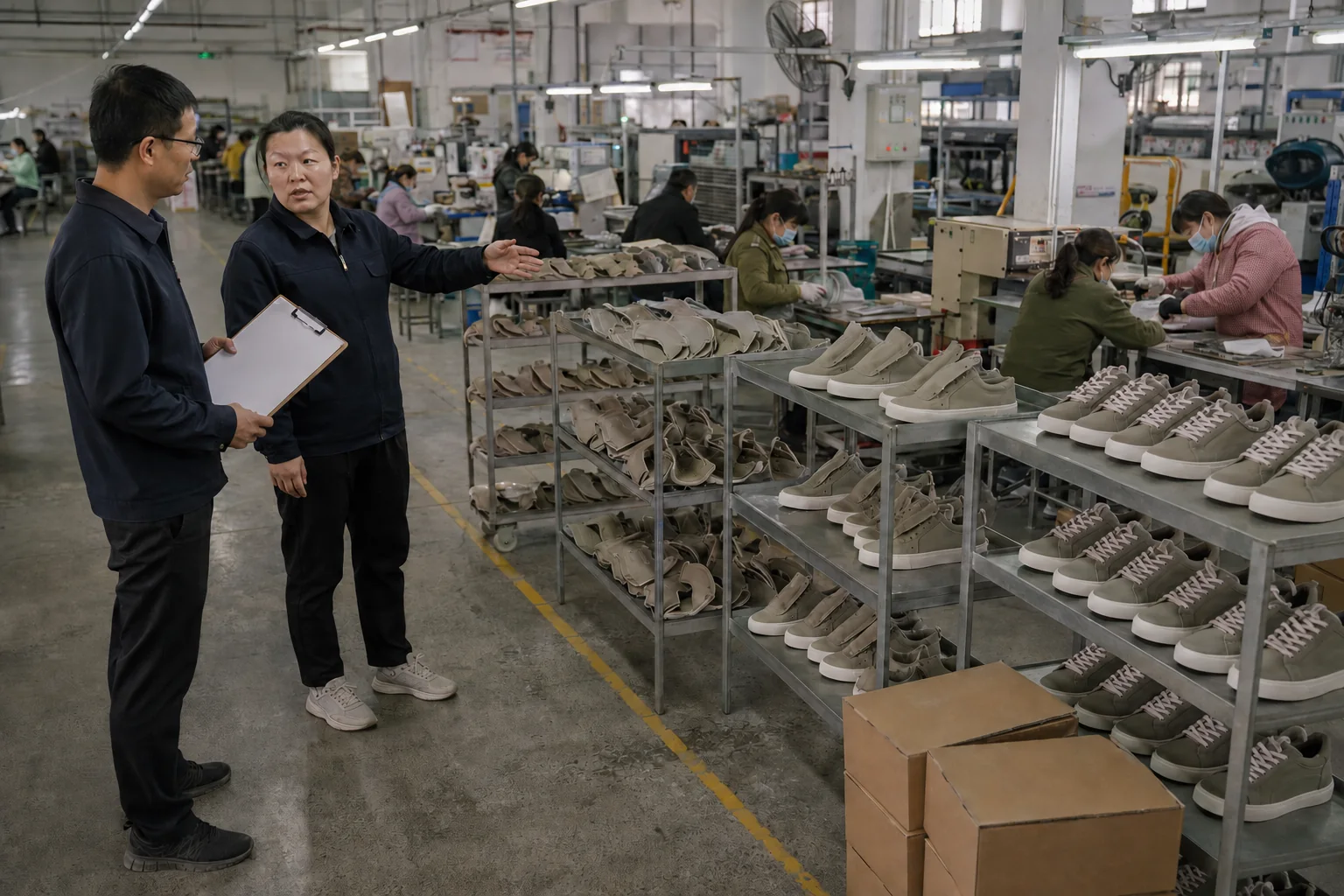
Photographs support the snapshot but do not replace reconciled quantities. Production views, work-in-process close-ups and the dated count should agree.
Find the constraint, not the loudest problem
Trace the remaining production route and identify the activity with no usable time buffer or available workaround; that constraint determines the earliest achievable completion date.
Examples include late upper materials, an unapproved color, missing shoe lasts, a slow stitching operation, a failed component, rework accumulating before finishing, delayed cartons or a fully booked subcontractor. These examples are not conclusions about any particular order.
The constraint can move. Once one queue clears, inspection, rework or packing may become the next bottleneck. Review the route after each material change.
Build a recovery table with accountable actions
| Action field | What a useful entry contains |
|---|---|
| Problem | Specific gap tied to a product, quantity, operation and date |
| Root-cause status | Verified cause, working hypothesis or still unknown—clearly labeled |
| Containment | Immediate step that prevents more affected output |
| Recovery action | Concrete work that changes the completion forecast |
| Owner | Named decision-maker or responsible function |
| Required input | Material, machine, person, approval, tool, file or supplier action |
| Evidence | Record that proves the action occurred and the result achieved |
| Due time | Date and time appropriate to the critical path |
| Dependency | Activity that must finish before this action can start |
| Forecast impact | Which milestone changes if the action succeeds or fails |
| Next decision | Buyer approval, reinspection, split shipment, booking change or escalation |
Avoid “factory will push” or “finish soon.” Such entries do not define output, responsibility or forecast evidence.
A practical recovery sequence
1. Freeze unauthorized changes
Confirm the current specification, approved sample, material references and packaging files. A supplier may propose substitutions or process changes. Require written review before production changes. Uncontrolled changes can become rework or rejection.
2. Reconcile remaining good quantity
Count what has passed the relevant process, what is in progress, what is held and what requires rework. Break the figures down by style, color and size where the shipment depends on complete assortments. Gross units started do not equal saleable units ready for packing.
3. Recalculate from the bottleneck
Use demonstrated good output under the current conditions, not the original quotation’s headline capacity. Include changeover, maintenance, quality checks, expected rework and availability of approved materials. Label assumptions that cannot yet be verified.
4. Separate containment from correction
Containment stops further damage—for example, holding an incorrect material or isolating an affected batch. Correction addresses existing goods. Corrective action addresses why the problem occurred and how recurrence will be prevented. Do not let urgent rework close the root-cause question automatically.
5. Test safe parallel work
Some activities can run together: prepare approved packaging while production continues, inspect completed variants early, or pre-book a flexible logistics option. Parallel work is useful only when dependencies are understood. Do not pack unapproved goods, bypass required checks, or pressure workers into unsafe operations to protect a date.
6. Define decision gates
Set the evidence needed for the next commercial decision. Typical gates may include material release, first corrected units, stable bottleneck output, rework closure, inspection readiness and final pack-out. Payment or shipment release should remain tied to the agreed contract and verified conditions.
7. Reforecast using actual progress
Compare planned and actual good output at a consistent daily cutoff. Record why the difference occurred and whether the bottleneck changed. A recovery date should move when evidence changes; keeping an impossible date unchanged does not protect the customer.
Daily evidence that makes follow-up useful
- good quantity completed by relevant operation and SKU;
- work-in-process waiting before the bottleneck;
- rejected, held and rework quantity with disposition status;
- material, tool and approval constraints that remain open;
- demonstrated bottleneck output versus recovery-plan output;
- photographs tied to location, product and date;
- inspection and packing readiness;
- action owner, due time and closure evidence; and
- revised completion and logistics impact when assumptions change.
Match updates to the risk and production cycle. One reconciled daily cutoff with clear exceptions is more useful than frequent unverified messages.
Recovery options buyers may evaluate
Evaluate how each option changes cost, quality and risk.
- Resequence production: prioritize complete material sets or variants needed for a commercial launch.
- Add qualified resources: use additional trained people or suitable equipment without weakening controls.
- Approve a controlled substitute: only after technical, appearance, compliance and commercial review.
- Split the shipment: release complete, conforming goods separately when logistics and customer needs justify it.
- Move an approved process: only with documented site, capability, quality and authorization controls.
- Change transport: compare the value of recovered time with verified freight, handling and inventory consequences.
- Renegotiate the customer plan: communicate an evidence-based date and scope rather than repeated optimism.
Contract terms, destination requirements, product risk and customer impact determine what is acceptable.
Red flags that justify escalation
- the supplier changes the delay reason without reconciling prior evidence;
- reported totals exceed the quantity that could have passed the bottleneck;
- photographs cannot be tied to the affected order or current date;
- rejected or reworked units are counted as good output;
- new subcontracting or material substitution appears without approval;
- the revised date depends entirely on overtime with no safety or quality review;
- inspection readiness is promised before the required quantity and assortment exist;
- logistics bookings are presented as proof that production will finish; or
- each missed milestone produces another date but no changed recovery action.
What a recovery plan cannot guarantee
A recovery plan cannot guarantee delivery, eliminate defects, change contractual rights or prove compliance. It provides a controlled basis for decisions: known facts, remaining uncertainty, active recovery work and evidence that changes the forecast.
Prepare a production recovery brief
ZWC Sourcing can help buyers organize the affected order, supplier evidence, critical-path actions and production follow-up after a delay. Send the product category, purchase-order status, current completion evidence, missed milestone, target date and supplier explanation.
AI assisted with research organization, drafting and creation of the illustrative hero image. Buyer-specific technical, legal and commercial decisions still require verification for the actual product and order. The image is illustrative and does not depict a named ZWC client, supplier or verified project.