
Quick answer
After a failed inspection, do not begin with a discount or an immediate reinspection date. First contain the affected goods, reconcile inspected and uninspected quantities, define each nonconformity against the approved requirement, and identify where the problem entered production. Then approve corrections, verify the corrected process and affected quantity, and schedule reinspection only when objective evidence shows the lot is ready. A passed reinspection can support shipment release; it does not by itself prove that the root cause will not recur.
Who should use this plan
This guide is for overseas buyers, importers and private-label product teams whose order has failed an inline, pre-shipment or other agreed product inspection. It applies to footwear, handbags, apparel, components and selected industrial products, although the technical checks and acceptance rules must be defined for the product.
A failed inspection creates two pressures: the buyer wants the shipment recovered quickly, and the supplier wants a clear path to release. Speed matters, but a rushed response can hide the true affected quantity, mix corrected and uncorrected goods, or repair visible symptoms without changing the process that caused them.
The corrective action plan should therefore produce a decision-ready record—not a promise that the factory will “pay more attention.”
Preserve the inspection facts
Start with the approved requirement and original inspection evidence. For every finding, record:
- product, purchase order, style, color, size or SKU;
- requirement and controlling specification or approved reference;
- inspection stage, date and location;
- sample selected and quantity checked under the agreed plan;
- observed condition, location and quantity;
- photographs or test records that show the finding;
- defect decision under the buyer-approved classification; and
- immediate lot status: released, held or awaiting buyer disposition.
Do not rewrite the requirement after seeing the defect. If the original specification is ambiguous, identify that as a control failure and obtain a written buyer decision. A supplier correction cannot make an undefined requirement precise on its own.
Separate containment, correction and corrective action
These activities solve different problems and should not be blended into one sentence.
| Stage | Question | Useful output |
|---|---|---|
| Containment | How do we stop suspect goods from being packed, shipped or mixed with acceptable goods? | Physical hold, affected-lot boundary and reconciled quantities |
| Correction | How will the detected units be sorted, repaired, replaced or otherwise dispositioned? | Approved work instruction, responsible owner and controlled quantity |
| Root-cause analysis | Why did the process create the issue, and why did existing controls fail to detect or prevent it? | Evidence-based cause for occurrence and escape |
| Corrective action | What will change in material, method, equipment, training, approval or verification? | Action, owner, due time and required proof |
| Effectiveness check | What evidence will show that the action works beyond the repaired sample? | First-output review, process evidence and defined follow-up |
| Reinspection | Is the corrected lot ready for the buyer’s release decision under the agreed scope? | Independent or authorized inspection result tied to the lot |
Containment protects the immediate order. Correction addresses affected goods. Corrective action changes the process. A supplier may need all three, but completion of one should not be presented as completion of the others.
Define the affected-lot boundary
Before sorting or repair begins, ask where the nonconformity could exist. The boundary may be connected to one material lot, machine, mold, operator, shift, color, size, finishing batch, assembly station or packing period. It may also extend beyond the inspected sample.
Build a quantity reconciliation:
Ordered quantity = acceptable and released + held for review + under correction + rejected or replaced + not yet produced.
Keep the categories mutually exclusive and update them as goods move. Mark and separate held goods so they cannot return to the packing area without authorization. Record where the goods are stored and who controls their status.
If traceability is weak, the affected boundary may need to be wider. Do not assume that only the photographed pieces are affected because the inspection sample found them.
Investigate occurrence and escape
A useful root-cause review asks two questions:
- Occurrence: What allowed the product or process to create the nonconformity?
- Escape: Why did the supplier’s existing check fail to prevent, identify or contain it before inspection?
For example, visible open bonding on footwear could involve surface preparation, adhesive condition, drying, pressure, material compatibility or handling. But the escape question may be different: perhaps the first-piece check did not include the bond area, the line sample was not representative, or held goods were mixed after rework.
Do not accept “operator careless” without evidence. Ask what instruction, reference, fixture, setting, material identity, maintenance record or verification step should have controlled the result. Human error may be part of an event, but a robust response explains why the process depended on one person noticing or remembering the right action.
Avoid forcing every issue into one root-cause template. A wrong label, shade mismatch, warped sole, loose handle and short carton count require different evidence.
Approve the correction method before bulk rework
The supplier should demonstrate the proposed correction on a small controlled sample before applying it to the entire lot. The buyer or qualified reviewer should consider whether the correction changes appearance, dimensions, function, durability, odor, cleanliness or compliance.
An approved correction instruction should state:
- which defect and quantity it covers;
- which units must not be reworked;
- materials, tools and sequence used;
- product-specific safety or technical limits;
- inspection after correction;
- how corrected goods are identified and counted; and
- who can authorize return to the released lot.
Do not allow uncontrolled heat, coating, solvent, adhesive, trimming or component substitution simply because the shipment is late. A cosmetically improved item may develop a different risk.
Require evidence before booking reinspection
Reinspection should follow readiness evidence, not the supplier’s preferred calendar. Before confirming the visit, request:
- final reconciliation of the affected and corrected quantity;
- completed correction record by defect type;
- photographs from the controlled rework and verification process;
- evidence that first corrected output matches the approved reference;
- confirmation that goods are finished, packed and accessible under the agreed inspection scope;
- updated packing and location information; and
- the supplier’s corrective-action record with open items clearly identified.
The reinspection scope should be approved for the actual failure. Repeating the original plan may be appropriate in some cases; another case may require targeted checks plus the original scope. The buyer should define that decision with qualified inspection input rather than relying on a generic rule.
Decide what a passed reinspection means
A reinspection report supports a lot decision at a particular time. It does not certify every unit, guarantee future production or close every systemic action.
Keep two tracks visible:
- Shipment disposition: whether the inspected lot can be released, held or requires another action under the agreed commercial process.
- System corrective action: whether the supplier has changed the process and demonstrated effectiveness sufficiently to reduce recurrence risk.
The buyer may release the shipment while requiring later evidence for a process action, or may keep the shipment on hold despite completed sorting if the remaining risk is unacceptable. The decision depends on the product, defect, evidence, agreement and destination requirements.
Red flags in a weak supplier response
- The response says only “we will be more careful.”
- Rework starts before the affected quantity is reconciled.
- Corrected and uncorrected goods share the same area without status control.
- The supplier disputes photographs but cannot identify the controlling requirement.
- The cause is assigned to an operator without examining the process or escape control.
- One repaired sample is used as proof that the complete lot is ready.
- Reinspection is booked before sorting and verification records exist.
- A substitution or process change appears during recovery without buyer approval.
- The supplier requests shipment release while corrective-action evidence remains unclear.
Buyer checklist before release
- Findings are linked to controlled requirements and original evidence.
- Suspect goods are contained and quantities reconcile.
- The affected-lot boundary is evidence-based.
- Occurrence and escape causes are investigated separately.
- Correction method is approved before bulk rework.
- Corrected output is verified against the current reference.
- Reinspection scope matches the risk and actual failure.
- Shipment disposition and system corrective action remain separate.
- Deviations, substitutions and unresolved items have written authority.
- Payment or shipment decisions follow the actual agreement and verified evidence.
A practical test for root-cause quality
Ask what evidence disproves the explanation. “Operator carelessness” is weak unless the action changes a controllable condition. If the response only says “remind workers,” require evidence of the process control preventing recurrence.
Next step
If a China supplier inspection has failed, send ZWC the product category, controlled specification, inspection report, affected quantity, supplier response, current production status and required shipment date. We can help organize the supplier follow-up questions, evidence and decision gates needed before reinspection or release.
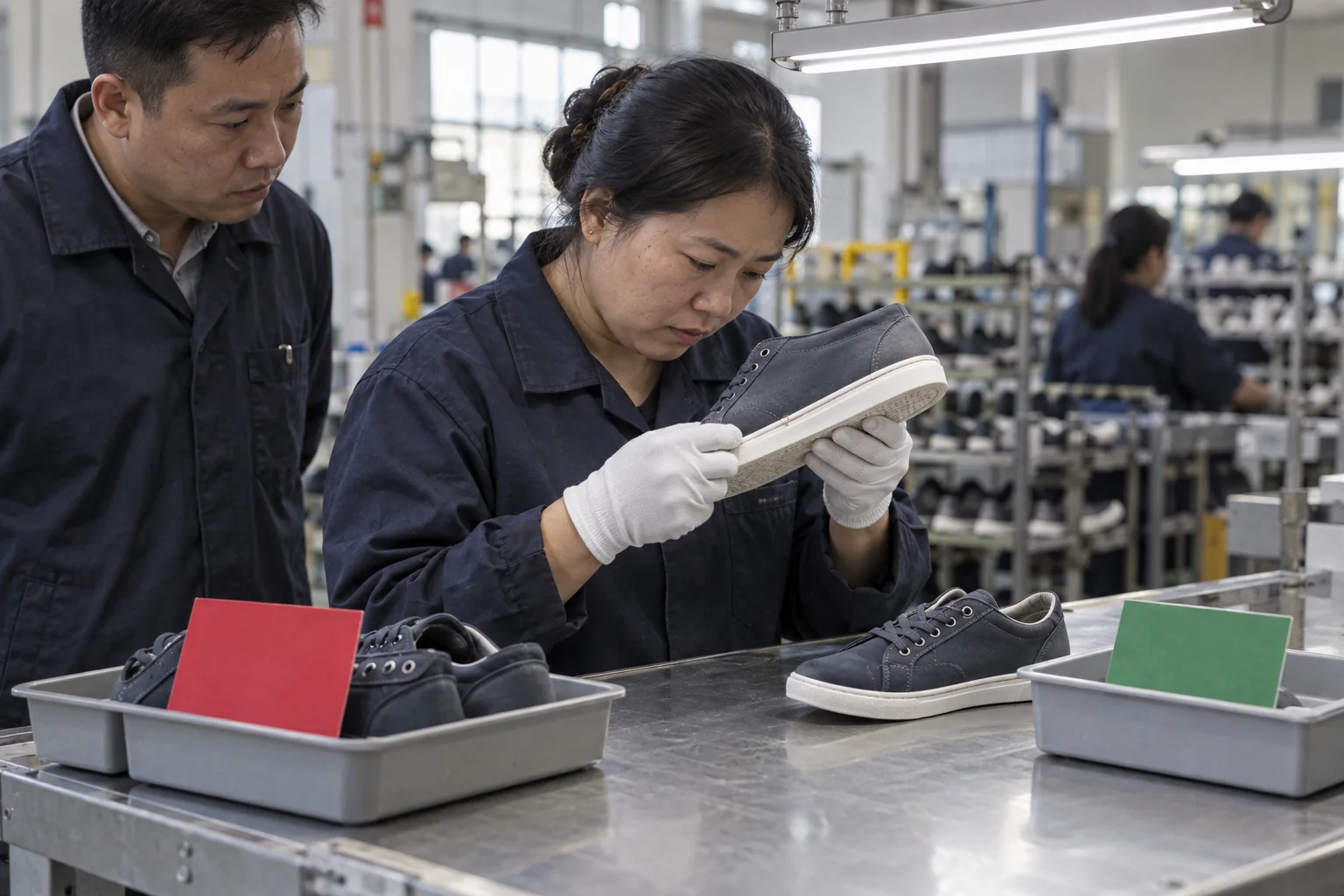
AI assisted with research organization, drafting and creation of the illustrative hero image. Buyer-specific technical, legal and commercial decisions still require verification for the actual product and order. The image is illustrative and does not depict a named ZWC client, supplier or verified project.