

Quick answer
Map an apparel order by operation, legal entity and actual production site before treating the supplier as a complete manufacturing route. Name who cuts, sews, decorates, washes, finishes and packs, including outside processors. Agree which changes require notification and renewed approval, and connect every handoff to the order record. A factory visit, commercial invoice or final inspection alone does not establish where every operation occurred or who controls the next handoff.
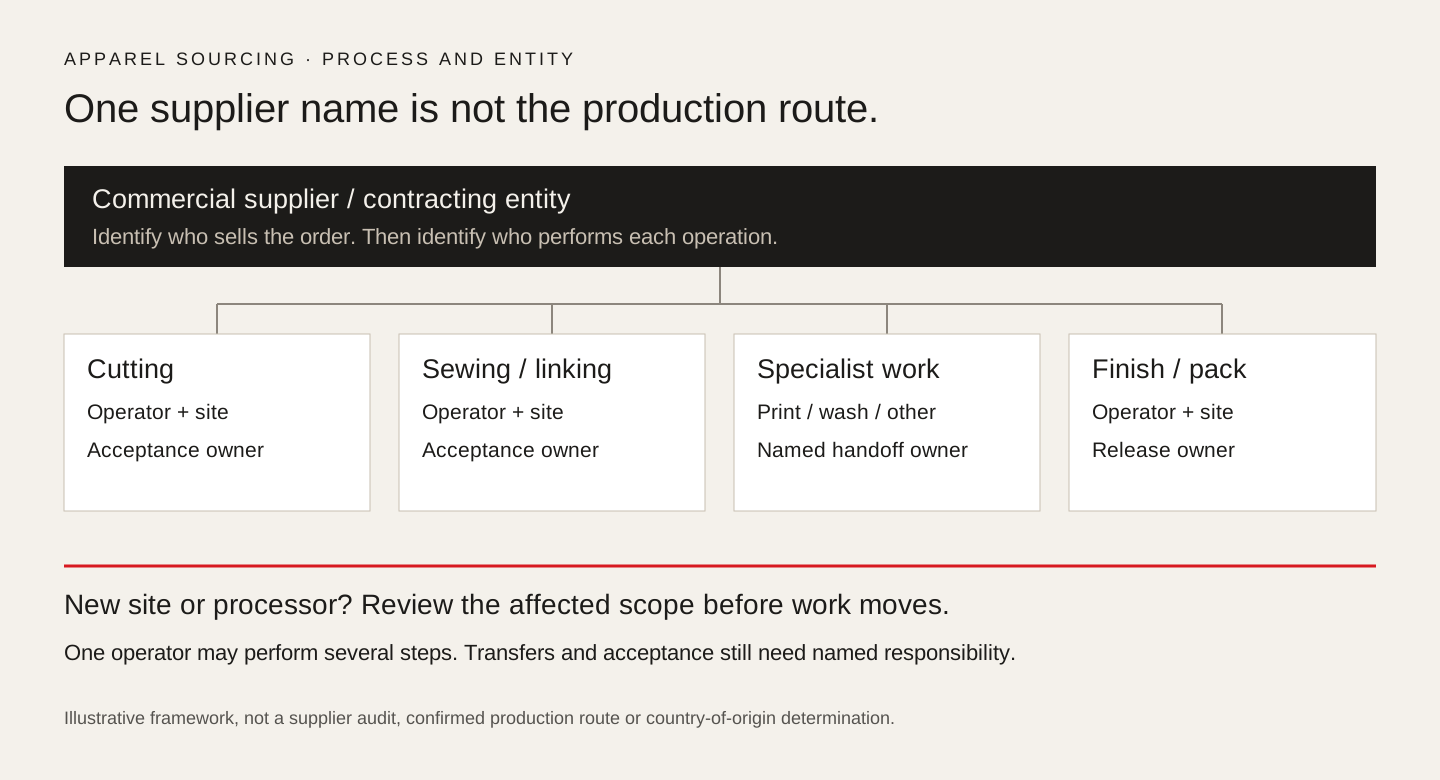
One supplier name can conceal several production decisions
You can approve a sewing factory and still leave the garment-wash route unresolved. If the wash is outside the quoted scope, who chooses the processor, sends the goods, accepts the returned garments and handles a disputed result? The missing input is not another general factory profile. It is an agreed production route with responsibility at each transfer.
This is an industry structure issue, not an accusation against every supplier using outside specialists. The OECD's February 2026 garment and footwear overview describes decentralised sourcing models and subcontracted specialist or overflow work. The practical buyer question is whether that arrangement is visible, appropriate for the order and subject to agreed controls.
For overseas brands sourcing apparel from China, separate the company selling the order from the sites performing it. The worksheet below is an original procurement framework, not a real customer case, a compliance certificate or a claim that subcontracting always produces a poor result.
Start with the garment route, not a tier label
Ask the supplier to list the operations required by the actual style. A woven shirt, a linked knitwear garment and a decorated sportswear item need different routes. Distinguish fabric dyeing and finishing from a wash or treatment applied to the assembled garment. Do not assume that the same company performs both.
For each operation, record the operator's legal name and production address. A head-office address does not identify the workshop. Note whether the supplier owns the site, contracts with it or purchases an input through an intermediary. Use the same names across quotations, visit records and production updates so that an unfamiliar trading name does not silently become a new approved site.
Include material and trim supply where it affects the manufacturing decision, but avoid collecting a directory with no connection to this order. Start with the processes that change the garment, its approved appearance, its performance or the buyer's stated sourcing requirements.
| Route entry | Identify before release | Name the accountable owner |
|---|---|---|
| Fabric supply and treatment | Mill or intermediary, relevant processing sites, approved material and finish | Who purchases, releases and resolves an unsuitable delivery |
| Cutting | Actual cutting site, pattern revision and material-release dependency | Who authorizes cutting and controls a recut |
| Sewing or linking | Manufacturing site and any split between styles or quantities | Who accepts work from the line and manages corrections |
| Print, embroidery or garment wash | Named specialist, operation scope and agreed reference | Who approves the trial and accepts returned work |
| Finishing and packing | Site, scope of pressing or preparation, label and packing revision | Who reconciles accepted goods and held quantities |
The table identifies questions to settle; it does not prescribe that every operation must be outsourced or every supplier must use the same structure. Where one site performs several steps, retain separate operation responsibilities even though the address is repeated.
Make the outside processor part of the order record
“We have a partner for that” is a starting answer, not a completed route. Ask which company will actually perform the operation, where it will work and what evidence the supplier can provide. Explain why the information is needed and agree confidentiality arrangements where appropriate. Do not promise a buyer unrestricted access to another company's site without permission.
Then define the handoff. Before garments leave for an outside operation, identify the style, revision, quantity, condition and expected treatment. Record the sender, receiver and the person authorized to accept the return. Distinguish custody during transport from technical acceptance after processing; one signature need not establish both.
The existing fabric shade and bundle guide addresses material identity through cutting and recutting. This route map answers a different question: which company and site performs each operation, and who decides when work may move between them? Connect the two records rather than replacing one with the other.
Ask what changes after the approved trial
A trial is only useful as a production reference when its route is identifiable. Record where the sample was made and which processes were performed elsewhere. If bulk production uses a different site, do not describe the sample as proof of that site's output without further evidence.
Agree a notification and approval process before the order encounters pressure. Specify who may propose a new processor or transfer, what information must accompany the proposal and which buyer or technical authority can accept it. A disclosure is not automatically an approval, and an unanswered message is not a release.
| Proposed route change | Question to resolve before affected work moves | Evidence or decision to retain |
|---|---|---|
| Additional sewing site for part of the order | Which styles and quantities move, and does the agreed approval cover that site? | Updated allocation, site evidence and written disposition |
| Different wash or decoration processor | Which approved attributes or requirements could change? | Identified trial, comparison and responsible technical acceptance |
| Change during work already in progress | Where are the affected goods now, and can they remain identifiable? | Dated work-in-progress map, hold boundary and handoff instructions |
| Packing moved to another location | Who accepts received goods and controls labels, assortment and release? | Receiving reconciliation, approved packing record and release owner |
The response need not be the same for every change. Some can be reviewed before work starts; others require holding an affected quantity while evidence is collected. Set the response from the actual scope and risk, not a universal turnaround promise. Never make a deadline the only reason to close an unresolved production-route question.
A process map is not an audit or an origin ruling
Separate what the evidence establishes. A visit documents what was observed at a particular place and time. A production update can connect an operation to an order if its identity is clear. A final inspection evaluates the agreed sample of goods and inspection scope. None should be presented as complete proof of every earlier operation.
Similarly, naming sites is a starting point for due diligence, not proof of acceptable labour or environmental conditions. The OECD's 2018 sector guidance concerns responsible supply-chain due diligence more broadly. This short procurement worksheet is not an implementation of the full guidance or a certification of a supplier.
Keep customs origin, preferential treatment and label wording as separately reviewed questions. Give the responsible trade adviser the actual material and processing route for the destination and transaction. This article does not determine a garment's origin, tariff treatment or legal compliance, and a supplier's sales address is not offered as that determination.
Use the route to make a sourcing decision
Before selecting a supplier, check whether the proposed route names the critical operations, their sites and the owners of unresolved handoffs. If an essential processor remains unconfirmed, record a conditional shortlist decision rather than presenting the route as fully approved. Compare competing offers on the same operation scope, including exclusions, approvals and transfers that remain to be arranged.
For a China apparel enquiry, send ZWC the garment reference or tech pack, fabric and finish direction, destination, quantities by variant, project stage and the production-scope question you need to resolve. Our apparel sourcing service can be discussed around that brief. Supplier access, development work, inspections, technical acceptance and commercial responsibilities require project-specific agreement. A clearer route supports a better discussion; it does not guarantee access, capacity, compliance or a particular order outcome.
Primary sources
- OECD: Due diligence essentials for responsible garment and footwear, 26 February 2026. Industry structure and subcontracted operations; original page read on 17 October 2026. No statistics, supplier accusations or mandatory legal rules carried over.
- OECD: Due Diligence Guidance for Responsible Supply Chains in the Garment and Footwear Sector, 7 March 2018. Official publication record and abstract checked on 17 October 2026; cited for scope only, not a claim that this worksheet implements the 192-page guidance.
AI assisted with organizing text, not generating the photographs. Photos by Ivan S and Skylar Kang / Pexels are used under the Pexels License. They illustrate sewing and garment-care contexts, not ZWC sites, suppliers, personnel, order evidence or audit findings; no endorsement is implied. The process map is an original explanatory vector, not a verified factory route.