
Quick answer
For an apparel order using several fabric rolls, preserve the link from each released roll and shade group to its cutting lay, component bundle and finished garment allocation. Keep identified remnants for potential replacements. Before a damaged panel is recut, confirm its original group and review the replacement beside the components it will join. A color approval is not permission to mix every approved roll indiscriminately.
A replacement sleeve can undo the original release
Consider a shirt with one damaged sleeve. The sewing team asks for a replacement, and the cutting room selects material carrying the same commercial color name. The missing question is whether that material belongs to the same released group as the rest of the shirt.
This is a planning scenario, not a ZWC customer case. It shows why a shade card alone is an incomplete production record. The buyer needs a way to identify the source of a specific component after cutting, not just evidence that fabric was reviewed earlier.
This guide is for overseas apparel buyers agreeing a cutting and replacement-control plan with a mill and garment factory. Our general batch-color guide covers masters, viewing conditions and color approval. Here, the decision is narrower: can the factory replace a panel without losing the original shade allocation?
Separate material approval from permission to combine
Give each physical roll a unique receiving identity. Record the mill's lot reference separately from the factory roll ID; one should not silently substitute for the other. Connect the material to the order, fabric specification and controlling reference revision.
A shade-group code records a permitted allocation under agreed rules. It is not a new color standard or a way to accept material outside the buyer's limits. The responsible reviewer must define the group, its scope and whether particular rolls or groups may be combined. A supplier's color name is not that decision.
The public summary of AATCC EP9-2025 describes visual comparison of textile specimens with a standard. It does not establish a universal garment tolerance or your factory's sampling plan. Agree the applicable method and acceptance rules with the responsible technical parties; this article does not reproduce the purchased procedure or prescribe numerical limits.
Do not turn a photograph, monitor image or group label into color evidence. Record the actual physical comparison and its release decision. If the evaluation does not cover variation within a roll, do not imply that a single retained swatch establishes the appearance of its entire length and width.
Build the allocation record before cutting
Use a record that the cutting and sewing teams can both maintain. A spreadsheet can work if the physical identifiers and revision controls remain reliable; purchasing software is not the first requirement.
| Record level | Fields to preserve | Decision it supports |
|---|---|---|
| Received roll | Factory roll ID, mill lot, order, fabric revision, received quantity and status | Distinguish released stock from unreviewed or held material |
| Shade release | Reference revision, group, evaluated scope, date and approving role | Establish where the material may be used, not just whether it arrived |
| Cutting lay | Lay ID, roll IDs, permitted allocation, marker/style revision and size mix | Trace which material entered a particular cutting run |
| Component bundle | Bundle ID, component type, size, lay and allocation link | Keep parts intended for the same garments identifiable |
| Remnant | Parent roll ID, group, remaining usable material and location | Find a potential replacement without guessing its source |
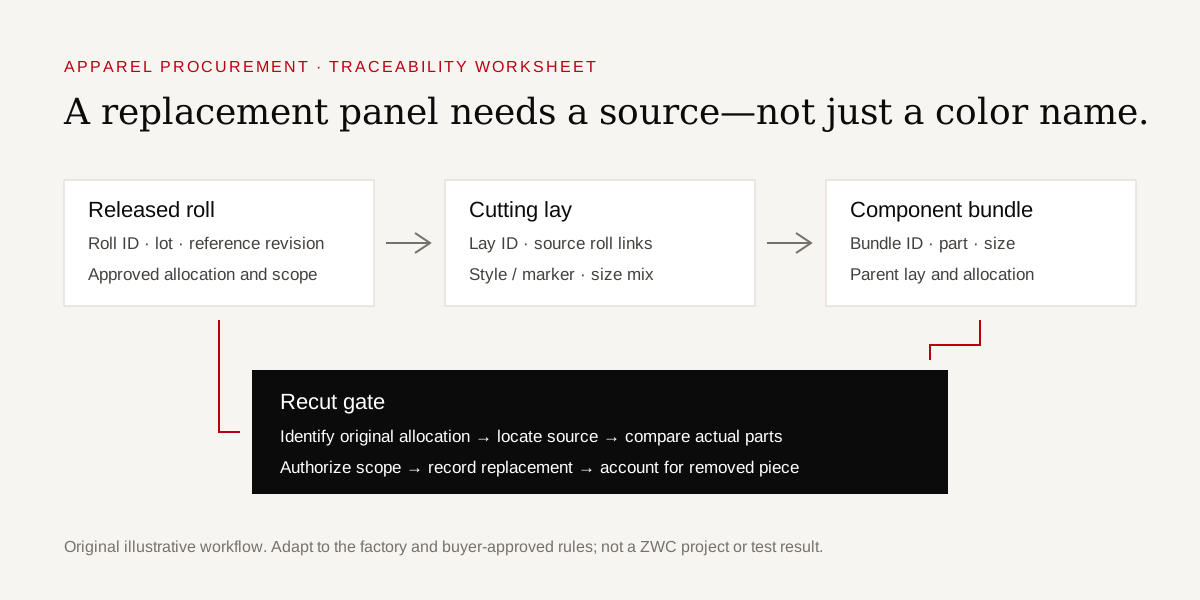
| Recut instruction | Original bundle/component, proposed source, comparison decision and replacement quantity | Authorize a bounded replacement and reconcile the original piece |
These fields are a proposed control asset, not an industry-mandated form. Adjust them to the factory's actual handling system. If a lay uses several rolls, document the permitted relationship and retain the relevant roll-to-component link; a single lay number must not hide which rolls supplied different parts.
Ask the factory to walk one nominated bundle backward to its material and forward to its sewing allocation. If the answer depends on an operator remembering the job, the record is not yet adequate for later replacement or investigation.
Keep the physical bundle and record together
Assign responsibility at the cutting-to-sewing handoff. The receiver should confirm that the bundle identity, component type, size and allocation agree with the handover record. Use an appropriate non-damaging identification method; do not mark visible garment surfaces merely to make tracing easier.
When bundles are split, merged or moved between workstations, preserve the parent link. Any new identifier should lead back to the original cutting record. A replacement label that keeps only the style and size discards the information needed for shade control.
Define where the matching requirement applies: adjacent panels, the whole garment, a coordinated set or another buyer-defined grouping. Do not automatically treat all units packed into one carton as a single matching unit. Likewise, two individually acceptable garments are not automatically an acceptable matching set.
Handle recutting as a new release decision
Do not send an unidentified loose panel as the entire replacement request. Identify the affected bundle and component, explain the defect or shortage, and check whether other components from that allocation are affected.
First locate retained material linked to the original source. It is a candidate, not an automatic approval. Confirm the fabric revision, physical condition, usable dimensions and compatibility with the intended replacement. The production team must also apply the relevant cutting and material-handling requirements.
Compare the proposed replacement with the actual components it will join under the agreed conditions. Where finishing can change appearance, include the relevant finished-state check in the plan. A successful incoming comparison alone must not be represented as proof of the completed garment's appearance.
| Situation | Proposed disposition | Evidence before sewing resumes |
|---|---|---|
| Original source is traceable and suitable material remains | Recut within the approved allocation | Identified source, comparison result and bounded instruction |
| Different roll or group is proposed | Hold for a specific compatibility decision | Actual adjacent-component comparison and named authorization |
| Original allocation cannot be reconstructed | Contain the affected bundle; investigate | Reconciled identities or an explicitly approved alternative |
| No acceptable replacement source is available | Discuss replacement scope, further sourcing or other disposition | Buyer-approved decision; no quiet substitution |
Record the new component against the original request and account for the removed piece. Do not let the rejected panel re-enter the bundle. Avoid promising that replacing a larger set of parts will solve the problem without checking the actual garment and available material.
Check quantities by released group, not just total meters
An order may have enough fabric in total but insufficient suitable material in the allocation that needs replacements. Ask for released quantities, planned consumption, retained remnants, holds and outstanding recut needs by group.
Clarify the treatment of remnants before comparing material cost. Useful reserves, unusable offcuts and material held for investigation are not interchangeable inventory. Their ownership, storage period and disposal authority should be agreed for the project; there is no universal reserve percentage in this guide.
Use one traceability challenge before scaling
Before releasing a larger cutting run, ask the factory to demonstrate the record chain on a bounded trial: nominate one component bundle, retrieve its roll and release references, locate any identified remnant, then explain how a replacement would be authorized and recorded. This is a verification exercise, not a claim that ZWC has already conducted such a trial.
Pause further allocation if roll identities are missing, shade codes change without approval, held stock is accessible as released stock, or replacement instructions lack a source and decision owner. Resolve the records and affected quantities before treating a final visual inspection as the only control.
For an apparel sourcing discussion, send ZWC the garment reference, fabric specification, mill and garment-factory arrangement, order stage and the traceability gap you need to resolve. We can discuss a sourcing and follow-up scope; inspection coverage, technical criteria and release authority require project-specific agreement. Start with our requirements form or WhatsApp, without sharing confidential customer or supplier records publicly.
Primary sources
- AATCC EP9-2025 official public scope summary, rechecked 12 October 2026. Summary only; full paid procedure not purchased or reproduced. This supports the description of textile visual comparison, not the proposed factory allocation ledger.
AI assisted with text and diagram drafting, not photography. Hero photograph by Leonardo Barucci / Pexels, under the Pexels License. It illustrates stored fabric rolls, not a ZWC factory, approved shade group or verified order. The accompanying original vector diagram is explanatory and contains no real client, factory or test data.