
Quick answer
Before releasing bulk cutting, connect each reviewed apparel size to the current finished-garment measurement chart, pattern revision, actual material and finishing condition. Check measurements and fit separately, then document which sizes and revisions are released, held or awaiting correction. An approved base-size sample does not establish that the whole assortment is ready, and a nominal size label does not define the intended wearer.
The expensive gap between one good sample and a cutting release
A buyer approves the base-size top, the factory prepares the other sizes, and an email says “approved for production.” What exactly was approved: the silhouette, the measurement chart, the graded patterns, or the finished size set? If that distinction remains open, cutting can turn an unresolved development question into committed fabric and work in progress.
For overseas apparel buyers, the useful question is not whether the samples look progressively bigger. It is whether the evidence supports the ordered range in the material and condition that will actually be delivered. Keep that decision separate from price agreement, fabric booking and permission to prepare patterns.
Give the size label a controlled meaning
Start with the target customer, intended silhouette and wearing context. Body measurements describe the wearer; finished-garment measurements describe the product. They are not interchangeable. A letter such as M cannot resolve ease, stretch, garment length or the differences between a close-fitting layer and outerwear.
Ask the buyer’s product developer or fit specialist to identify the base size, the size range and the relevant body or fit reference. Then connect the finished-garment chart to named points of measurement, or POMs. Specify units, start and end points, whether a width is measured flat, fastening position and any agreed tension or preparation. Photographs can clarify the method but should not replace it.
Do not borrow grade increments or tolerances from another style simply because the size labels match. The responsible technical owner should approve those values for this garment. This guide provides a procurement control framework, not a grading formula or an international size-conversion table.
Build a size-set record that leads to a decision
Use one controlled record rather than separate photographs, spreadsheets and chat approvals. The following is a field map, not a completed inspection report. Repeat its measurement and fit entries for each reviewed size and critical POM.
| Record area | What the buyer and supplier must connect | Decision it supports |
|---|---|---|
| Identity | Style, size, color, sample ID, chart revision and pattern revision | Are we reviewing the intended version? |
| Material and state | Fabric and trim references, construction, finishing stage and care-treatment status | Does the sample represent the planned product? |
| Measurement | Named POM, method, specified value, agreed tolerance and actual reading | Does this size meet its garment chart? |
| Fit | Target-wearer or form reference, intended use, observations and technical reviewer | Is the reviewed fit acceptable for its stated scope? |
| Range coverage | Sizes reviewed, grading transitions and reasons for the sample selection | Which parts of the assortment remain untested? |
| Release | Approved, held or rejected scope; required correction, owner and evidence | What may proceed, and what must stop? |
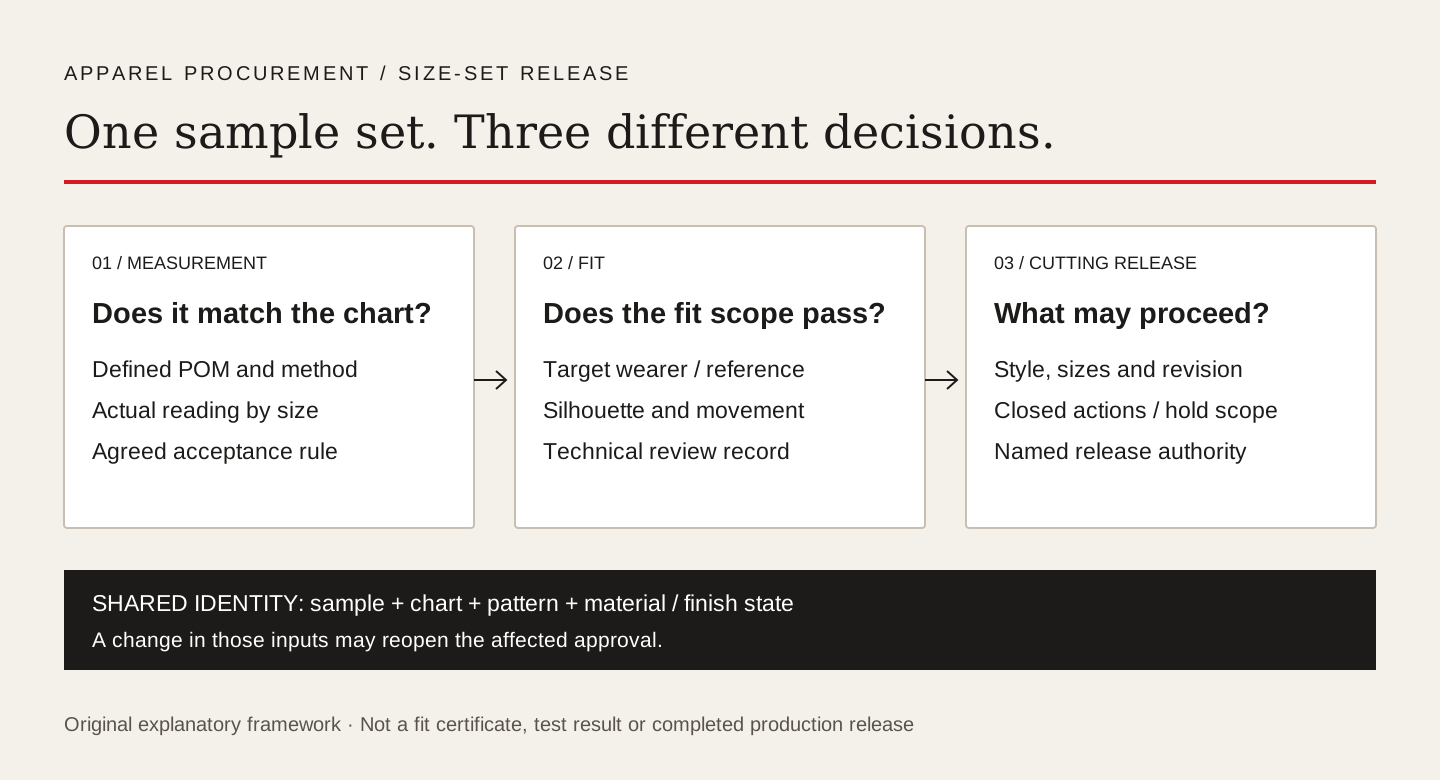
Choose the sample sizes with the technical owner before sampling. Consider the ordered range, key commercial sizes, changes in grading rules or construction, and unresolved fit risks. Neither a single base size nor a fixed universal sample count suits every project. If only selected sizes are reviewed, record that limitation and the basis for any wider release.
Keep measurement approval separate from fit approval
A measurement sheet can show conformity to a chart without establishing comfortable movement or the intended silhouette. Conversely, a garment that looks acceptable on one form does not prove that every POM or every ordered size meets the specification. Record both decisions; do not let one silently stand in for the other.
Hohenstein’s fitting-service factsheet describes assessment of garment measurements alongside movement and workmanship relevant to fit, including individual garments or size sets. The document is marked May 2019 and describes a particular service, including a German body-reference basis. It is useful context for separating the checks, not a universal size system, a current service quotation or evidence that ZWC has commissioned testing.
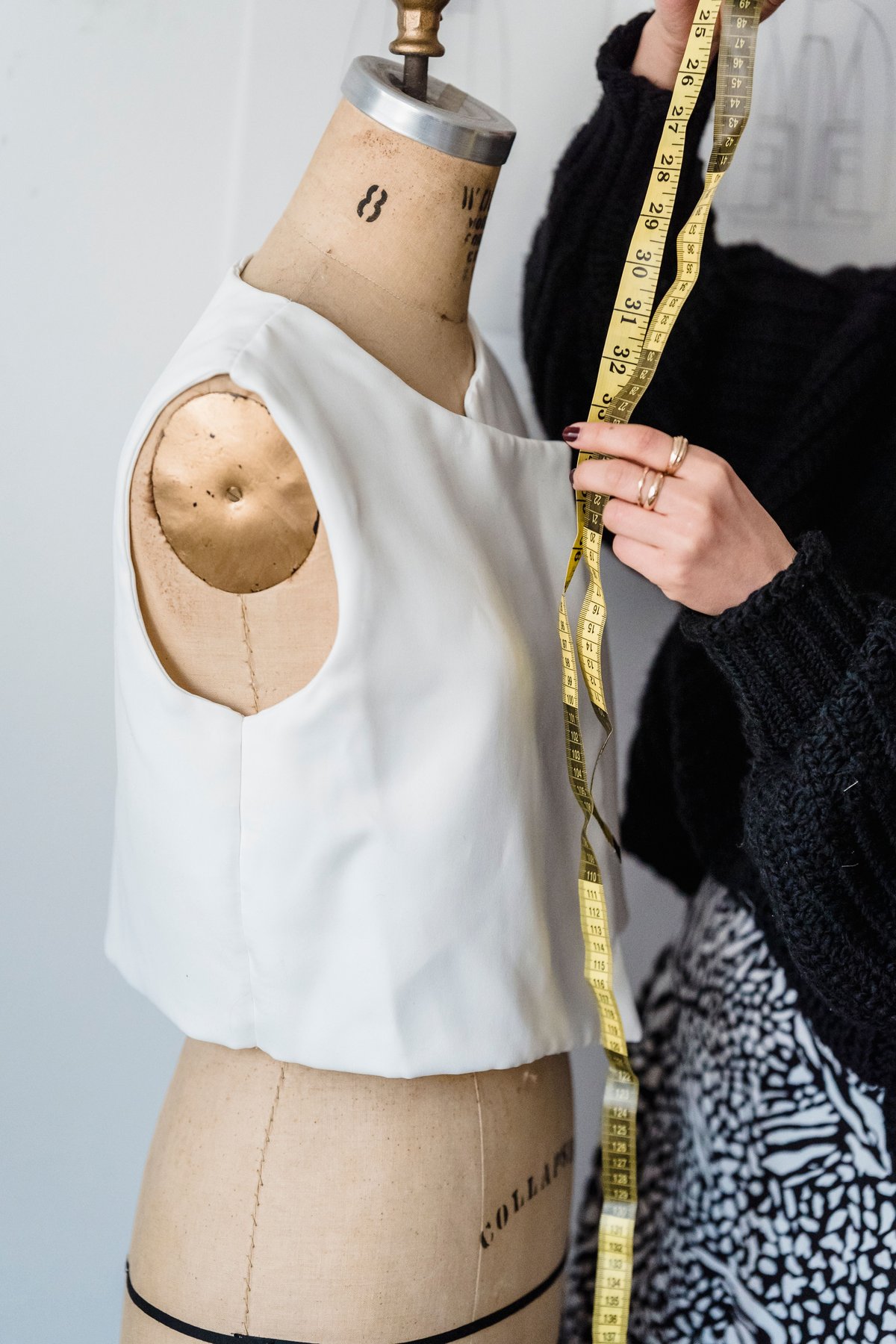
Use the fit reference agreed for the intended customer. Record the sample’s identity and state, who assessed it, the observations and the scope of acceptance. A stock dress-form photograph illustrates development work; it cannot certify fit, establish the form’s suitability or replace the actual review record.
State whether the sample is before or after treatment
“Finished sample” is too vague if production includes garment washing, pressing or another treatment that the reviewed sample has not received. Name the stage. If pre-treatment and post-treatment measurements are required, preserve both sets of readings against the same identified sample and agreed procedure. Do not merge them into one unexplained result.
AATCC’s public TM150-2025 summary concerns garment length and width changes after home laundering and flags an applicability limitation for certain stretch fabrics. Naming that method does not specify a project’s acceptance limits or prove a sample passed. Ask the responsible technical specialist or laboratory to select the applicable procedure, preparation and reporting basis for the actual product; do not improvise test conditions from a public summary.
This is a release question as well as a test question: does the sample’s material and finishing route match what the factory proposes to cut and deliver? If not, identify the difference before interpreting its measurements as production evidence.
Diagnose the mismatch before asking for a remake
| What the review finds | Question to resolve | Boundary before release |
|---|---|---|
| Two reviewers obtain different readings | Are POM location, flat or curved measurement, fastening and preparation identical? | Reconcile the method before changing the pattern. |
| Base size is acceptable but another size is not | Is the issue in the chart, graded pattern, cutting or assembly? | Technical owner identifies affected sizes; do not assume an isolated failure. |
| Measurements match but fit is unacceptable | Are target wearer, ease, balance, movement and construction assumptions appropriate? | Obtain a technical fit decision, not another copy of the same measurement sheet. |
| Post-treatment dimensions differ from the approved state | Do material, finish route and assessment conditions match the specification? | Resolve the cause and required evidence before treating the range as approved. |
| A correction appears only in a sample-room adjustment | Is it incorporated in controlled patterns and production instructions? | Close the revision loop before production uses the old files. |
These are investigation prompts, not diagnoses. The technical owner should define the correction, affected range and resampling scope. A rushed remake can reproduce the problem if the source chart or measurement method remains unresolved.
Release a bounded assortment, not an ambiguous email
Before authorizing cutting, check that:
- The active chart, graded patterns and production instructions have matching, identifiable revisions.
- Samples are linked to the proposed material, trims, construction and finishing route; differences have an explicit disposition.
- Measurement and fit decisions are recorded separately, with unresolved sizes visible.
- Corrections are reflected in the controlled files, and obsolete versions are withdrawn from the cutting workflow.
- The authorized person states the style, size range, revision and conditions released. Any partial release has an explicit operational boundary that the factory can maintain.
- A later material, pattern, construction or finish change triggers review of the affected approval rather than inheriting the old acceptance automatically.
Size-set approval does not prove bulk workmanship, color consistency, label accuracy or compliance. Those need their own controls. For related decisions, see ZWC’s apparel technical requirements and fabric roll-to-bundle traceability guide.
If your next decision is whether an apparel supplier is ready to move from samples to cutting, share the garment brief, size range, material and finish direction, current revisions and unresolved question. ZWC can discuss an apparel sourcing and follow-up scope. Technical development, test selection and release authority must be agreed for the project; this article is not a claim of fit-engineering or laboratory services.
Primary sources
- Hohenstein fitting service and measurement chart optimisation factsheet, marked May 2019; rechecked 18 October 2026. Used for the distinction between measurement and fit assessments, not current service timing or universal sizing claims.
- AATCC TM150 public purpose and scope, listing TM150-2025; rechecked 18 October 2026. Public summary only; the full paid method was not purchased or reproduced. No pass limits or sample test results are inferred.
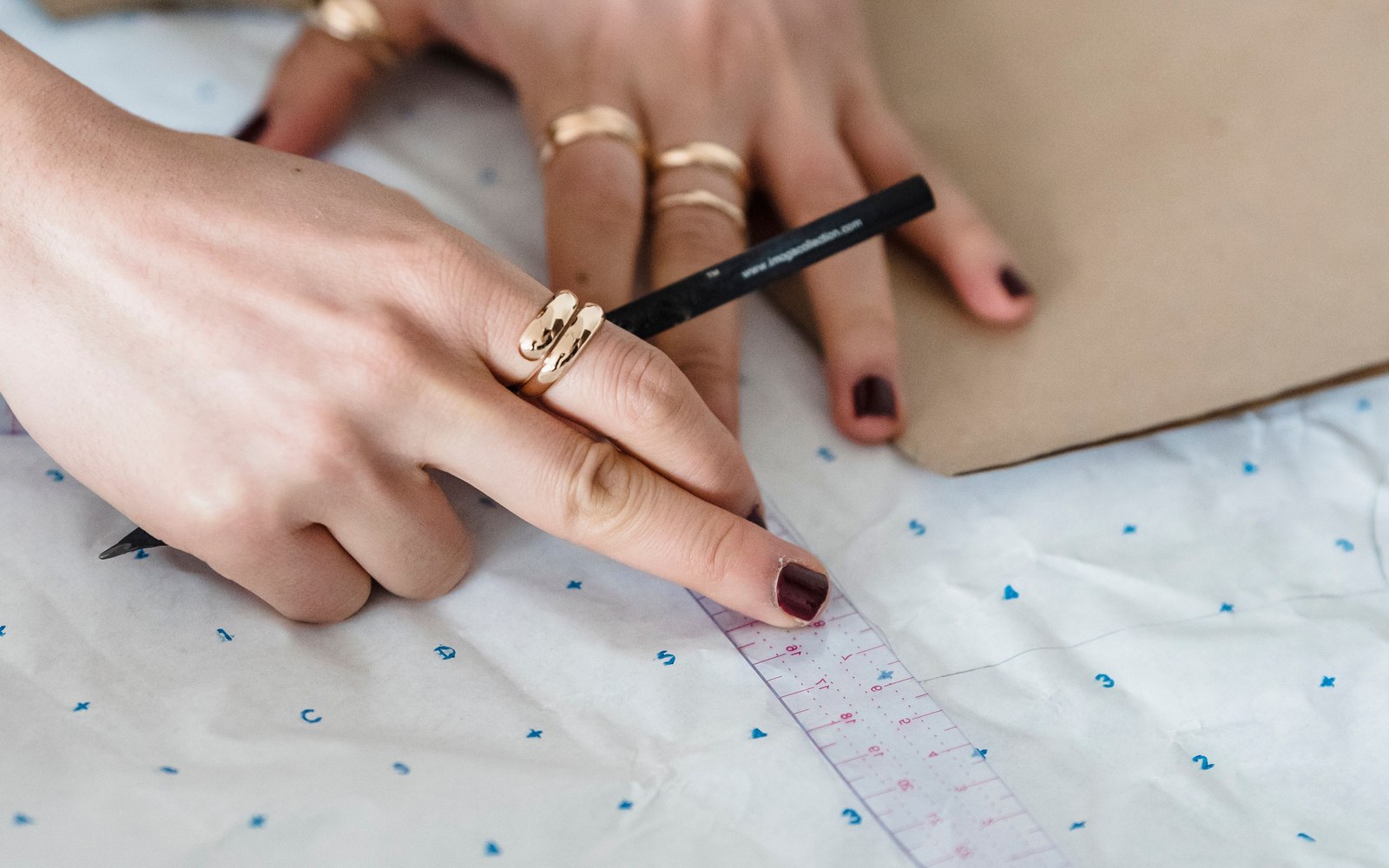
AI assisted with organizing text, not generating the photographs. Both photos by Michael Burrows / Pexels are used under the Pexels License: pattern work and dress-form development. These are illustrative stock scenes, not ZWC people, sites, project records, validated techniques or endorsements. The decision map is an original explanatory vector, not a completed approval.