
Quick answer
A water-repellent fabric or zipper does not establish that a finished bag will keep its contents dry. Before approving a claim, define the protected compartment, expected exposure, closure state and product condition. Match supporting evidence to the actual materials, seams, openings and assembled design. Keep the wording no broader than that evidence. A photograph of droplets, a fabric report or a supplier's “waterproof” label cannot substitute for finished-product verification.
A convincing droplet photograph can leave the buying question unanswered
Water beads on the outer panel. The supplier presents a fabric report. The sales description promises protection for a laptop. Those three items may describe different things: surface behaviour, a material specimen and a finished-product promise. Paying for a higher-specification fabric does not close the gap between them.
This guide is for private-label backpack and textile-bag buyers deciding what a proposed water-resistance statement can cover. It is not a recommendation for submersible equipment, protective cases or safety-critical use. Start with the claim you actually need, then ask which product evidence would support it. Do not ask the factory to choose a marketing adjective before you have defined the exposure and the compartment being protected.
Start with one bounded use statement
Describe the expected situation in ordinary language before discussing a test: carrying the closed bag between buildings, travelling with it in sustained rain, or placing it on a wet surface are not automatically the same requirement. Specify what is inside and which compartment matters. An external pocket and an internal sleeve should not silently inherit the same promise.
Record the bag's orientation, closure instructions and relevant condition, including whether the claim concerns a new product or one after specified use or care. These are questions for the development brief, not invented test parameters. Have the responsible product specialist and competent laboratory agree the applicable evaluation, specimens and acceptance criteria.
Write exclusions with the same care as the headline. If immersion, open pockets or a particular closure state are outside the intended scope, make that visible during development. Do not turn “not evaluated” into “probably suitable”. Protection of valuable contents needs a clear evidence boundary, not a demonstration using a customer's live electronics.
Separate the evidence levels
AATCC's public TM127 scope addresses fabric resistance to water penetration under hydrostatic pressure. It expressly distinguishes that assessment from rain or spray evaluations. The public summary is not the full paid method, a universal bag pass level or evidence that a particular bag has passed anything. A fabric result answers a specimen-level question; keep its method, condition and identity attached.
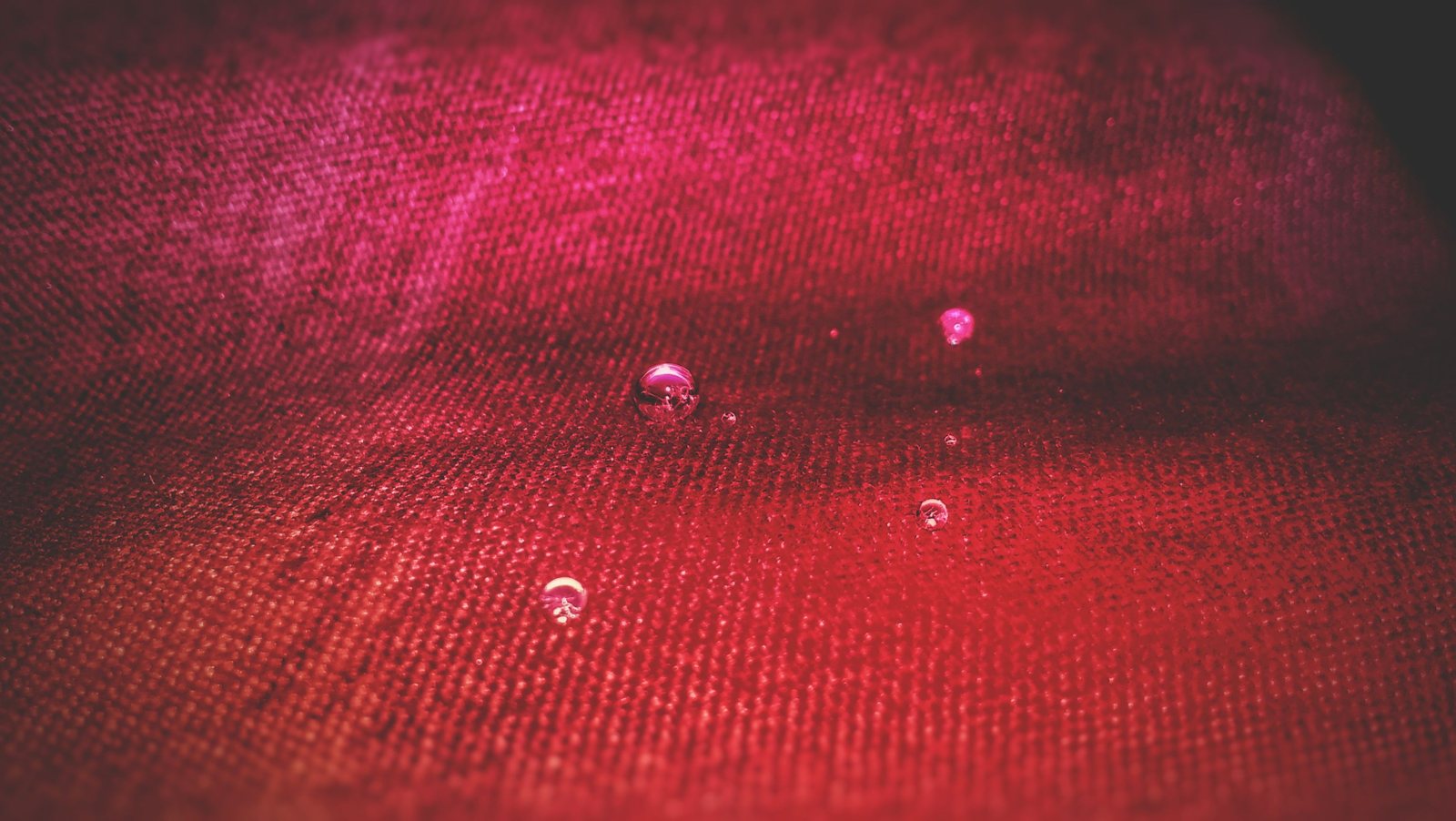
The purchasing consequence is straightforward: do not translate a material rating into a finished-bag exposure claim. Nor should a visibly beading surface be treated as proof about the bag's interior. The accompanying droplet photograph shows a textile surface, not an identified bag material, documented test or finding about dry contents.
| Evidence offered | What to identify before relying on it | What remains unresolved |
|---|---|---|
| Fabric report | Material code, construction/finish, specimen state, method and reported result | Performance of assembled seams, openings and compartments |
| Zipper declaration | Exact zipper family, specification and supplier limitations | Its integration into this bag and the complete closure path |
| Seam or assembly evidence | Actual joint construction, materials and evaluated configuration | Other entry paths and unreviewed design variants |
| Finished-bag evaluation | Style/revision, compartments, closure state, exposure, condition and acceptance basis | Uses or variants outside the documented scope |
| Catalogue photo or water-pour video | What was shown, what was omitted and whether any controlled record exists | Any general protection claim not supported by an agreed evaluation |
Keep the evidence stack, rather than replacing one layer with another. A completed-bag assessment does not remove the need to identify the materials used in later production. A material document does not remove the need to evaluate the assembly.
Inspect the closure and construction proposal
Ask the supplier to mark the proposed water-management features on the actual design: main opening, zipper ends, seams, attachment penetrations, base and pocket boundaries. Record what is specified, what is only proposed and what has not been evaluated. Do not infer a coating, taped seam or welded construction from a product photograph.
The component name needs scrutiny too. YKK's own AquaGuard guidance describes the featured VISLON AquaGuard zipper as water repellent rather than waterproof or watertight. Its separate AQUASEAL discussion concerns a different product and includes application precautions. These manufacturer-specific distinctions are useful because a familiar brand name alone does not identify the offered component or approve the finished assembly. No YKK supply relationship or component availability is implied here.
Do not prescribe a sealing process merely because another bag uses it. Ask how the proposed materials, closure geometry and assembly route work together, then obtain technical confirmation. A development change may require different equipment, preparation or inspection. The supplier should make those dependencies visible before the buyer compares the resulting quotation.
Build a claim-to-evidence register
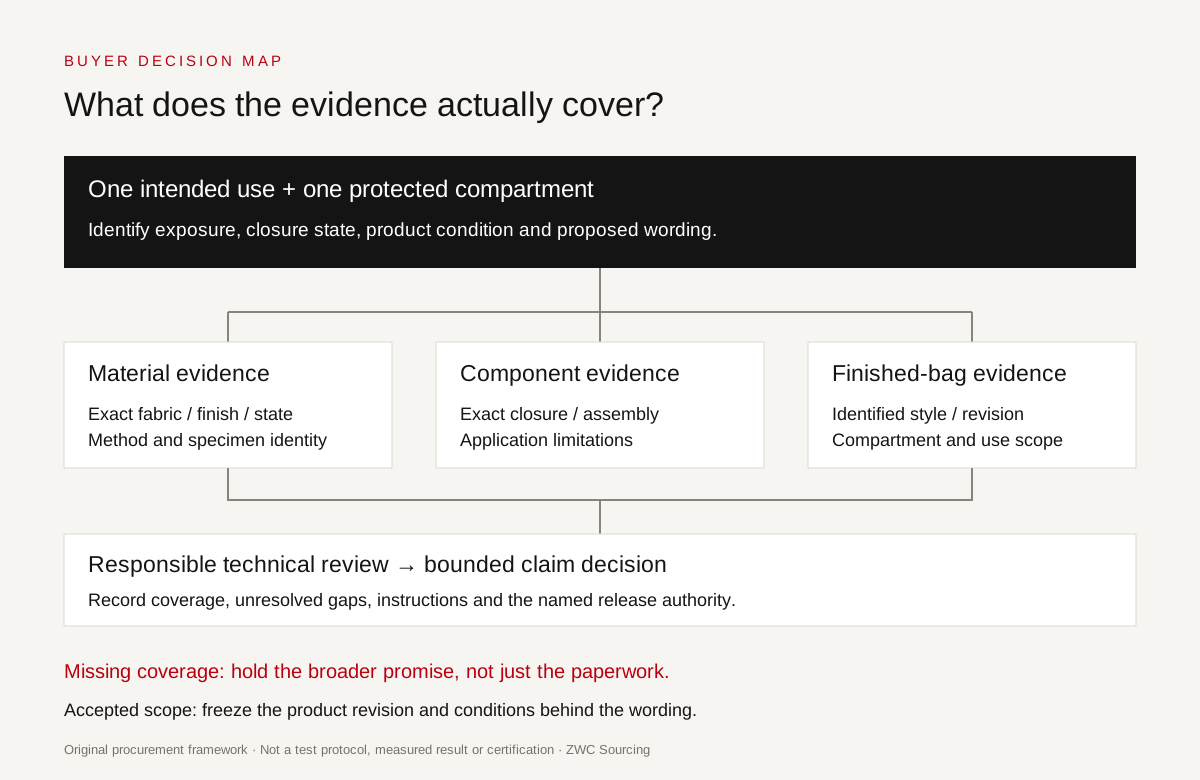
Use one row for each proposed claim and compartment. Record the exact proposed wording, intended use, product revision, supporting documents, untested conditions and decision owner. Attach the retained sample identity and any care or closure instructions on which the evaluation depends.
The useful output is not a folder named “waterproof certificates”. It is a traceable answer to whether a particular statement is supported for the actual ordered design. A report title alone cannot show coverage. Ask which colours, sizes, material sources and construction variants the responsible technical reviewer accepts within its scope; do not assume the range follows automatically from one sample.
| Finding at review | Purchasing or release action | What must be resolved |
|---|---|---|
| Only a fabric report is available | Keep the claim at its verified material scope; hold broader finished-bag wording | Suitable assembly evidence and an accepted evaluation plan |
| An opening or compartment is outside the evidence | Identify that limitation; do not extend the claim to it | Revised wording, design or evaluation scope |
| The evaluated sample differs from the proposed order | Pause affected approval and map the differences | Whether existing evidence covers the actual revision |
| A proposed process change affects the quoted price | Obtain an itemized alternative, not an unexplained premium | Construction, verification, recurring cost and development responsibility |
| Evidence and wording are accepted for a defined scope | Freeze the identified configuration and conditions | Named release authority and control of later changes |
The register should distinguish a technical assessment from permission to print packaging. Name who approves the product evidence and who authorizes the final copy. Where destination-specific claims or obligations are involved, obtain appropriate market review; this guide does not determine legal compliance.
Compare the cost of delivering the promise
Request separate lines for shell material, closure, construction changes, development samples, agreed verification and any accessories. Keep one-time charges apart from recurring unit costs. Ask what is excluded, who supplies each item and which change would trigger another sample or review. Use actual supplier quotations rather than a generic percentage for “waterproofing”.
A narrower, accurately supported claim may be more appropriate than a stronger promise the proposed design cannot demonstrate. Conversely, do not quietly reduce an essential protection requirement to reach a target price. Revisit the design or sourcing route, or stop the offer, when the required use is outside the evidence or supplier capability.
Keep the approved boundary through production
Carry the accepted material codes, closure identity, construction revision and instructions into the order and inspection references. Record changes to these items before treating earlier evidence as current. Link finished samples and relevant material lots to the actual production scope; a visually similar substitute is not automatically covered.
For a China-side bag-sourcing discussion, share the product reference, destination, protected compartment, intended exposure, proposed claim, quantities and development stage. ZWC can discuss supplier coordination and quotation alignment; product capability, technical verification and service responsibilities require confirmation. See the handbag quality-plan guide and hardware change-control guide, or send a focused brief. The next step is to identify the evidence gap—not promise that a bag is waterproof.
Primary sources
- AATCC TM127 public scope, page identifies TM127-2017(2018)e; checked 20 October 2026. Public fabric-level scope only, not full method, latest-edition certification or a mandatory finished-bag criterion.
- YKK Americas: Caring for AquaGuard and AQUASEAL zippers, undated manufacturer page checked 20 October 2026. Specific component distinctions and precautions only; no ZWC relationship, product selection or whole-bag performance conclusion.
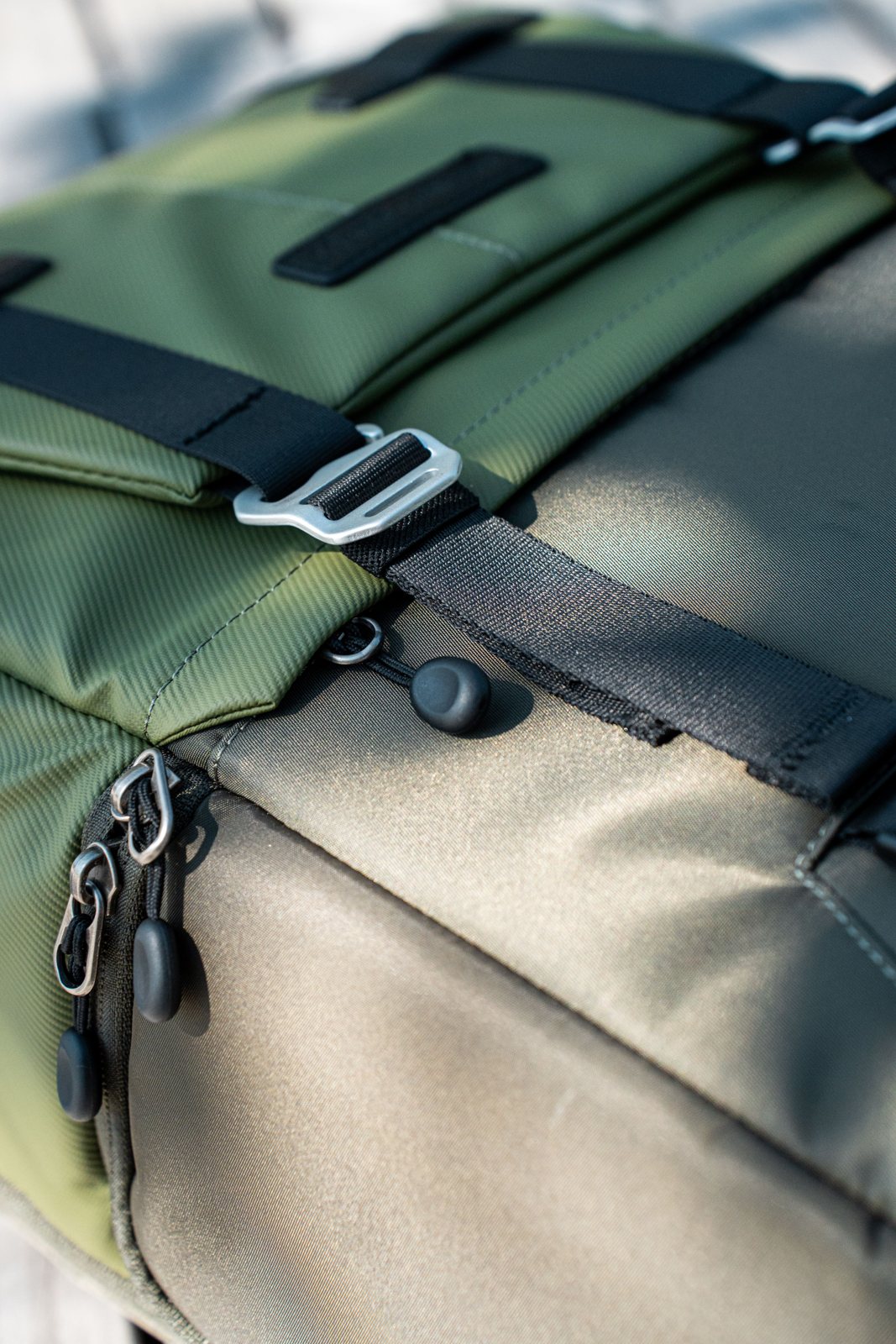
AI assisted with organizing the text, not generating these photographs. Hero: Clément Proust / Pexels; textile detail: Prashant pacific / Pexels. Both used under the Pexels License, resized/compressed. Illustrative stock, not ZWC products, suppliers, tested samples or endorsements. Neither photograph establishes waterproofness, material identity or a particular zipper family. The workflow is original explanatory vector artwork.