
Quick answer
Before accepting a cheaper bag, check whether its price covers the same shell, lining, reinforcement and assembly work. Map each internal part to its location, intended role, material reference and connection to adjacent parts. Price a changed package as an explicit alternative, with its own sample and review responsibilities. Similar exterior photographs do not establish equivalent internal work, and neither a thicker layer nor a lower material price proves a better finished product.
Start with the difference the quotation does not show
Imagine two proposals for a structured everyday handbag with a similar exterior. One quotation names a lining and several internal parts. The other describes only the outer material and finished dimensions. This is a hypothetical purchasing situation, not a ZWC order. The useful first step is to establish whether the prices cover the same product, not to assume that the shorter quotation reflects a more efficient factory.
A buyer may want a particular silhouette, access to pockets and a stated carrying use. Those requirements do not specify every hidden part. Ask the supplier to show how its proposed construction addresses them, leaving unknowns visible. A finished photograph is an appearance reference, not an internal bill of materials.
This guide addresses the commercial scope of internal bag development and alternatives. It does not prescribe reinforcement materials, adhesive recipes, thicknesses, loads, laboratory methods or a universal construction. Appropriate product specialists must define technical suitability and acceptance for the actual bag and market.
Separate lining, reinforcement and the proposed result
Texon's bag and belt catalogue lists named reinforcement products and describes different intended roles. For example, it presents T448 for shape-retention applications and distinguishes Texon soft for situations without corners or sharp edges. These are the manufacturer's descriptions of its materials, not this guide's recommendation for a particular handbag.
The catalogue also contains products described for footwear and garments. Appearing on the same category page does not establish that every lining or reinforcement listed is appropriate for a bag. Do not transfer a footwear lining claim into a handbag specification, or turn an accessory product description into approval of a complete construction.
Ask the supplier which exact article is proposed, in which part, in what supplied and assembled state, and why. This guide does not reproduce the catalogue's certification, recycled-content, environmental, mechanical-property or economy claims as independent findings. No material or catalogue photograph is offered as evidence that a ZWC supplier uses it.
Ask for a part map that can be priced
Start with a drawing or annotated proposal that the parties are permitted to share. Identify the shell panels, lining sections and any proposed inserts, backing, base or attachment reinforcement. The list should describe the actual offer; it is not a requirement to put every possible layer in every bag.
Where the internal arrangement is unknown, request an explanation or a representative construction submission rather than drawing an invented cross-section from the exterior. Keep proposal, sample and approved revision distinct. If an inaccessible proprietary detail cannot be disclosed, record what can be identified and substantiated and whether that is sufficient to continue.
Use this original purchasing worksheet against one brief revision. Blank or unknown fields are preferable to a guessed material description.
| Proposed part or area | Ask the supplier to identify | Connect to the quote | Question for the responsible reviewer |
|---|---|---|---|
| Shell and any backing | Actual material article, panel location and proposed supplied state | Whether backing or preparation is included in the shell price | Which requirements concern appearance, support or another defined role? |
| Lining sections | Material reference, placement and proposed attachment or pocket arrangement | Material, cutting and assembly included or excluded | Does the representative submission show the intended access and assembled arrangement? |
| Base or body insert, if proposed | Part drawing, material reference, coverage and how it is held | Separate input, preparation, fitting and any new development charge | Which shape and use requirements remain unresolved? |
| Handle or strap attachment area | Identified proposed reinforcement and its connections | Whether the attachment work belongs to the bag maker or another party | Who reviews the assembled attachment for the actual intended use? |
| Edges and transitions | Proposed layer terminations, finishing state and visible reference | Which finishing or rework tasks the price includes | Which interfaces need representative review before the next commitment? |
The last column supplies questions, not a technical passing rule. An identified material does not prove that its location, joining or surrounding construction will work. Ask the appropriate reviewer to identify what the next submission must establish.

Keep an alternative beside the reference offer
Once the reference package is clear, a supplier may propose fewer parts, a different material article, a changed lining or another assembly arrangement. Such a proposal can be worth considering. It is not automatically the same bag at a lower cost.
Ask which requirement is unchanged and which is being reconsidered. Preserve the difference in a marked proposal, a separate quotation and the sample record. Avoid an instruction such as “reduce cost inside” without defining the permitted change and decision owner.
This second original register separates the commercial fields from the validation work. It deliberately contains no benchmark price or saving percentage.
| Alternative | Commercial fields to reconcile | Evidence or responsibility to clarify | Hold when |
|---|---|---|---|
| Change a material article | Input price, purchasing minimum, residual stock and quoted quantity basis | Revised part reference and suitability-review scope | Only a colour or outward resemblance has been matched |
| Change a lining arrangement | Included materials, cutting, assembly and sample revisions | Representative internal arrangement and named appearance/use reviewer | The quote does not identify the changed parts |
| Change insert coverage or shape | New preparation, development and recurring work | Revised drawing, affected interfaces and submission purpose | The earlier approval is reused without mapping the change |
| Change an attachment package | Component supply, assembly work and excluded assessment costs | Review responsibility for the complete proposed attachment | A strip or component record is treated as approval of the assembled bag |
Use actual dated quotations with currency, quantities, inclusions and exclusions. Separate one-time development from recurring unit charges. Confirm how unused inputs, rejected submissions and further revisions are treated. A lower input price may leave other work outside the offer; it does not establish the cost of acceptable delivered bags.
Buy the next answer, not an undefined sample
Give the next sample or construction submission a specific purpose. It might clarify the internal arrangement, compare a proposed alternative or show the completed state that the supplier has priced. Record the product, part revisions, materials, assembly state and questions still open.
An appearance discussion and a technical acceptance decision may involve different people. Name who can approve the commercial change and who is responsible for product-specific assessment. Do not let a general chat message saying “looks good” authorize an unreviewed material or attachment substitution.
No generic flex, load, stiffness, abrasion or durability threshold is supplied here. Assessment methods, representative specimens and acceptance criteria need the appropriate product and technical review. A display sample, stock photograph or manufacturer's general brochure cannot replace that scope.
Link the internal scope to the order record
Continue when the reference package and alternative are identified, the quotation makes their differences visible and the next submission has an agreed decision purpose. Ask for clarification when the proposed construction remains a list of marketing terms. Hold the affected commitment when a critical part or review responsibility is unidentified.
This is separate from the handbag quality-control plan, which follows an agreed product through production and shipment. The leather specification guide addresses the material description, while the bag requirements page introduces assembled-product evidence questions. None establishes the internal structure of an unseen proposal.
For a sourcing discussion, share the bag reference, intended use and market, shape priorities, quantities, development stage and internal fields still unknown. ZWC can discuss supplier matching and coordination. Actual construction access, material availability, development work, technical assessment and acceptance require project-specific confirmation; no saving, laboratory service or approved material system is promised.
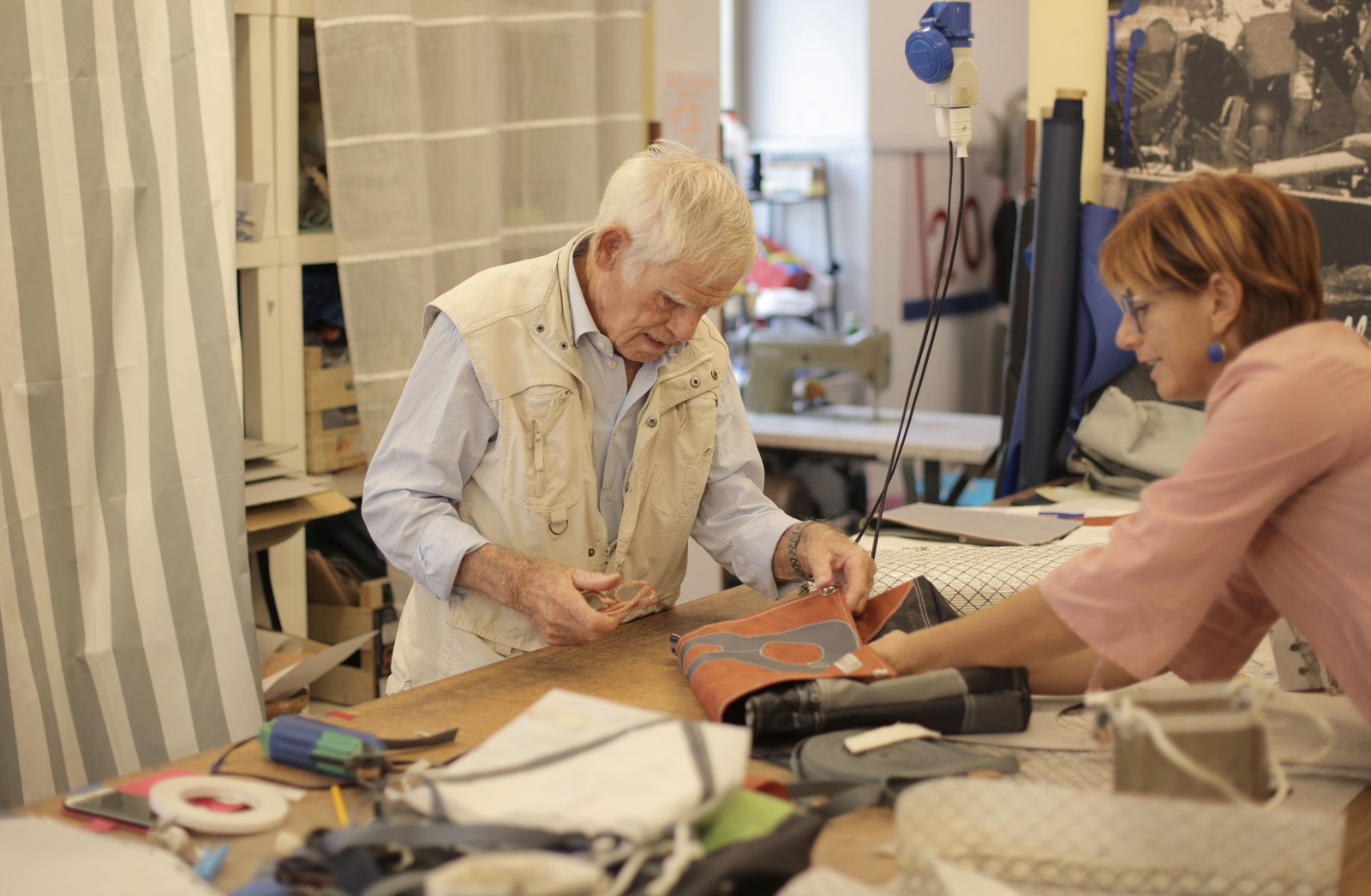
AI assisted drafting and research organisation, not photography. Hero: Andrea Piacquadio / Pexels. Supporting: Gustavo Fring / Pexels. Both Pexels License, full-frame resized/compressed only. Historical workshop and template contexts, not ZWC staff, suppliers, projects, named materials or verified hidden construction. No endorsement implied. The two matrices are original purchasing questions, not product approval.