
Quick answer
Choose the least development work that can deliver your product's essential difference—not automatically the cheapest catalogue shoe or the most customized tooling. Compare an existing model, a bounded modification and a new development against the same customer, use and acceptance brief. Confirm what is actually available, what may change, what evidence must be renewed and what use rights are documented. Release the next investment only when its unresolved question is clear.
A new mould is not a reason for someone to buy the shoe
Your first footwear launch may need a distinct reason to buy—not a new mould. That reason might concern appearance, an underserved assortment or a clearly defined use. Write it before asking a factory to price customization. Otherwise, development spending can produce a different-looking shoe without answering why the intended customer should choose it.
This guide is for overseas founders and buyers planning an ordinary fashion or casual-footwear collection sourced from China. It is a procurement framework, not a launch-budget estimate, design service or guarantee of fit. Protective, medical or performance claims require their own evidence and appropriate professional review; a lower-development route does not remove those obligations.
Define what must be different and what can stay fixed
Create a short product brief with the intended wearer, use, destination, sales channel, appearance direction, size and width range, proposed quantities and current development stage. Separate the essential difference from preferences. If an attractive sole profile is optional but a particular fitting requirement is essential, do not let the catalogue reverse those priorities.
Then list the parts you are willing to keep: the supplier's existing last, sole family, upper pattern, materials or construction. None is confirmed merely because a salesperson calls the model “ready.” Request the actual codes, offered sizes, present availability and restrictions before treating it as a usable platform.
An existing model is useful only if the fixed elements suit the brief. A new last or outsole is justified only if the project needs the change and can fund its development and validation. Neither path wins by definition.
Compare three routes by what remains unresolved
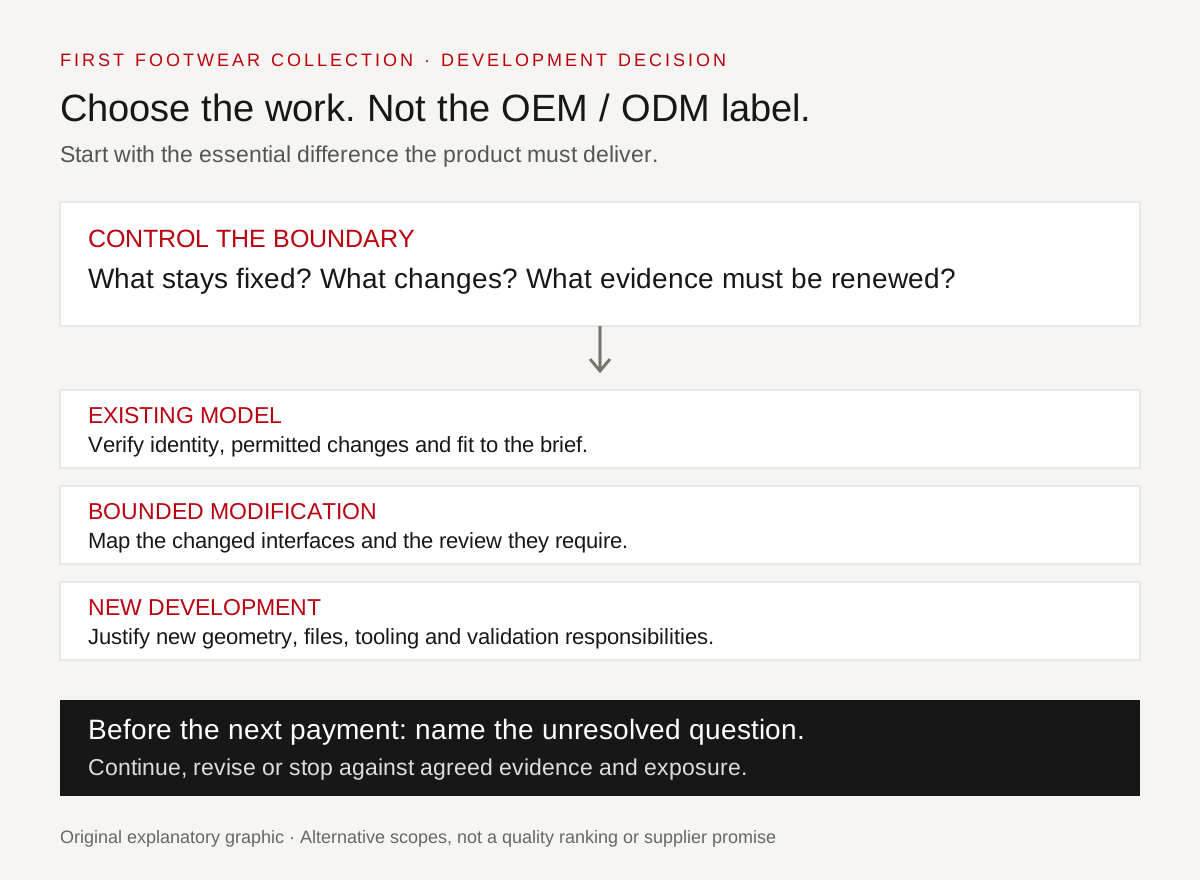
The labels OEM, ODM and private label can conceal different scopes. Ask suppliers to describe the work rather than relying on the label. The routes below are comparison categories, not claims about what every factory offers.
| Route | What to establish first | Potential constraint | Next investment should resolve |
|---|---|---|---|
| Existing model with agreed branding or packing | Exact model, permitted changes, size range, material identity and documented use permission | The available shape and construction may not deliver the essential difference | Whether an identified sample meets the brief without unsupported modifications |
| Bounded modification of an identified platform | Fixed components, proposed changes and the interfaces affected | A seemingly small upper, lining or closure change can reopen development questions | Whether the modified combination works under the agreed specification and review plan |
| New last, sole or broader product development | Controlled design inputs, development owner, tooling scope and acceptance responsibilities | More interfaces, revisions and commitments need management; uniqueness is not automatic | Whether the new geometry and construction are justified and supported before expanding spend |
Ask for a route-specific proposal, including exclusions. If the supplier cannot identify what is fixed, you are not yet comparing a bounded modification with a new development—you are comparing two descriptions of unknown work.
A cosmetic change can become a construction change
The last is the form used in making the shoe, but it is not the only influence on the finished product. SATRA's June 2012 article explains that fit is affected by foot dimensions, last shape, detail design, upper materials, pattern design and manufacturing processes. It is useful background, not a current specification for your shoe. SATRA: measuring feet, lasts and footwear.
That is why “keep the same sole and change the upper” is a development proposal, not proof of compatibility or unchanged fit. Request a change map: what changes, which patterns or components it affects, what the sample must demonstrate and who decides whether the evidence is adequate. Do not silently carry an earlier approval over to a different material or construction.
Likewise, a sole's appearance is not its material specification. SATRA describes rubber compounds as combinations selected for end use and cost, and distinguishes material testing from assessment dependent on moulded shape. Reusing a tread outline does not establish the same compound or finished performance. SATRA: footwear materials and components.
Keep the technical questions proportionate to the actual change. Qualified product specialists should define relevant assessment methods and acceptance criteria; this guide does not supply universal dimensions, test thresholds or processing instructions.
Price the development boundary before calculating a unit cost
Request a dated quotation showing currency, quantity basis, delivery terms and the exact product revision. Separate one-time development work from recurring production costs and inventory commitments. A lower development charge can leave corrections, additional sizes or files outside the offer; a higher charge is not proof of a more complete scope.
| Cost or commitment | Ask the supplier to identify | Keep visible in the decision |
|---|---|---|
| Design and development | Deliverables, revisions, responsible party and exclusions | What the next payment buys and what remains unresolved |
| Lasts, moulds and other tooling | Asset list, covered sizes, trials, correction scope and use arrangement | What is included now versus needed for a wider assortment |
| Samples and validation | Sample stage, materials, quantities, assessment scope and shipment | A visual sample is not a full production or performance release |
| Materials and production | Variant minimums, material commitments, unit quotation and change conditions | Remaining stock, substitutions and reorder availability |
| Packing and delivery | Artwork, packaging, verification and logistics scope | Costs not included in the quoted shoe price |
Do not use a competitor's advertised starting budget as your project estimate. Calculate only from your actual quantities, quotes and assumptions. Compare first-order cash commitments separately from expected repeat-order costs, without assuming that development will never recur.
Verify use permission without assuming exclusivity
Ask what permission covers the existing design, tooling and files, which party can authorize changes, and whether any exclusivity is actually offered. A catalogue photograph, development invoice or new logo should not be treated as a complete rights assessment.
WIPO explains that industrial design protection concerns product appearance and that rights are territorial. This is a reason to review the actual design and destination—not a conclusion that an available shoe is safe to copy or that paying for a mould makes its appearance exclusive. Obtain appropriate legal advice on the transaction and any proposed protection. WIPO: industrial design FAQ.
For physical asset records, use our tooling-control guide. Keep that asset-and-custody exercise separate from deciding how much product development the brand needs.
Give each stage a continue, revise or stop decision
Before the first sample, name the decision it must support. An appearance review, a construction trial and a size-range assessment answer different questions. Record the product revision, open issues, reviewer and what may proceed; “sample approved” should not authorize unrelated work.
Continue when the essential difference remains achievable and the agreed evidence supports the next step. Revise when a bounded correction has a defined owner and cost. Stop or change route when the fixed platform cannot meet the brief, permissions remain unresolved, or the development commitment exceeds the buyer's approved exposure. A sunk development payment is not evidence that the next payment is worthwhile.
Before bulk release, the ordered size range still needs its own size-set approval plan. Existing tooling does not exempt a new order from material, fit, workmanship or destination-specific checks.
Send ZWC the shoe reference, intended wearer and use, destination, essential difference, quantity by variant and current development status. Say which elements can remain fixed and which cannot. Our footwear sourcing service can be the starting point for a supplier-matching and sampling-coordination discussion. Development capability, tooling availability, technical review, rights and commercial terms require confirmation for the nominated project; no exclusive design, in-house engineering or guaranteed low-cost launch is promised here.
Primary sources
- SATRA: Measuring feet, lasts and footwear, Peter Allen, originally June 2012, checked 19 October 2026. Historical technical background, not current numerical specification or a ZWC fit result.
- SATRA: Footwear materials and components, undated public page, checked 19 October 2026. Material/shape evidence distinction; no supplier guarantee or proprietary test method adopted.
- WIPO: Frequently asked questions on industrial designs, undated general guidance, checked 19 October 2026. Appearance and territorial scope; not clearance, ownership advice or jurisdiction-specific filing instructions.
AI assisted with organizing text, not generating the photographs. Photos by Gizem toprak and Lukas Blazek / Pexels are used under the Pexels License. The second photo is cropped. These are illustrative stock craft and product-detail contexts, not ZWC sites, employees, samples, available tooling, performance evidence or endorsements. The route map is an original explanatory vector.