
Quick answer
Treat a footwear reorder as a continuity decision, not permission to repeat an old purchase order unchanged. Confirm which approved inputs can still be supplied, which exist only as identified stock and which require a replacement. Reconcile usable quantities by size, side and colour before committing to the assortment. Then choose explicitly between repeating the identified product, buying a bounded final quantity, qualifying a changed revision or retiring the style. An old approved shoe cannot establish today's component availability.
The sample is still here. Is the original product still available?
A reorder can look cheaper because the development work has already been paid for. That advantage disappears if the quoted price assumes an unavailable outsole, an unconfirmed upper material or a size range that remaining components cannot complete. Before negotiating another unit-price reduction, establish what the supplier is actually proposing to repeat.
This guide is for ordinary fashion and casual-footwear buyers returning to a previously produced style. It is not a PPE selection guide or a claim that an existing model remains compliant, safe or suitable for every use. Protective, performance and other specialised footwear need product-specific evidence and appropriate professional review.
The important distinction is between an unchanged specification and an unchanged supply route. Your drawing may be identical while the material code has been replaced, a component source has changed or the original mould is no longer available. Ask for the differences in writing before issuing an unconditional repeat instruction.
Ask for a dated continuity response, not “same as last order”
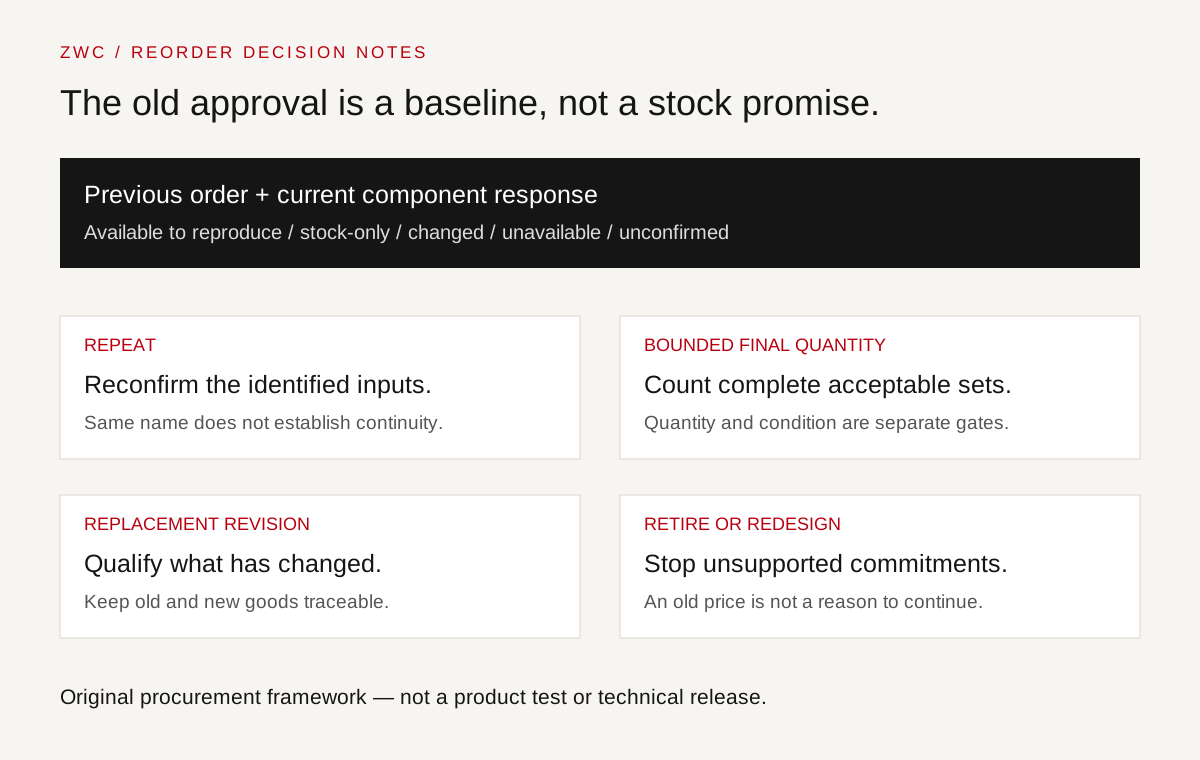
Start from one identified baseline: the previous order, approved product revision, bill of materials, size-to-component map and retained reference. Then ask the supplier to mark each important input as available to reproduce, stock-only, changed, unavailable or unconfirmed. Include the response date and the party responsible for confirming it.
SATRA's November 2015 discussion of retail specifications specifically challenges vague repeat-order descriptions and argues for specifications covering materials, components and processes. It also explains why those specifications need review. This is historical professional guidance, not a current legal opinion or evidence about your supplier. Read SATRA's specification discussion.
| Input to reconcile | Previous-order reference | Current response needed | Decision left open |
|---|---|---|---|
| Upper and lining | Material and source codes, colour/finish and approved revision | Same identified material available, a proposed replacement, or remaining lot only | Whether the current offer is a repeat or a material change |
| Sole family | Material identity, component codes and size/side allocation | Reproducible supply versus counted stock, including missing sizes | Whether the proposed assortment can be completed |
| Lasts and moulds | Tool register and size coverage | Current location, access, condition and responsibility for any correction | Whether an old tool reference still supports the production plan |
| Closures and internal parts | Lace/zip/elastic, footbed, reinforcement and other relevant codes | Current source and specification; no invisible substitutions | Which interfaces and functions need renewed review |
| Production route | Producing site and identified external stages | Same route or a declared site/process change | Which earlier evidence still represents the proposed production |
| Packing and claim files | Active artwork, labels and product descriptions | Current destination and sales-channel instructions | Whether old wording or packaging is being carried forward incorrectly |
Do not turn “unconfirmed” into “unchanged” because the supplier has not reported a problem. It means the buying decision still lacks an answer. A dated continuity response can expire as stock is allocated or the order changes; agree when it must be reconfirmed.
A stock balance is not a complete reorder quantity
If a component is stock-only, request the actual lot identity, location, ownership or allocation status and usable quantity. Separate reserved, rejected, damaged and uncertain stock from the quantity proposed for your order. A total across several sizes is not evidence that your requested size mix is possible.
For paired components, reconcile left and right quantities within each required size and colour. Then connect them to the other components needed for complete shoes. The commercially useful number is the quantity of complete, approved sets that can support the chosen assortment—not the largest component balance in a warehouse message.
Keep this exercise separate from a quality release. Counting identifies a possible quantity; it does not establish that stored components remain acceptable. Request storage history and condition information, then let the responsible product specialist define any additional assessment. If records or identification are missing, the stock remains uncertain rather than becoming an automatic low-cost opportunity.
Old stock and a familiar appearance need different evidence
SATRA's public description of TM344, revised February 2022, covers hydrolytic conditioning of susceptible materials before mechanical assessment, particularly polyurethane soling and upper materials. That scope is a reason to ask material-specific ageing questions; it does not provide a universal shelf life, a visual acceptance rule or a conversion from laboratory conditioning to years in storage. The full paid method was not used to prescribe a test here. SATRA TM344 public scope.
Likewise, an outsole with the old tread outline is not necessarily the old material. SATRA distinguishes rubber compounding for the intended purpose from testing influenced by moulded shape. Keep material identity and geometry separate when reviewing a replacement. SATRA materials and components.
Ask a qualified footwear specialist or appropriate laboratory to determine relevant evidence, sample condition and acceptance criteria for the actual change and intended use. This guide sets no generic testing interval or pass threshold. Do not approve an unidentified stock lot simply because another lot of the style passed an earlier assessment.
Choose the reorder route before reserving more inventory
| Route | When it may be worth evaluating | Commitment to keep visible | Hold or exit condition |
|---|---|---|---|
| Repeat the identified product | Required inputs and production route are reconfirmed against the baseline | Current quantities, assessment scope and delivery terms | Any unresolved substitution or missing assortment component |
| Buy a bounded final quantity | Identified, acceptable stock can support a defined final assortment | Exact lots, allocation conditions and goods that may remain unused | Insufficient complete sets, unclear condition or unacceptable leftover exposure |
| Qualify a replacement revision | A discontinued input has a documented alternative worth developing | New samples, review work, affected sizes, cost and schedule consequences | Replacement cannot meet the brief or the approval evidence is incomplete |
| Retire or redesign the style | Continuity cannot be supported within the buyer's constraints | Remaining commitments and the transition to another product | Do not buy unwanted components merely to preserve a nominal repeat price |
Compare these routes with actual dated quotations. Separate recurring shoe price from new development, tooling corrections, verification, freight and remaining inventory commitments. A final purchase of components is not the same as a confirmed order for saleable finished shoes. Do not assume that purchasing more stock necessarily lowers total cost.
If a replacement is proposed, give it a distinct controlled revision. Identify which appearance, fit, assembly and functional questions it reopens, and record who can approve the next step. Keep old and replacement components, work in progress and finished goods traceable; do not allow a mixed shipment to inherit one vague “same style” approval.
Close the reorder decision, then release production
Record the selected route, approved assortment, component status, stock allocations, changed revision if any, outstanding evidence and authorised release scope. Give unresolved questions an owner and due date. A commercial stock reservation should state its conditions; it should not silently authorize material consumption or substitute for technical acceptance.
Once continuity is established, use the sample-to-bulk transfer checklist for production execution. If the component family or ordered sizes changed, revisit the relevant footwear size-set approval questions. Those checks support the selected route; they do not resolve whether discontinued inputs can be supplied in the first place.
Send ZWC the previous product/order reference, destination, proposed reorder quantities by size and colour, current component codes and the supplier's continuity response. State whether you are considering old stock, a replacement or a final run. We can discuss footwear supplier coordination and follow-up; availability, development, technical assessment and commercial responsibilities require project-specific confirmation. No guaranteed repeat price, exclusive component supply or unchanged product performance is implied.
Primary sources
- SATRA specification consultancy discussion, originally November 2015; historical specification-review principles, rechecked 22 October 2026. Not jurisdiction-specific advice.
- SATRA TM344 public scope, revision February 2022; rechecked 22 October 2026. No paid method text, test settings, shelf-life claim or pass criterion adopted.
- SATRA Footwear Materials and Components, undated public page; rechecked 22 October 2026. Material identity and moulded-shape evidence remain separate; no ZWC product tested.
AI assisted with organizing text, not generating the photographs. Product-appearance hero: Ali Nafezarefi / Pexels; footwear-component work: Fernanda Simões / Pexels. Both use the Pexels License and were resized/compressed. They are illustrative, not a ZWC sample, supplier, available component, stock lot or tested material; no endorsement implied. The reorder workflow is original SVG artwork, not a measured result.