
Quick answer
Compare upper proposals as development packages, not competing surface textures. Identify the last and size range, material references, upper-forming route, joining and reinforcement work, finishing state and bottom interface. Ask which pattern or knitting-program revisions the quotation covers, what representative samples must establish and who can authorize changes. Neither “knitted” nor “cut-and-sewn” proves lower cost, fewer seams, suitable fit or finished-shoe performance.
A familiar silhouette can conceal a different work package
Imagine two suppliers quoting an ordinary casual shoe from the same reference image. One proposes a knitted upper; the other proposes cut panels and sewn joints. This is a hypothetical buying situation, not a ZWC project. Before ranking prices, the buyer needs to know whether both suppliers have priced the same requirements and the same stage of development.
An appealing surface sample does not settle the shape around the intended last, the size coverage or the work needed at the bottom interface. A cheaper-looking proposal may simply exclude programming, pattern revisions, components or representative trials. Those are questions to resolve, not reasons to assume one route is inherently better.
This guide concerns the upper-development handoff. It does not select protective footwear, prescribe knitting or sewing settings, approve materials or claim that ZWC has physically tested either route.
Do not turn “knitted” into “seamless”
SHIMA SEIKI's shoes and accessories page describes knitting machines together with design systems and software, and discusses shaped knitting and virtual samples. Its sample catalogue distinguishes upper samples from other footwear and accessory examples. That is manufacturer-specific capability context, not evidence that every knit upper is produced in one piece or needs no later assembly.
The catalogue describes a lace-up upper example with a tongue and knitted texture effects. A buyer should therefore ask what the particular proposal actually contains: a panel, a shaped upper component, an upper assembly or another defined output. Do not transfer a seamless-product claim from one manufacturer example to every shoe carrying a knitted appearance.
The manufacturer's statements about reduced waste, speed or virtual sampling are not adopted here as guaranteed savings or permission to omit physical validation. The two cited pages have the same issuer; they are not independent evidence of market-wide outcomes. No branded images or knitting data are reproduced.
Freeze the common brief before comparing routes
Give both bidders the same intended wearer and use, destination, last reference, size assortment, appearance priorities and development stage. Identify which requirements are fixed and which are proposals. If the last or bottom is not settled, mark that dependency rather than asking the upper maker to treat a picture as a complete specification.
Describe the offered material and construction at the level the supplier can substantiate. A fibre name alone does not identify a knit specification. A panel's appearance alone does not identify its backing, lining or reinforcement package. Request actual references and the proposed component list, leaving unknowns visible.
For a cut-and-sewn proposal, ask which patterns, cutting work, joint specifications and assembly steps are included. For a knitted proposal, ask who develops the program, which input references it assumes and what later joining or finishing remains. These are supplier questions, not a universal production sequence.
Compare the work, not only the pair price
Use this original worksheet against one controlled brief revision. The rows are purchasing fields, not technical recommendations.
| Work package | Knitted proposal: ask for | Cut-and-sewn proposal: ask for | Common decision before advancing |
|---|---|---|---|
| Shape and sizes | Program/sample references and proposed size-development coverage | Pattern revisions and proposed size-development coverage | Identify the last and sizes actually represented, not just the display size |
| Inputs and structure | Named yarn/material references, component list and any separate backing or reinforcement | Named panel materials, layers, lining and reinforcement references | Connect every quoted input to an identified proposal; do not infer hidden layers |
| Joining and finishing | What remains after knitting, including separately proposed components | Defined joints, edge treatments and other proposed assembly work | Record which party supplies and approves the completed upper state |
| Development charges | Programming, revisions, trials and separately charged materials | Patterns, cutting preparation, revisions and trials | Reconcile one-time charges with recurring unit costs and exclusions |
| Transfer to shoe assembly | Proposed upper delivery state and bottom-interface responsibilities | Proposed upper delivery state and bottom-interface responsibilities | Confirm who resolves the upper/last/bottom connection before a production commitment |
Do not fill this table with assumed factory costs or a standard lead time. Ask for dated amounts, quantities, currency, included revisions and commercial consequences of rejected or changed work. If one bidder quotes a finished upper and another quotes an intermediate component, keep them in different comparison lanes until the missing scope is priced.
A digital preview and a physical sample answer different questions
A virtual rendering can help communicate a proposed appearance. It cannot, by itself, establish the physical behaviour of the intended upper and complete shoe. Ask what the preview represents and which material, shape, size or assembly questions remain open.
Likewise, a fabric swatch is not a full upper, and one presentation shoe is not evidence covering an unspecified size range. Define the next representative submission with the responsible footwear developer. Record its material references, revisions, size, assembly state and purpose. The appropriate technical personnel must set relevant assessments and acceptance criteria for the actual product and market.
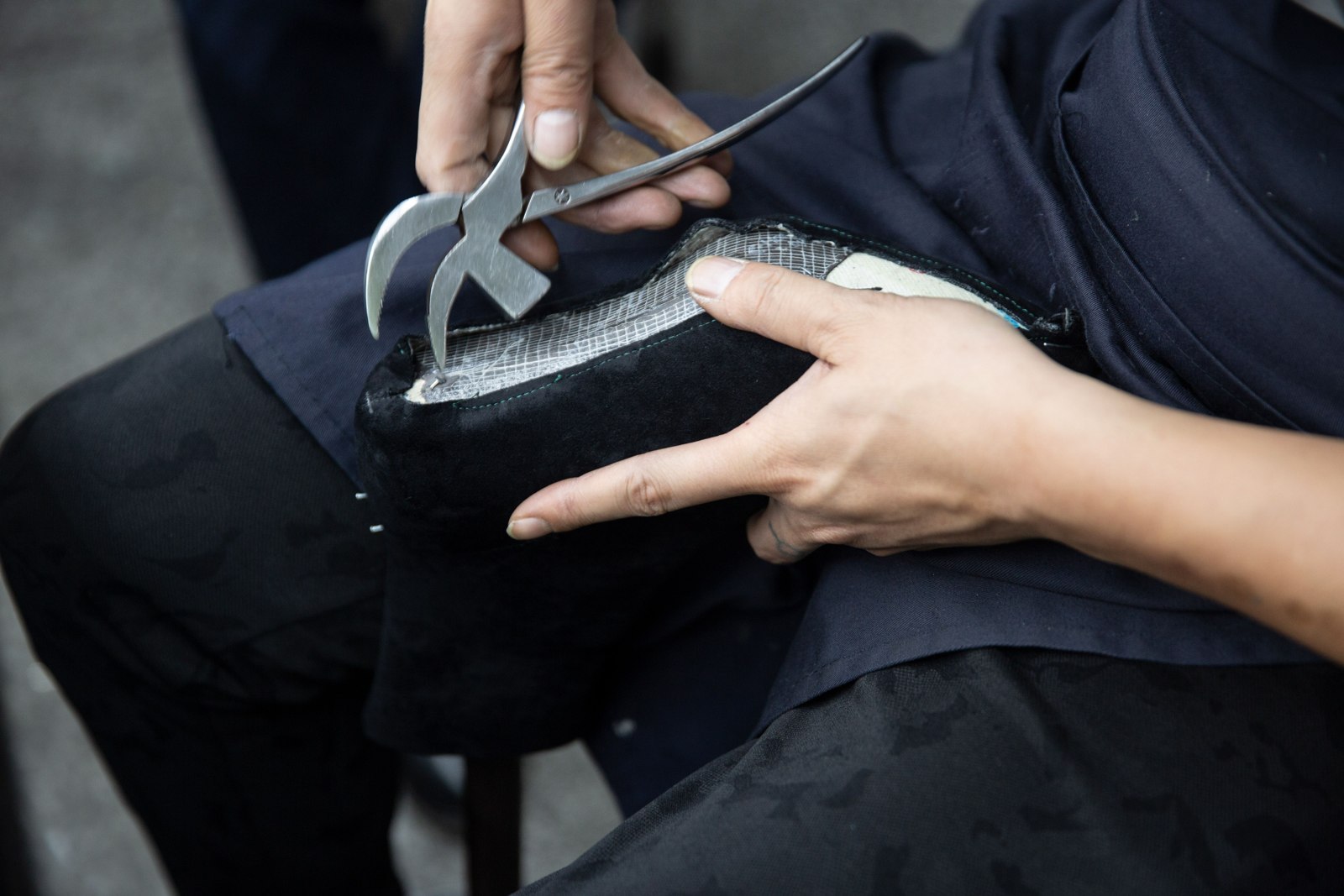
No generic stretch, seam strength, breathability, abrasion or fit threshold is supplied here. Neither the stock textile photograph nor the historical hand-work scene is evidence for a proposed upper's composition, construction or performance. They illustrate why a texture reference and an assembly question need separate records.
Make revision consequences visible
A change can reopen work that a quotation treated as finished. This second original register helps the buyer ask what must be reconsidered; it does not declare that every listed change requires the same test or development route.
| Proposed change | Ask what carries over | Evidence or decision to request | Hold the next commitment when |
|---|---|---|---|
| Material reference changes | Program or pattern assumptions, joining and finishing proposal | Revised input/component record and the technical review scope | Only the colour or surface appearance has been matched |
| Last, proportion or size coverage changes | The actual shape references and represented sizes | Revised development scope and representative submission plan | The display size is treated as blanket acceptance |
| Joining or reinforcement changes | Appearance priorities, completed-upper state and interface responsibilities | Affected-component list and named approval owners | A change is described as equivalent without showing its scope |
| Upper route changes after approval | Which requirements remain fixed and which are redesigned | Separate alternative proposal, revised charges and validation responsibilities | The old approval is reused without identifying what changed |
Keep commercial and technical decisions distinct. A purchasing contact can agree a price consequence without being the appropriate person to approve fit or a material interface. Name both responsibilities rather than leaving a general “approved” message to cover everything.
Preserve the handoff, not an assumption of exclusivity
Before commissioning development, ask what deliverables the parties will exchange: revision-controlled patterns or program identifiers, material references, sample records and agreed instructions for subsequent orders. Confirm permitted use and transfer of working files with the contracting parties and appropriate advisers. Paying for development does not automatically answer every ownership or licence question.
Keep this decision separate from the finished-shoe construction-route comparison. That guide addresses how the upper and bottom are assembled; this one identifies the work needed to develop and hand over the upper. Use the size-set guide for the separate size-approval discussion, subject to the actual product brief.
For a footwear sourcing discussion, share the intended wearer and use, destination, reference style, last/bottom status, sizes, quantities and unresolved upper-development question. ZWC can discuss supplier matching and coordination. Programming access, development capability, material availability, trials, file rights and technical acceptance require project-specific confirmation; no cheapest-route or performance promise is made.
AI assisted research organization and drafting, not photography. Hero: Engin Akyurt / Pexels. Supporting image: Bella Zhong / Pexels, a historical photograph also used in our older footwear-cluster guide. Both Pexels License, full-frame resized/compressed only. Illustrative textile and hand-work contexts—not identified upper materials, a proposed production route, product tests, ZWC projects or endorsement. Matrices are original buyer questions, not certified results or technical approval.