

Quick answer
Before paying a premium for recycled-fiber apparel, connect the proposed claim to an identified garment component, material supply and order allocation. Verify certification scope separately from transaction evidence, then have the responsible parties confirm the permitted wording. A supplier's certificate, a swatch or a composition report alone does not close all three questions. Keep unsupported product claims on hold rather than printing them while documents are still being resolved.
A certified supplier is not the same decision as a certified order
The quotation says “recycled polyester.” A certificate arrives with the company introduction, and the brand starts designing a hangtag. Yet the purchase order has not identified which fabric will be used or how its supporting records reach the finished garments. The documentation has moved faster than the buying decision.
For an overseas apparel brand, the useful question is not whether the supplier can email a certificate. It is whether the proposed evidence supports the claim for this purchase. This guide provides an original order-to-claim worksheet, not a certification assessment, environmental-impact comparison or ZWC customer case.
Textile Exchange's chain-of-custody explanation distinguishes scope certificates, concerning a company's qualification, from transaction certificates, concerning specific certified products. That distinction is the starting point—not permission to attach a logo to any order from the company.
Define exactly what the claim describes
Write the intended statement before asking suppliers to price it. Identify the garment style, material code, component and proposed claim basis. A shell fabric, lining and sewing thread are different inputs. Evidence about one cannot silently become a statement about the whole garment.
Ask what any percentage refers to and how that basis is documented. A recycled share within a supplied yarn is not automatically the recycled share of the finished garment. Do not convert the figure without the necessary composition, component and calculation basis. Confirm the applicable claim rules with the responsible certification and market-compliance parties.
Also separate recycled content from recyclability, biodegradability and reduced environmental impact. This article establishes none of those outcomes. Avoid turning a material-origin statement into a broad “sustainable garment” promise. Textile Exchange's RCS and GRS overview describes different certification scopes; the names are not interchangeable purchasing specifications.
Build an order-to-claim register before releasing artwork
Use one row for each proposed statement and the goods it covers. Keep document identifiers and reviewed versions, not just an attachment folder called “certificates.” The fields below are proposed buyer controls, not a substitute for a scheme's required records.
| Register entry | Connect it to the actual purchase | Stop condition |
|---|---|---|
| Claim and component | Exact draft wording, style revision, shell/lining/other component and percentage basis | Wording describes more than the identified component |
| Supplied material | Yarn or fabric code, composition, supplier, lot and relevant purchase reference | Catalogue name substitutes for material identity |
| Certification scope | Actual holder, site, standard, covered activity/product scope, status and relevant dates | Seller or producing route does not match; scope unresolved |
| Transaction evidence | Issuer, certificate identifier, parties, product description and shipment/quantity references | Document is authentic but cannot be connected to this supply |
| Production allocation | Incoming reference linked to the style, quantities and affected cutting/production records | Unidentified replacement or mixed stock enters the order |
| Claim release | Approved wording/artwork revision, covered goods, responsible reviewer and decision date | Artwork or sales copy exceeds the accepted evidence |
Assign an owner to every open entry. A supplier may gather material records, while the brand retains control of its product page. Naming that split is more useful than asking one salesperson to “guarantee everything.” Keep sensitive commercial documents in an agreed controlled channel, not public comments.
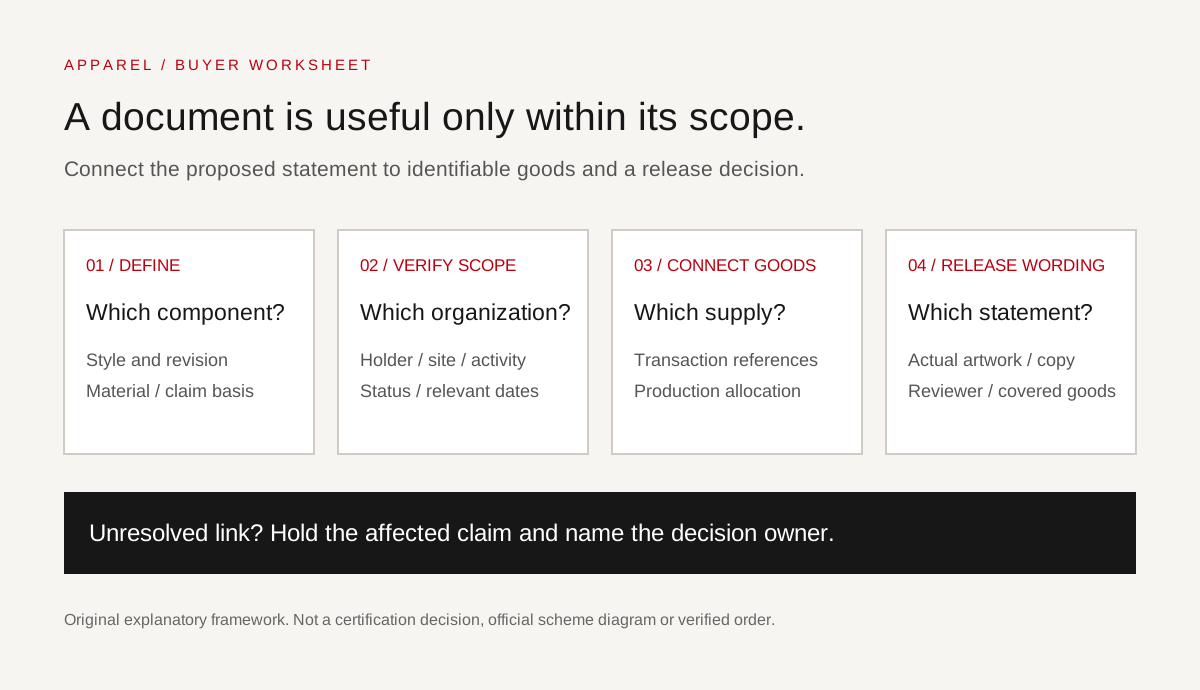
Verify scope and transactions through their proper channels
Start with the named organization and relevant scope, not a familiar logo in a PDF. Textile Exchange's certified-company search is based on scope-certificate data from active certification bodies. Its guidance directs discrepancies to the relevant body. A matching entry is useful evidence about that entry; it does not identify which stock was allocated to your order.
Then check the transaction document. The official authentication guidance asks users to compare returned information and raise missing or mismatched records with their certification body. Authentication and order matching remain separate checks: a genuine document for another product or delivery does not resolve your purchase.
Before committing to the programme, agree who obtains the relevant documents, what they will cover, when they can be issued and what happens if they remain unresolved. Do not demand a final shipment document as if it already existed before shipment. Instead, define the earlier sourcing decision and the later document/claim release as separate gates, with consequences agreed in writing.
Preserve the link when material or production changes
Consider a hypothetical order where the approved fabric is unavailable and a similar replacement is proposed. The question is not only whether the new fabric looks acceptable. Reopen its identity, source, documentation route and effect on the proposed claim before allocating it to the affected garments.
Record which quantities used the original material, which remain uncut and which would use the alternative. Do not let one unchanged style number conceal different evidence coverage. If the route changes, identify the relevant processor and ask the responsible certification party what that change means; this guide does not decide certification eligibility.
Our fabric roll-to-bundle guide addresses physical allocation through cutting and recutting. The apparel production-route guide identifies who performs each operation. Connect those records to this claim register. Neither a shade decision nor a factory route map becomes recycled-content verification simply because it is traceable.

Treat claim approval as its own release
Textile Exchange's claims guidance covers product-related statements both on labels and off-product, including ecommerce descriptions. It describes certification-body approval rather than approval by Textile Exchange itself. Resolve the applicable policy and exact artwork with the responsible body; do not copy a supplier's tag or assume a website sentence is exempt.
Use the following disposition table to keep purchasing and marketing decisions explicit. It is not a legal approval checklist.
| What is unresolved? | Buyer-side disposition | What must close the gap? |
|---|---|---|
| Supplier scope only; order route undefined | Keep the claim conditional during sourcing | Identified material/route and agreed evidence plan |
| Transaction details conflict with the order | Hold the affected claim and investigate | Issuer clarification plus reconciled supply references |
| Replacement material lacks matching coverage | Separate the affected allocation; reopen review | Verified alternative and written disposition |
| Records accepted but artwork changed | Do not reuse an earlier artwork approval blindly | Review of the actual new wording and layout |
| Evidence remains incomplete at the decision gate | Escalate before proceeding | Authorized outcome; no invented certificate or quiet relabeling |
Removing a logo is not automatically a complete solution. Plain-text claims and existing commercial promises also need review. Agree whether the project should wait, change scope or stop; do not describe undocumented goods as equivalent to the originally requested programme.
Compare the premium against a deliverable, not a badge
Ask each offer to separate material identity, proposed certified scope, document responsibilities, claim-review work and exclusions. Request actual costs and timing rather than assuming a universal certification surcharge. A cheaper quote that omits the required evidence is a different offer, not demonstrated savings.
Keep garment suitability separate too. Recycled-content documentation does not answer the order's shrinkage, pilling, appearance or fit questions. Set those requirements through the normal apparel specification process, using the actual material and finish. No performance or environmental advantage is inferred here.
For a China apparel sourcing discussion, share the garment reference, destination, material/component direction, quantities, proposed claim and current documentation gap. ZWC can discuss supplier coordination and follow-up. Certified sourcing availability, certification services, technical acceptance and market-specific claim review require separate confirmation; this article does not claim that ZWC or a nominated supplier holds certification.
Primary sources
- Textile Exchange: Chain of custody, RCS/GRS overview, certified-company search, transaction authentication and claims guidance. Public guidance checked 21 October 2026; underlying full standards and individual certificates not audited. Policy transitions make project-specific confirmation important; no numerical eligibility threshold or universal legal conclusion is supplied.
AI assisted with organizing text, not creating the photographs. Hero: syamhari syamhari / Pexels; garment display: Ron Lach / Pexels, under the Pexels License, resized/compressed. Illustrative stock, not ZWC products, suppliers, recycled material or certification evidence. No endorsement implied. The original vector is explanatory, not a scheme approval.