
Quick answer
Compare circuit-breaker offers only against the same engineer-approved application record and identified configuration. Ask suppliers to map their model, rating evidence, accessories and exclusions to that record. Procurement can organize the comparison; qualified electrical professionals must determine system requirements, product suitability and acceptance. This guide does not select a breaker, set protection values or authorize installation or operation.
Start with the decision that procurement can actually own
The purchasing question is not which amperage looks sufficient. It is whether suppliers have priced the same defined requirement, and whether the responsible technical reviewer can assess their differences without reconstructing the enquiry from email fragments.
Name the destination, intended equipment or installation, project reference and technical decision owner. State whether the enquiry concerns a standalone device, a specified assembly interface or an authorized replacement proposal. A photograph or an old purchase description is a reference, not a complete replacement specification.
If the application record is incomplete, request budget information explicitly subject to unresolved inputs. Keep that reply separate from a technically accepted offer. A supplier's willingness to quote does not establish that the missing design work has been completed.
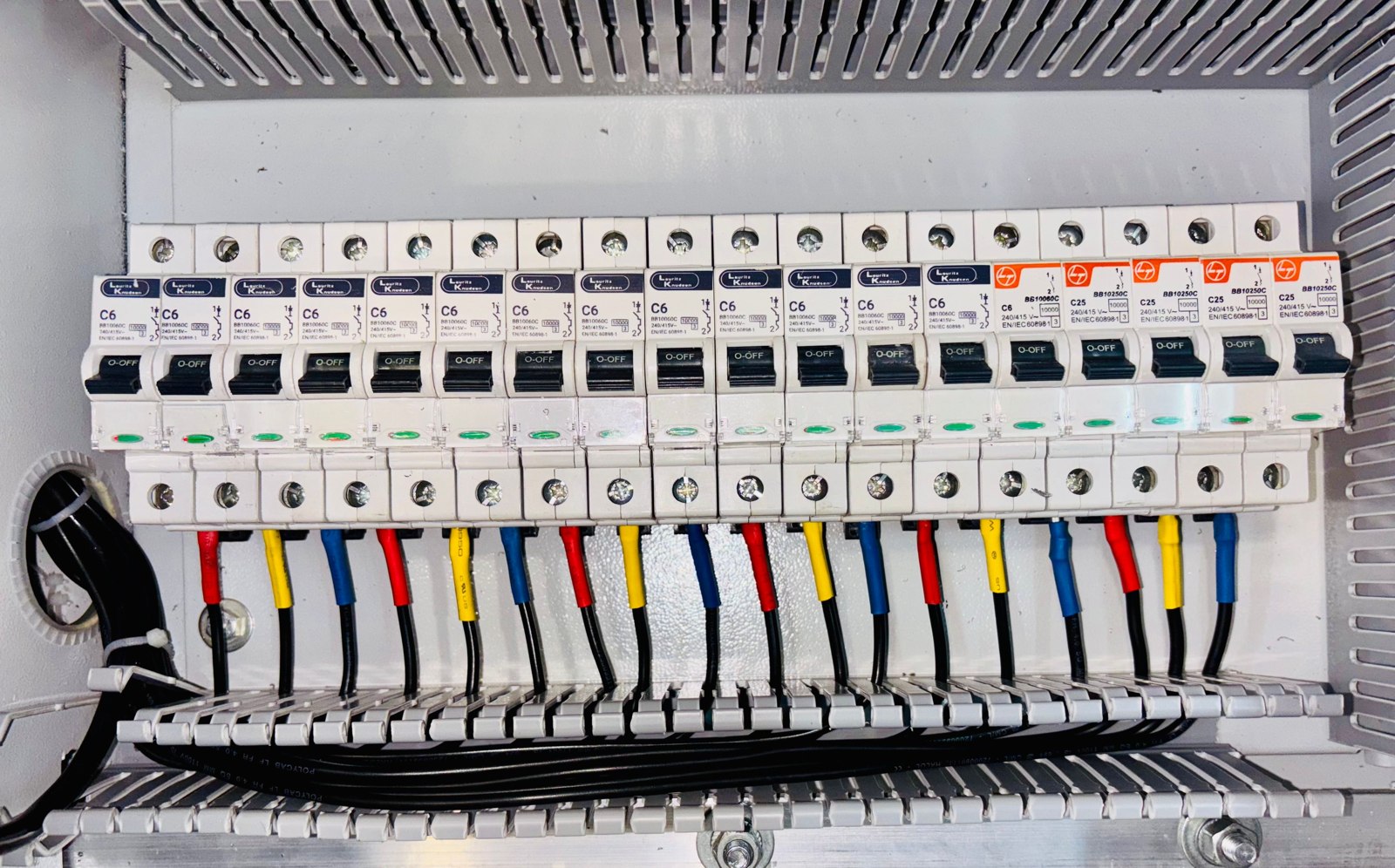
The opening stock photograph illustrates visible device labels and an enclosure context. It does not establish the photographed equipment's suitability, approval, condition or isolation state. Do not open equipment or obtain readings for this worksheet; use records supplied through the project's authorized technical process.
A standard number needs its scope and edition
IEC's public catalogue distinguishes IEC 60898-1:2015+AMD1:2019, for a.c. overcurrent circuit-breakers in household and similar installations, from IEC 60947-2:2024, whose stated scope includes circuit-breakers intended for installation and operation by instructed or skilled persons. These are scope descriptions, not a rule for choosing between products from their appearance.
The latter catalogue identifies edition 6.0 and says it replaces the 2016 edition and its 2019 amendment. The former is a consolidated edition incorporating an amendment. Therefore, recording only “IEC compliant” loses information that a reviewer may need.
Ask the responsible professional to identify the requirements applicable to the actual product, use and destination, including any relevant national adoption or conformity route. Do not assume that the newest catalogue edition is automatically the legally required edition everywhere, or that two standard references are interchangeable approvals.
Only the public descriptions were reviewed here. They are not the full purchased standards, a test procedure, a certification search or a technical assessment of an offered product.
Build one application-to-offer worksheet
Use the following as an original procurement intake sheet. Values come from approved project documents and identified manufacturer evidence, not from this article. Keep the original terminology alongside any translation.
| Record group | Buyer-controlled input to obtain | Supplier reply to connect | Clarification needed when |
|---|---|---|---|
| Application and authority | Destination, use, project reference, responsible technical owner | Intended-use statement and explicit exclusions | A catalogue family replaces the actual application |
| System conditions | Approved electrical-system description and specification revision | Exact declared operating conditions and referenced data pages | AC/DC, voltage or other stated conditions differ or are omitted |
| Protective requirements | Reviewer-approved current, fault-duty and protection requirements | Exact model, release/trip-unit version and relevant rating evidence | A single headline rating stands in for the required evidence |
| Physical interface | Approved assembly, mounting, connection and space requirements | Dimensions, terminals, orientation and included interface parts | Fit is inferred from a photograph or family name |
| Options and scope | Required accessories, quantities and supply boundary | Complete reference codes, included items and exclusions | A necessary item is an unpriced option |
| Applicable evidence | Reviewer-defined standards, editions and assessment route | Product-specific supporting references and limitations | A company certificate is offered as product coverage |
A blank cell is an open question, not permission for procurement to choose a value. Identify who will supply the input and which decision must wait. Restrict sensitive project information to an agreed channel; the public enquiry need not contain confidential drawings or an entire plant diagram.
Keep rating labels attached to their conditions
Schneider Electric's manufacturer FAQ distinguishes Icu, the rated ultimate short-circuit breaking capacity, from Ics, the rated service short-circuit breaking capacity, and directs readers to the respective product catalogue. Use that distinction to ask a better question, not to derive a universal selection rule or a required percentage.
Request the complete applicable rating table and exact product reference. Ask the qualified reviewer which conditions and evidence must be compared. Do not detach a capacity value from its stated operating conditions, transfer a value between product variants, or convert an unexplained label into an accepted project requirement.
The FAQ originated in 2016 and was modified in September 2026. Its examples and older attachments are not treated here as current universal classification rules or as the full 2024 standard. No calculation, recommended threshold or field setting is provided.

Ask for a declared alternative, not an invisible substitution
An alternative may change the device family, release, accessory package or assembly interface. Ask the supplier to price it on a separate line and explain the differences against the same application-record revision.
| Difference in the reply | Procurement action | Review owner and pause point |
|---|---|---|
| Proposed model or suffix differs | Preserve both references and request a difference statement | Technical reviewer assesses relevance before equivalence is accepted |
| Rating evidence uses another condition or edition | Link the original data and identify the mismatch | Qualified reviewer resolves applicability; price alone cannot close it |
| Accessories or connection parts are excluded | Obtain an itemized complete-scope offer | Technical owner confirms the required configuration before commercial comparison |
| Replacement is said to be physically compatible | Request identified interface evidence through the authorized process | Responsible equipment professional assesses the replacement; no trial installation as a check |
| Evidence will arrive after order placement | Identify the missing deliverable and proposed commitment boundary | Buyer and reviewer decide what remains on hold; no assumed approval |
These are administrative hold points, not operating instructions. “Ready for technical review” must not be shortened to “approved.” Record the reviewer, accepted scope, exclusions and document revision when a real assessment occurs; do not invent a signature to complete the worksheet.
Compare commercial scope after the differences are visible
Keep device quantity, accessory quantity, documentation, agreed inspection scope, packaging, delivery basis and validity on the comparison. Separate optional work and unresolved assumptions from the base offer. A lower price on a narrower package is not yet a saving on the original requirement.
Avoid creating an apparent technical ranking by adding a few rating columns together. A commercial score cannot compensate for an unresolved application, incompatible interface or unaccepted evidence scope. Actual selection and any protection-coordination study remain with qualified professionals.
Once the configuration is accepted through the project's real process, carry its reference into the order and change record. Our electrical document-to-order guide addresses that later traceability task. The present worksheet addresses the earlier question: what exactly are the offers being compared against?
For a sourcing discussion, provide the product family, destination, indicative quantity, approved specification reference and the specific supplier-clarification gap. ZWC's current sourcing categories and supplier-mapping approach define the starting scope for coordination. Engineering design, certification, installation and product approval are not promised by this article.
AI assisted research organisation and drafting, not photography. Hero: ranjeet . / Pexels; document context: Vanessa Garcia / Pexels, credited above. Both Pexels License, full-frame resized/compressed. Historical illustrations, not ZWC equipment, personnel, suppliers or projects. Visible brands, labels and positions do not establish an endorsed product, verified specification, conformity, safety or isolation state. No endorsement implied. Two original worksheets are procurement questions, not an engineered design or actual technical approval.