
Quick answer
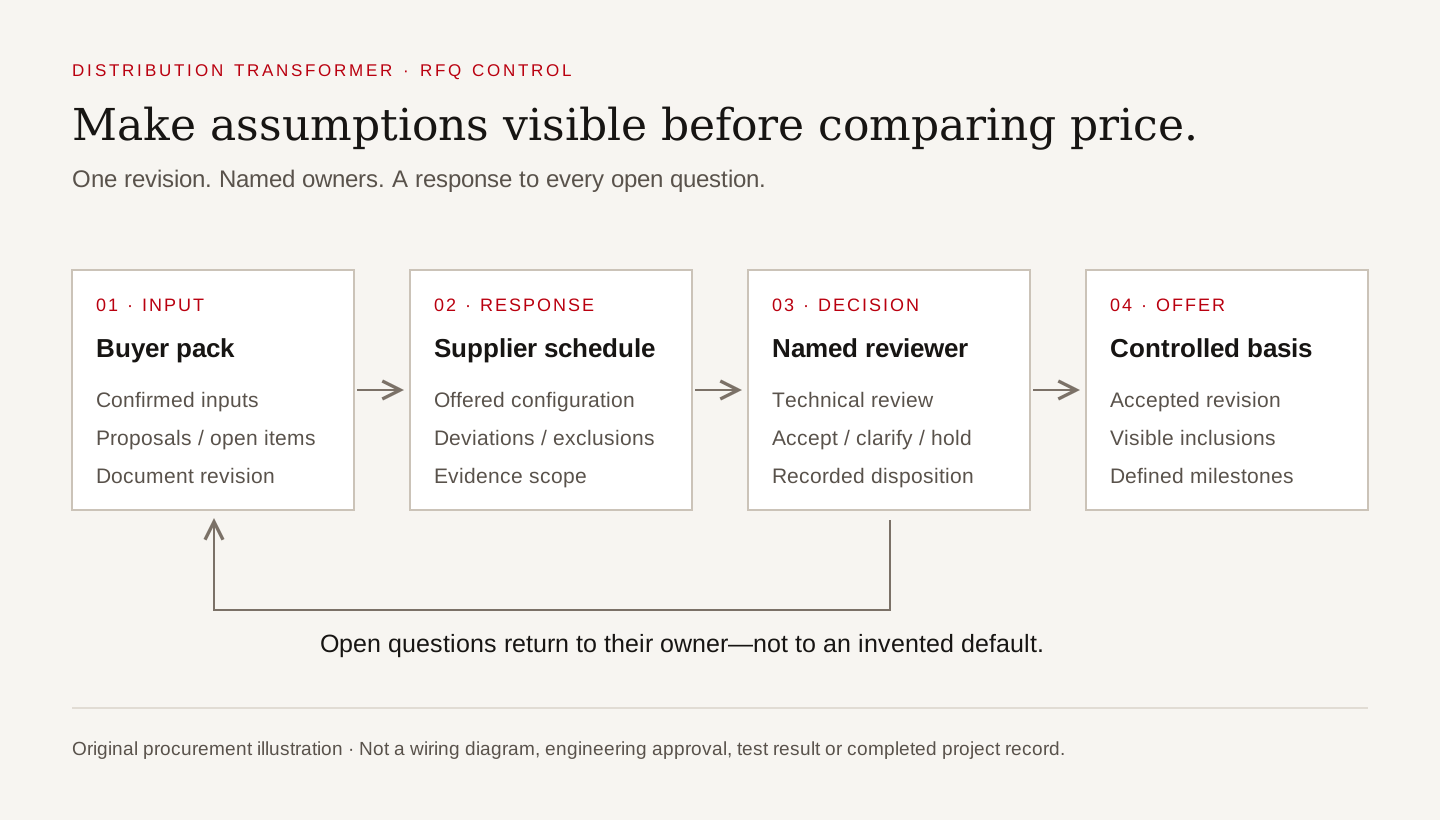
Send suppliers one controlled RFQ pack with an engineer-approved application and rating schedule, installation interfaces, destination requirements, document deliverables and commercial scope. Mark each input as confirmed, proposed or unresolved, with a named owner. Require a separate deviation schedule rather than accepting a general statement of compliance. Compare prices only after the responsible technical parties have resolved differences that could change the equipment or its acceptance.
The same kVA label is not the same buying specification
A low quotation can look attractive because the supplier has filled an empty field differently from the other bidders. A capacity label does not settle the voltage arrangement, installation form, site conditions, accessories or evidence the buyer expects. If those assumptions remain invisible, a price comparison can reward a different product rather than a better offer.
This guide helps procurement teams organize a distribution-transformer enquiry. It does not select a transformer, calculate a rating or authorize an electrical installation. A qualified project engineer and, where applicable, the utility or other approving authority must define and accept the technical basis. Keep large power transformers, control transformers and other specialist applications outside this enquiry unless the responsible engineer explicitly includes them.
The question for purchasing is: are all suppliers responding to the same approved requirement, and can every departure be found before an order is placed?
Name the equipment family before copying a data sheet
Start with the intended function, destination and proposed equipment form. State whether the enquiry concerns a liquid-filled or dry-type distribution transformer and the installation arrangement under review. Do not let a photograph decide these inputs.
Eaton's general-purpose ventilated dry-type product page lists multiple voltage combinations and options for frequency, enclosure and temperature rise. Its December 2024 line card also distinguishes several application families. These are examples of why a family name alone is incomplete—not specifications to copy into a different manufacturer's offer or proof of destination compliance.
An old nameplate or drawing may help identify a replacement enquiry, but it should be labeled as existing-equipment information. Ask the project engineer to decide which requirements remain applicable. Do not treat a similar-looking catalogue model as an approved replacement.
Build a document index that exposes unknowns
Give the RFQ pack an issue date and revision. List the data schedule, drawings, applicable project specifications, supplier response form and commercial instructions. Identify the document that governs if two inputs disagree, with the precedence accepted by the responsible parties.
For each unresolved field, name the person who will supply or approve it and the decision it blocks. “Supplier to propose” is a valid status when alternatives are wanted; it is not the same as buyer approval. “Not applicable” should be a reasoned response, not a substitute for missing information.
For sensitive site documents, share only what is necessary through an agreed channel. Do not place network drawings, access credentials or confidential infrastructure information in a public enquiry or comment thread.
| RFQ section | Information to obtain from the responsible owner | Required supplier response |
|---|---|---|
| Application and electrical basis | Engineer-approved duty, rated power, phase, frequency, primary/secondary arrangement and required connection details | Identify the offered configuration and flag every departure; do not silently select missing values |
| Service conditions and construction | Approved indoor/outdoor use, site environment and required liquid-filled or dry-type arrangement | Confirm the proposed construction and any restrictions against the stated conditions |
| Physical and connection interfaces | Controlled layout, mounting, terminal/cable interface, access and transport constraints | Submit the proposed outline, interface details, mass and delivery configuration for review |
| Performance and applicable requirements | Project-approved loss, impedance, temperature, sound and insulation requirements where relevant; named standards/editions and destination approvals | State the offered or guaranteed values, assessment basis and relevant supporting documents |
| Accessories and supply boundary | Agreed included items, monitoring/protection interfaces, spares, documents and excluded site work | Itemize inclusions, options, exclusions and responsibility boundaries |
| Verification and document delivery | Required drawing reviews, manufacturing evidence, test scope, witness/hold points and report language | List documents, timing, traceability and any additional test or attendance charges |
| Commercial and schedule basis | Quantity by variant, delivery destination/term, currency, validity and required milestones | Quote the identified revision, lead-time trigger, packing, shipping basis and payment assumptions |
The table is a procurement organizer, not a completed engineering specification. Not every listed attribute applies to every transformer. The project engineer must decide the required fields and values.
Put deviations where the buyer can find them
Require the supplier to return the completed schedule and a separate list of deviations, exclusions and proposed alternatives. Each item should identify the affected requirement, proposed difference, commercial effect and requested decision. A broad “complies with IEC” or a certificate bearing a company name cannot close a model-specific technical question.
There is a useful historical example in Energicity's RFQ dated 9 May 2025. Its specification expressly identifies an outdoor liquid-filled application, excludes dry-type transformers from that scope and requires departures to be disclosed at bidding. That is evidence of one buyer's structured enquiry—not a live tender, a universal standard or a source of ratings for your project.
Route technical deviations to the qualified reviewer, not to the person negotiating the lowest price. Record accepted changes in a revised common basis or an explicitly approved supplier-specific schedule. Keep the approval connected to the final quotation; an accepted email attachment can otherwise disappear from the order record.
Separate budgetary information from an order-ready offer
You can seek an indicative budget while some inputs remain open, provided the supplier's assumptions and the estimate's limitations are visible. Label that response accordingly. Do not turn it into an order-ready quotation by deleting the word “indicative.”
| Situation | Procurement treatment | Evidence needed before the next commitment |
|---|---|---|
| Electrical basis is incomplete | Request clarification or a clearly bounded budgetary response | Engineer-approved schedule or an expressly limited evaluation scope |
| An offered interface differs from the site drawing | Keep the offer outside like-for-like comparison until reviewed | Accepted interface drawing and a documented responsibility for any change |
| A proposed document does not identify the offered model or configuration | Request a traceable document rather than infer coverage | Evidence tied to the actual equipment and required acceptance scope |
| Price excludes tests, accessories or delivery items | Show the exclusions separately; do not assume they are included | Priced scope and named responsibility for each unresolved item |
| Lead time starts after an unspecified approval | Clarify the trigger and dependencies before comparing schedules | Agreed submission/review milestones and a defined manufacturing-release basis |
Some gaps require a revised offer; others require stopping the enquiry until engineering information exists. The procurement team should not invent a value to keep the comparison moving.
Agree the evidence sequence before manufacturing release
Separate quotation review, drawing acceptance, manufacturing release, inspection/testing and shipment authorization. Assign the actual decision-maker at each point. Payment milestones should refer to agreed deliverables rather than an undefined promise that everything will be tested later.
Have qualified technical parties define the applicable test plan, acceptance criteria and witness requirements. Specify how the reports identify the supplied configuration and units, what happens after a failed or inconclusive assessment, and which changes require resubmission. A brochure or an unrelated test report is not evidence that the equipment being ordered has passed its required checks.
The precise standards, approvals, import conditions and installation requirements depend on the destination and application and must be checked for the real project. This article establishes none of them. It provides no energized-work instructions, connection procedure, protection setting or engineering sign-off.
Start a China-side search with the unresolved decision
For an electrical supplier-search discussion, share the application, destination, engineer-approved specification status, quantity, project stage and approval authority. State whether the immediate need is a supplier search, a document comparison or clarification of a proposed manufacturing scope. Confirm category and supplier fit before making any commercial commitment.
See ZWC's electrical sourcing category, manufacturer-scope checklist and supplier mapping approach. Contact ZWC to discuss an enquiry scope. ZWC's sourcing discussion is not a claim to utility approval, transformer design capability, laboratory certification, installation services or guaranteed availability. Those responsibilities and the specific product scope require separate confirmation.
Primary sources
- Eaton: General purpose ventilated transformers — undated manufacturer's family/options page; checked 16 October 2026. Only evidence that configuration choices exist, not an offer, universal requirement or ZWC relationship.
- Eaton: Dry-type distribution transformers line card — publication PA00912002EN, December 2024; checked 16 October 2026. Historical product-family context, not current regulatory confirmation.
- Energicity: Request for quote for distribution transformers — dated 9 May 2025, historical project-specific RFQ; scope/deviation sections checked 16 October 2026. Not a current procurement opportunity, transferable specification or endorsement.
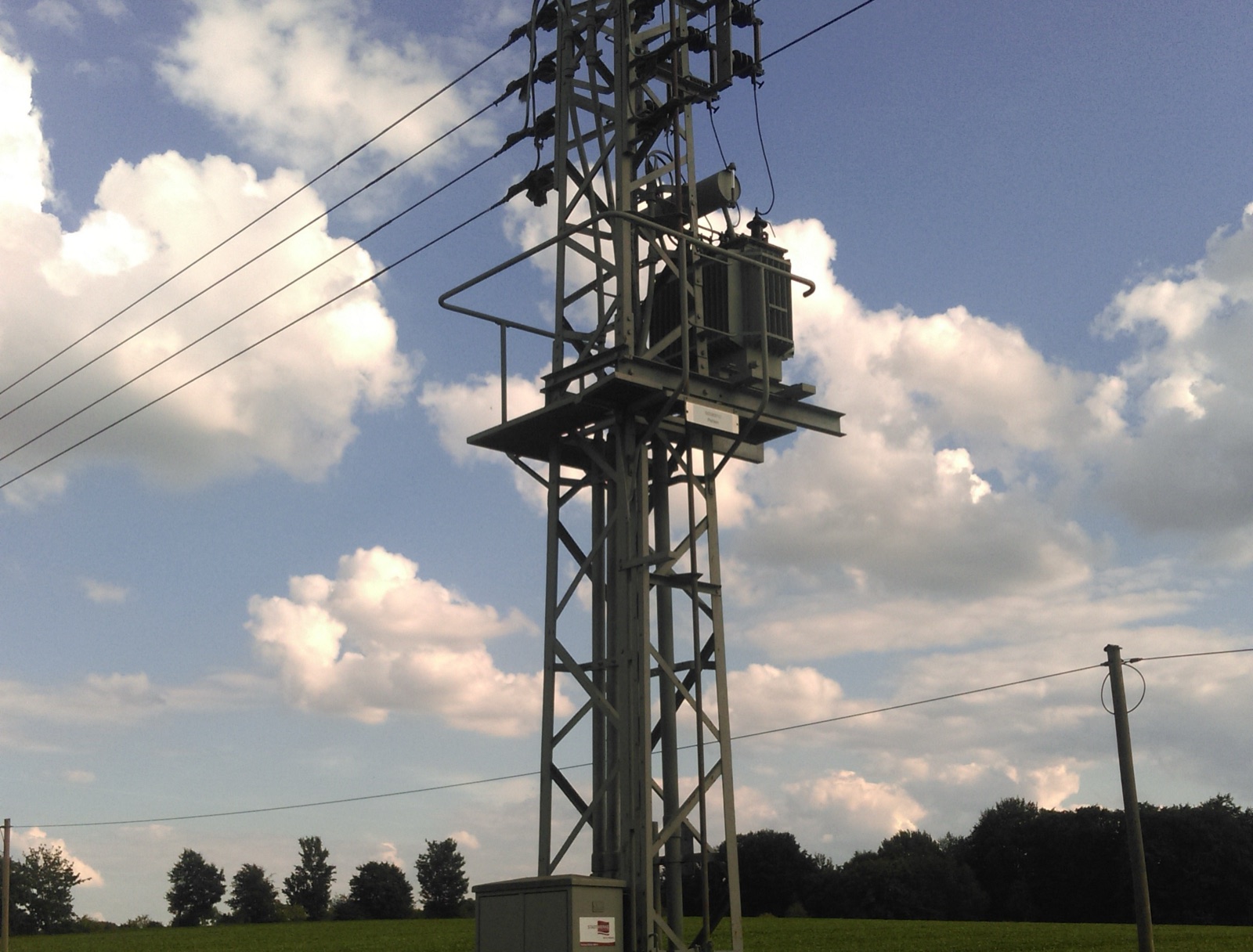
AI assisted with organizing text, not photography. Hero: Pole mounted transformer.jpg by HighVoltage 5576, photographed 4 August 2020, CC BY-SA 4.0. Changes: landscape crop, proportional resize and JPEG compression; no AI retouching. The adapted photograph remains available under CC BY-SA 4.0 and is excepted from the site's general all-rights-reserved notice. It is historical installation context, not ZWC equipment, supplier evidence, a technical approval or an endorsement. The second visual is a separate original explanatory vector, not an electrical schematic or generated factory photograph.