
Quick answer
Use Yueqing and Liushi as starting points for an electrical supplier search, not as proof that a seller manufactures every catalogue item. Before arranging a visit, map each proposed product family to its named manufacturer, production site, in-house operations and purchased or outsourced stages. Then check the evidence at the relevant site. Regional background helps locate leads; it does not establish product conformity, order capacity or responsibility for changes.
One catalogue can hide several supply routes
A buyer requesting breakers, contactors, enclosures and connection hardware may receive a convenient single catalogue. The unresolved question is not how many pages it contains. It is whether the proposed order comes from one production system or several manufacturers whose responsibilities have not been explained.
A supplier that openly consolidates products can be a useful commercial partner. A company claiming to make everything requires a different verification scope. Treating these two arrangements as equivalent makes a factory visit less useful: you may inspect the seller's strongest line while leaving the other quoted families unexamined.
This guide is for overseas distributors and project procurement teams building a shortlist for selected industrial electrical products. It concerns manufacturing scope and supplier mapping, not electrical design. Product selection, system compatibility, safety requirements and technical acceptance belong with the responsible qualified professionals.
What the Yueqing industry background actually supports
Government-hosted Wenzhou company profiles provide a documented starting point. A January 2022 profile places CHINT in Beibaixiang, Yueqing, and describes electrical distribution and control activities. An August 2021 profile places Delixi Electric in Liushi, Yueqing, and describes low-voltage electrical production. These are dated regional references, not current verification of either company or an endorsement of another seller using the same town name. CHINT profile, Delixi profile.
The useful inference is limited: Yueqing contains identifiable electrical manufacturing activity worth researching. The profiles do not establish a 2026 market share, the cheapest source, current stock, available export capacity or the quality of every local factory. Nor do they establish a ZWC relationship with the named companies.
Build a search around the product family and required supply role, then use geography to organize contact and visits. A regional label should narrow the search area; it should never replace the questions asked of the individual supplier.
Make a product-family scope ledger before the visit
Ask the seller to complete one row for each proposed family. Do not accept one company-wide answer for the entire catalogue. Begin with the actual quotation references so that the answers cannot drift toward unrelated display products.
| Ledger field | What to record | What remains unresolved without it |
|---|---|---|
| Quoted family and reference | Product family, proposed model or drawing reference, and quotation revision | Which catalogue items the reply covers |
| Seller's role | Manufacturer, assembler, distributor or consolidator for this family | Whether a manufacturing claim is being made |
| Actual manufacturer and site | Named producing entity and address of the relevant operation | Whether the visit reaches the proposed supply source |
| In-house scope | Operations performed at that site, with the relevant product references | Whether the visible line belongs to this family |
| Purchased and outsourced scope | Bought-in items, external stages and who controls their approval | Where dependencies and substitutions enter |
| Release and change responsibility | Who confirms the final specification, records changes and answers for nonconformity | Who can resolve a discrepancy after the seller takes the order |
The ledger is a proposed buyer working document, not a mandatory regulatory form. Keep it short enough for the supplier to answer, but specific enough to expose a mixed route. An unanswered cell is an open qualification question, not automatically evidence of fraud.
If the supplier cannot disclose a subcontractor immediately, ask what can be verified under an agreed confidentiality arrangement. Decide whether that evidence is sufficient before spending on a visit or treating the route as approved. Do not invent the missing manufacturer from a photograph, package label or nearby address.
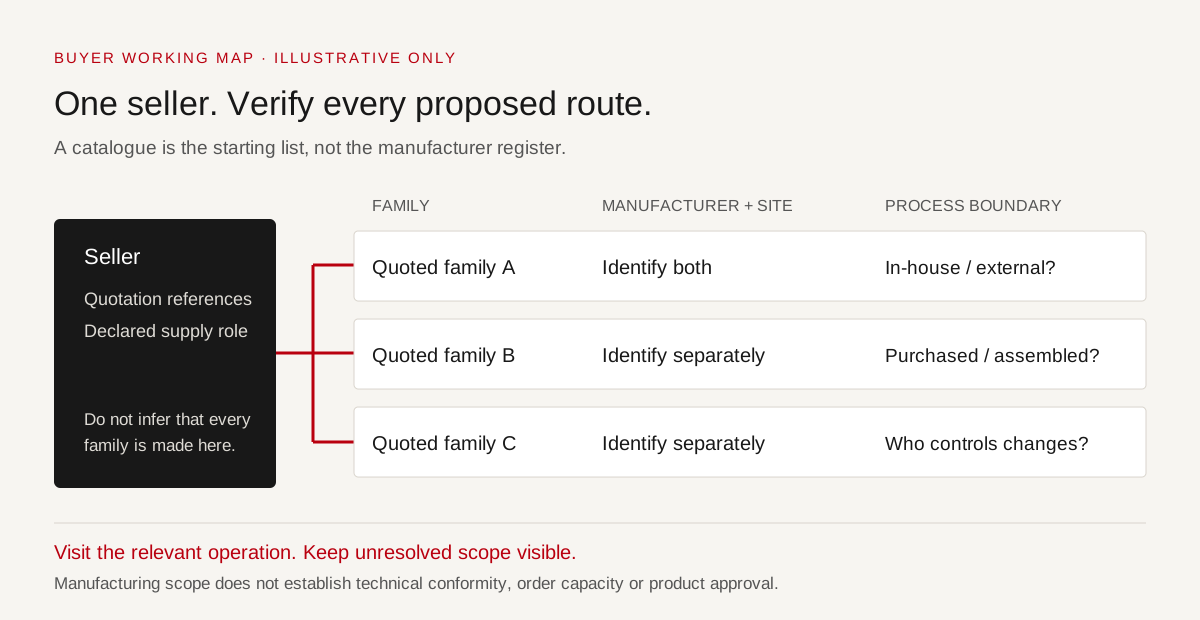
Trace the proposed route, not the showroom
A factory tour should answer the ledger's gaps. For a family described as made in-house, ask to see the relevant operations and how the site identifies its work. A line producing another family is evidence about that other line, even if its machines look impressive.
For an assembled product, clarify which items arrive finished and which operations remain at the assembly site. A workshop assembling purchased parts should not be described as manufacturing every constituent part. That distinction does not make the route unacceptable; it changes the dependencies that need to be controlled.
For a consolidator, focus on how sources are identified, incoming discrepancies are handled and approved references survive repacking. A branded carton or a sample on a shelf does not by itself show who made the contents or authorize the seller to represent the brand. Confirm the relevant commercial authorization independently where required.
Request permission before taking photographs. Use an agreed shot list that connects a visible operation to the product family and site, rather than collecting publicity images. Do not photograph customer documents, account details or unrelated proprietary processes. Site staff must control access and safety; a procurement visitor should not open equipment or request live demonstrations.
Choose the visit that closes the largest evidence gap
| Supplier reply | Useful next verification | Hold point |
|---|---|---|
| All quoted families are claimed as in-house | Map each family to the site's operations; inspect the relevant scope, not only one showcase line | Do not approve unobserved families from the tour alone |
| Some families are made elsewhere | Identify the external manufacturer, site and approval handoff; agree access or another credible verification route | Do not transfer conclusions from the visited site to the external one |
| The seller is a consolidator | Check source identification, incoming handling, repacking and discrepancy ownership for the quoted families | Do not label consolidation capability as manufacturing capability |
| Scope changes between the quotation and visit | Reconcile the ledger and quotation revision before continuing qualification | Do not silently accept a changed source or process boundary |
The objective is not to collect the largest number of visits. It is to close the question most likely to change your supplier decision. Sometimes the missing evidence is at a second site. Sometimes it is a written explanation of the seller's limited role. A second tour of the same showroom will resolve neither.
Keep scope verification separate from product acceptance
A coherent manufacturer map can explain where a product is proposed to come from. It cannot prove that the particular product meets its destination requirements, that a submitted technical report covers the offered version, or that an order will be produced on time.
Keep those workstreams separate. The responsible technical reviewer should determine applicable requirements and the evidence needed for the actual product and market. Manufacturing-site verification is not a substitute for technical review, order-specific inspection or agreed acceptance conditions. See our factory audit versus product inspection guide for that distinction.
Do not extend a low-voltage component supplier's demonstrated scope to large power transformers, a complete switchgear system or installation work without separate qualification. A related catalogue heading does not make these interchangeable procurement decisions.
Send a shortlist brief with the missing decision attached
Before contacting ZWC, prepare the product family, application, destination market, indicative quantity and drawing or specification approved by your responsible technical team. Include the supplier's proposed role and the specific gap: unknown production site, undisclosed external stage or unclear change responsibility.
ZWC's supplier-mapping approach and current sourcing categories provide the starting scope for a discussion about selected industrial electrical and power hardware. Supplier availability, access, documentation and the work ZWC can undertake require project-specific agreement. This article does not promise engineering design, certification, installation or supply from the companies named in the regional references.
The first useful deliverable is a clearer route: which entity does what, where the evidence must be checked, and what still prevents supplier approval. That is a better basis for comparing the next quotation than the breadth of a catalogue alone.
Primary sources
- Wenzhou government-hosted CHINT profile: updated 5 January 2022; historical location and described activity only. Rechecked 12 October 2026.
- Wenzhou government-hosted Delixi Electric profile: updated 23 August 2021; historical location and low-voltage activity only. Rechecked 12 October 2026. Figures, customer names and certification implications are not used.
AI assisted with text and diagram drafting, not photography. Hero photograph by ready made / Pexels, under the Pexels License. It illustrates electrical enclosures, not Yueqing, a ZWC supplier, a verified installation or a recommended product. No rating, compliance or endorsement is inferred from the photograph. The original vector diagram is explanatory and contains no actual supplier or client data.