
Quick answer
Compare EVA sole proposals through the supplied component and its complete manufacturing route, not the polymer label alone. Ask suppliers to identify intermediate parts, every relevant tool, included finishing and the evidence linking trial output to the ordered sizes and assembly interface. Injection and compression can be stages within a proposal, not necessarily mutually exclusive alternatives. A route name does not prove lower cost or acceptable performance.
The missing line between material and delivered component
Two suppliers quote an EVA midsole from the same drawing. One includes a later forming stage; the other lists only an initial moulded component. Their unit prices appear comparable until the buyer asks what actually arrives at the assembly factory.
This is a purchasing scenario, not a ZWC order history. The decision is whether both quotations cover the same finished component and development work. It is narrower than selecting the finished shoe's upper-to-bottom construction or buying a factory's machinery.
Start with a component boundary: drawing revision, left and right, size and width coverage, intended mating surfaces, appearance reference and required delivery condition. Separate a midsole, an outsole and an assembled bottom unit. Do not let the word “sole” hide which parts and operations remain outside the offer.
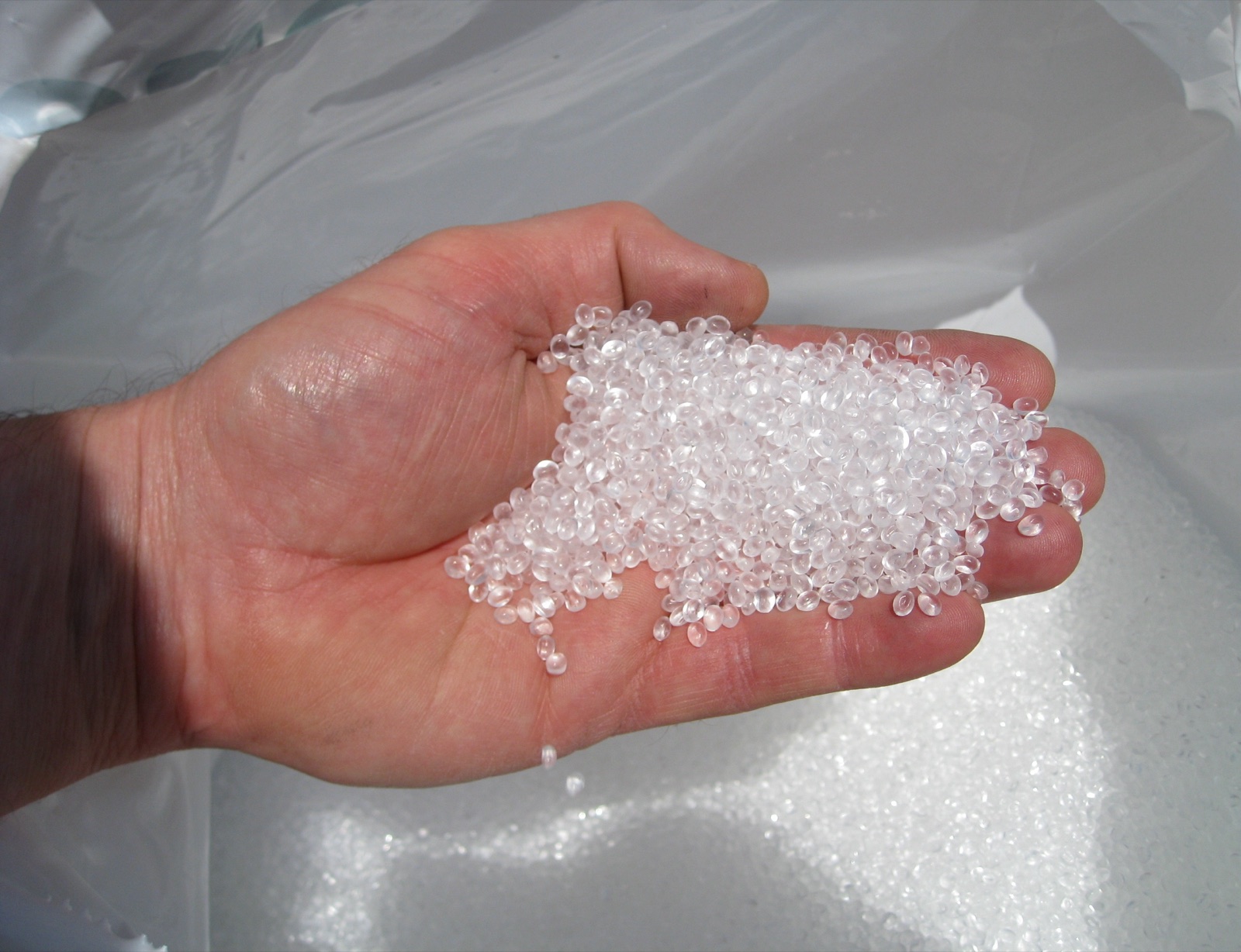
The two photographs separate an input from a finished item. The historical granules photograph is described as EVA by its author, but does not identify an approved footwear compound. The finished flip-flops illustrate a delivery boundary; their material and manufacturing route are not verified. Neither picture connects the depicted goods to a supplier proposal. That connection needs records, not resemblance.
Treat the route as a connected sequence
Tien Kang's EVA injection page identifies a machinery family for EVA footwear components. Its separate hot-and-cold moulding page describes heating and cooling stages. These examples establish that the catalogue separates routes and stages; they do not select a route for your design.
The manufacturer's compression-machine description specifically refers to EVA co-shot components entering a compression mould. That is a useful warning against a simplistic injection-versus-compression price contest: a proposal may connect an intermediate to another forming operation.
Request the actual sequence for the quoted part and name the owner of each handoff. Where the supplier proposes a bought-in intermediate, ask who identifies and accepts it. Where it offers a single-stage route, ask what evidence supports the required delivered condition. Do not assume that every catalogue route can make every geometry or that all suppliers use terminology consistently.
This guide does not reproduce machine settings, formulations or processing instructions. Equipment-marketing statements about productivity, quality or labour savings are not adopted as verified results for a buyer's component.

Make the quotation reveal its dependencies
Use the following as an RFQ worksheet. Complete it separately for each actual proposal against one controlled component brief. A blank field is an unresolved scope question, not a reason to enter a guessed allowance.
| RFQ field | Supplier response to obtain | Comparison stops when |
|---|---|---|
| Delivered item | Component code, drawing revision, sizes, sides and supplied condition | One offer is an intermediate and another a finished part |
| Route and handoffs | Named stages, external stages and responsible companies | A route label replaces the actual sequence |
| Material identity | Proposed compound reference, source and approved revision | “EVA” is the only material description |
| Tools by stage | Each tool code, size coverage, ownership and permitted carry-over | The quote lists one mould but leaves another stage unpriced |
| Finishing and assembly | Included trimming, surface work, joining or other proposed operations | Excluded work moves to the buyer without an owner |
| Trial scope | Intended material, tool revisions, sizes and delivery condition | A catalogue sample substitutes for representative output |
| Commercial scope | Development, tooling, recurring part price, commitments and exclusions | Unlike work is ranked in one unit-price column |
For a multi-part proposal, add a component-to-stage map. It should show which item enters each operation and which identified item leaves it. That makes it possible to ask where responsibility transfers without prescribing how an operator runs the machine.
A mould quotation needs a stage and a size map
Ask the supplier to reconcile the tooling list with its proposed route. If an intermediate and a later forming operation require different tools, identify both. If tools are proposed for reuse, record the actual tool references and the limits of what they can produce. “Existing mould” does not establish availability, ownership, size coverage or compatibility.
Keep development tools, intended production tools and altered tools distinguishable. A presentation sample made through temporary means may support shape discussion while leaving production evidence open. It should not silently become the approved production reference.
Size coverage is also more than the number of finished sizes offered. Request the relationship between the ordered sizes, their component references and the tools used at each stage. Where that relationship changes across the assortment, the responsible technical team should decide what additional evidence is needed. Do not assign a universal sample count or tolerance from another product.
Our tooling-control guide addresses asset records. The size-set guide addresses size-specific approval. This article adds the route-specific connection between those records and the bought sole component.
Separate a changed proposal from a saving
A supplier may suggest another material reference, fewer operations or different tooling. Consider the alternative openly, but keep it outside the unchanged-brief comparison until the consequences are understood. Ask which requirement changes, which components remain valid and who must approve the revised proposal.
Use actual quoted amounts for development and recurring costs. Show any excluded validation, finishing, transport between processors or material commitments where relevant. A lower first quotation is not yet a lower cost for accepted, delivered components. Nor does an additional stage automatically mean an inferior commercial option.
Do not estimate good pairs per hour from machine stations, infer scrap from a marketing photograph, or rank rebound, ageing, density or durability from the route name. Those questions require appropriate evidence for an identified product and material system. This worksheet deliberately supplies no universal performance hierarchy or savings percentage.
Match the trial to the unanswered question
Before authorising the next trial, write down what it must establish and what it cannot establish. The footwear technologist and, where appropriate, qualified laboratory should define methods, conditions, specimen coverage and acceptance decisions. Purchasing staff should ensure the evidence remains connected to the actual proposal.
| Proposed change | Evidence connection to review | Hold condition |
|---|---|---|
| Different forming sequence | Changed stages, material identity, tools and intended supplied condition | Supplier calls the routes equivalent without mapping the differences |
| Different compound or source | Exact revised reference and its relationship to existing evidence | The old material name is retained while the actual reference changes |
| Different size or tool allocation | Size-to-component-to-tool map and relevant approval scope | Evidence covers only the presentation size |
| Added or removed finishing | Actual mating surface, appearance and assembly responsibilities | A visually similar sample bypasses the changed interface |
| External intermediate supplier | Identified incoming component and acceptance owner | Neither party accepts responsibility for the handoff |
A sample's appearance can support an appearance decision. It does not establish production repeatability, assembly suitability or every claimed property. Record limitations and unresolved deviations beside the release decision rather than hiding them in a general “approved” email.
Decide what to request next
Continue when the proposed route and commercial scope are explicit and the next trial addresses a named uncertainty. Request a revised quotation when missing stages or responsibilities prevent comparison. Hold the next commitment when the supplier changes the delivered component, material reference or essential interface without a controlled approval path.
For a sole-sourcing discussion, provide the component drawing or reference, finished-shoe use, market, size allocation, assembly interface and development stage. ZWC can discuss supplier matching and coordination; actual manufacturing capability, trials and acceptance responsibilities need project-specific confirmation.
AI assisted research organisation and drafting. The tables are original purchasing worksheets, not operating instructions, laboratory results, machine recommendations or a ZWC project case. Engineering decisions and product acceptance remain with the responsible qualified people.
AI assisted research organisation and drafting, not photography. Hero: EVA granule / Cjp24, May 2009, CC BY-SA 3.0; resized/compressed derivative remains under that licence. Supporting: Flip flops - just pick one up / Jairo, April 2008, CC BY 2.0, resized/compressed. Independent historical illustrations, not ZWC projects, an approved compound, proof of an EVA manufacturing route, current prices or operating instructions. No endorsement implied. The photograph licences apply to those images separately from the original article and worksheets.