
Quick answer
Before accepting a Keqiao fabric quotation, name who can approve the substrate, color and finished fabric—and who must obtain that approval before placing the next processing instruction. A sales contact can coordinate an order without having authority to accept a changed finish. Keep technical acceptance, permission to proceed and the commercial treatment of a problem as three separate decisions.
A market swatch does not settle the production brief
A buyer selects a fabric with the right appearance. The seller later proposes a different base fabric to meet the quantity, while the processor offers to adjust the finish to reproduce the handle. Who can say yes? Without a named decision owner, a revised sample can become a production instruction before anyone has accepted the complete change.
This is an illustrative purchasing scenario, not a ZWC customer case. It concerns the authority to approve dyeing and finishing outcomes, not a dye recipe or a claim that sellers in Keqiao follow one business model.
A March 2024 Xinhua report carried by China's government portal describes Keqiao as a textile-industry cluster. That historical context explains why the location belongs in a sourcing discussion. It does not establish a particular seller's processing sites, equipment, capacity, environmental performance or relationship with ZWC. Those remain supplier- and order-specific questions.
First identify what is actually being sold
Ask whether the offer covers identified finished stock, fabric to be produced against a reference, or a processing service using separately supplied material. Do not assume that a shop address identifies the mill or that the party issuing the invoice performs every operation.
For finished stock, connect the offer to identifiable available rolls and their actual condition. Ask what would happen if the requested quantity exceeds that stock. An additional production lot should not inherit approval solely because it carries the same article number.
For development or production, identify the proposed substrate and the intended finished state. “Same as swatch” is incomplete if the parties have not established which physical reference controls, what it represents and which properties still require evaluation. For separately supplied material, also record who can authorize its delivery into processing. Ownership of material and authority to approve a result need not belong to the same person.
Give each approval a scope
CottonWorks' lab-dip demonstration connects a requested color to a specified substrate and describes approval before production scale-up. Its example concerns reactive dyeing of cotton interlock; it is not a universal procedure for all fibers, dyes or finishes. The useful purchasing distinction is that a color-development decision has a defined reference and scope—not that one small approved specimen proves the whole bulk order.
Name the person who supplies the controlling reference, the technical party who evaluates the submitted evidence, and the person who communicates the resulting release to the seller. These may be different roles. Keep one current decision record rather than letting the processor select between contradictory buyer messages.
Decision-ownership matrix
| Decision | Proposal and evidence to collect | Named acceptance owner | Instruction that must wait |
|---|---|---|---|
| Substrate identity | Seller or mill identifies composition, construction, reference revision and proposed material | Buyer's designated material authority | Ordering or substituting the affected base material |
| Color development | Processor submits identified lab-dip options against the agreed target | Designated color reviewer | Treating one option as the approved production target |
| Finished fabric | Supplier submits material in the agreed finished state and the requested evaluations | Material or garment technical reviewer | Describing unfinished evidence as final fabric approval |
| Bulk continuation | Supplier connects the reviewed material and records to an identified quantity | Buyer-designated release owner | Advancing the affected quantity beyond the agreed checkpoint |
| Proposed change | Seller identifies what changes, affected quantity and replacement evidence | Relevant technical owner, then commercial decision owner | Implementing a change on the strength of a quotation alone |
This is an original coordination worksheet, not a mandatory industry form. Fill it with actual people and organizations. “Buyer” and “factory” are headings, not sufficient contact names. Agree a deputy for absence without giving every copied recipient independent release authority.
Approve the finished state, not just a color name
In its knit-textile development guidance, CottonWorks distinguishes preliminary development from sample yardage with finishing, and discusses evaluating fabric in the garment. The scope is knit development; do not transfer its examples into universal woven-fabric acceptance criteria.
Translate that distinction into your brief: which sample represents the finished fabric, which properties will be evaluated, under what agreed methods and conditions, and who will interpret the results? Do not invent a universal shrinkage allowance, color tolerance or fastness grade. The responsible technical parties must establish suitable requirements for the actual fabric, garment, destination and end use.
Keep appearance and other required evaluations connected to the same identified revision. A reviewer accepting color should state whether that decision also covers handle or other submitted evidence. If it does not, leave those questions visibly open. Likewise, an attractive hand sample does not replace the agreed evaluations of the intended garment application.

Put the commercial consequence beside the technical decision
An accepted trial does not automatically answer who pays for an unsuccessful bulk result. Before committing material or processing, record the quoted scope, exclusions and the proposed treatment of additional sampling, testing, reprocessing, shortages and unusable material. Ask the seller to distinguish included work from work requiring a new price or instruction.
The worksheet should expose unresolved terms, not assign legal fault after a defect occurs. Commercial responsibilities need agreement between the actual parties; obtain appropriate professional review where contractual interpretation is required. Do not rely on this article as a contract or a ruling on liability.
Change-and-hold register
| Trigger | Identify the affected scope | Evidence before a decision | Record the disposition |
|---|---|---|---|
| Proposed substrate substitution | Reference revision and material not yet processed | Comparison required by the material reviewer; revised offer and schedule | Accept a defined revision, reject it, or retain the hold |
| Proposed finishing adjustment | Trial and bulk quantities that would receive the change | Finished-state sample and relevant technical review | Name the accepted state and the instruction owner |
| Conflicting approvals | Messages, samples and quantities relying on each instruction | A consolidated decision from the designated authority | Withdraw superseded instructions and notify recipients |
| Bulk evidence differs from the reference | Identified lot, quantity, processing stage and downstream allocation | Comparison and investigation appropriate to the discrepancy | Segregation, further review or a bounded release; no silent acceptance |
These are response prompts, not assertions that every change needs the same test or that reprocessing will succeed. Record what remains on hold, who can remove that hold, and which evidence the next decision requires. A delivery deadline is a constraint to discuss, not acceptance evidence.
Close the handoff before fabric enters garment production
Send the garment factory the accepted fabric reference and revision, any quantity-specific restrictions, outstanding conditions and the person to contact about discrepancies. Ask the receiver to confirm which material it actually received. A supplier's “approved” label should lead to a retrievable decision, not replace one.
Keep this approval record separate from two related controls. Our production-role guide identifies the companies and sites performing operations. Our roll-to-bundle guide follows material allocation through cutting and recutting. This article instead determines who may accept the fabric decision before the next commitment. Link the records; do not maintain three competing versions of the same approval.
For an apparel sourcing discussion, send ZWC the fabric or garment reference, intended finish, destination, quantities, purchase arrangement and the approval gap you need to resolve. We can discuss a project-specific sourcing and follow-up scope. Supplier access, development, laboratory work, acceptance authority and commercial responsibilities require agreement; a Keqiao brief does not imply an established mill partnership or guaranteed result.
Editorial disclosure: prepared with AI assistance and checked against the linked public sources. The matrices are proposed buyer-side coordination tools, not ZWC project records. No dyeing, garment testing, supplier audit or legal review is claimed.
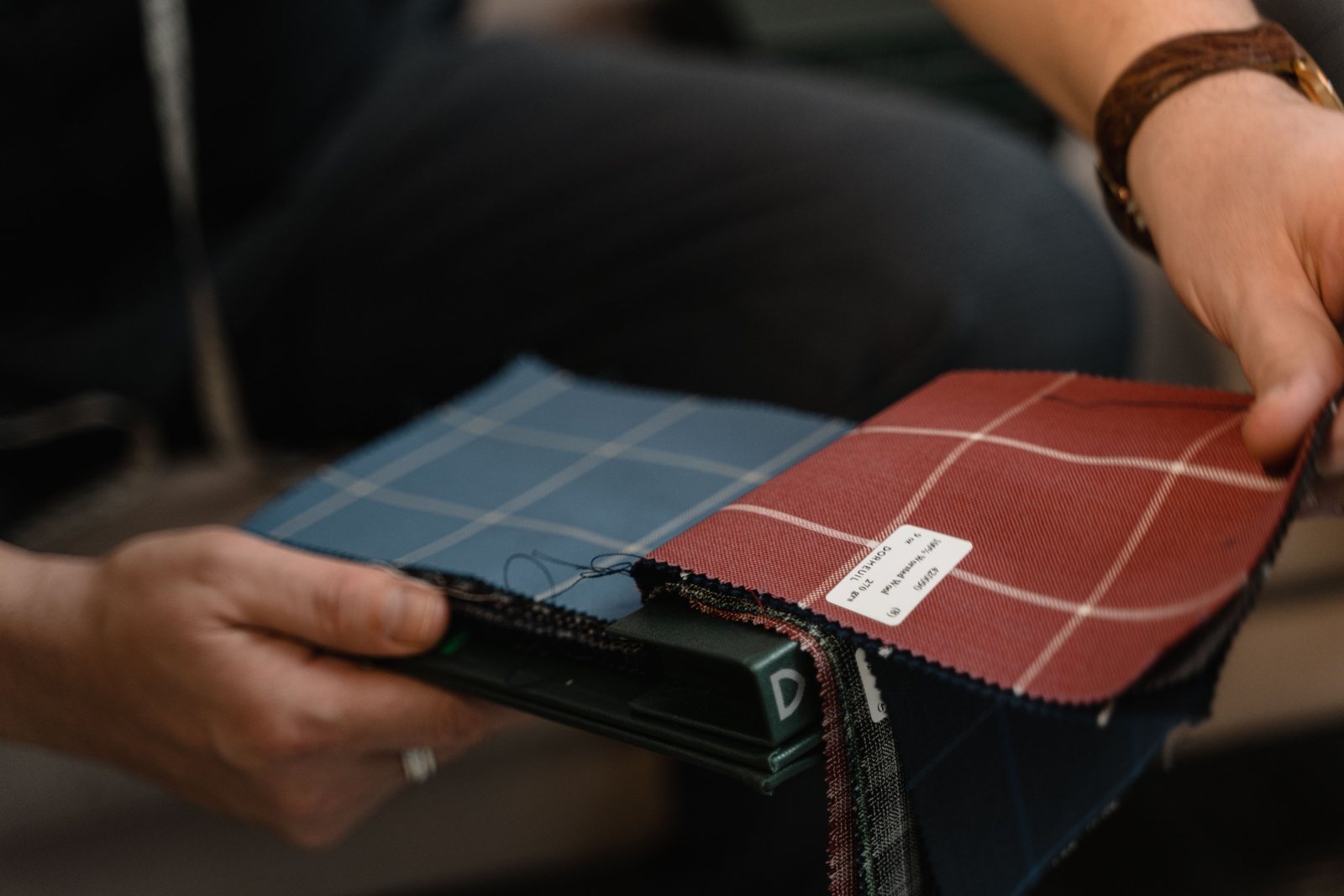
AI assisted with research organization and drafting, not the photographs. Hero photo: Tima Miroshnichenko / Pexels, Pexels License; illustrative fabric selection, not a ZWC project, Keqiao facility or approved reference. Neither depicted people nor sample brands endorse ZWC. Second photo: Anna Shvets / Pexels under the same licence, garment-worktable context only. No physical testing, supplier audit or legal review is claimed.