
Quick answer
Freeze the purpose of a bag prototype before pretending the whole design is frozen. Identify the buying decision, fixed inputs, permitted experiments, temporary components and evidence required from that round. A silhouette model and a production-intent sample can answer different questions. Authorize the next development spend only when the result resolves its stated question—or when a bounded revision has a clear learning objective. Neither step authorizes bulk production.
A polished sample can still leave the development decision open
A first bag sample may look ready for a product photograph while leaving the opening awkward, the pocket arrangement unresolved or the intended material unavailable. Ordering another sample without naming the unanswered question can repeat the same uncertainty in a different color.
For overseas brands commissioning a private-label handbag, tote or crossbody bag, the useful decision is not simply whether the sample is attractive. It is whether this particular development round produces enough information to continue, revise the concept or stop. That starts before the sample maker cuts the first prototype.
This original prototype brief addresses the purchase of a learning round, not a ZWC case or a pattern-making prescription. The later golden-sample approval checklist addresses controlled references before bulk production.
Freeze the question, not every unresolved answer
Start with one sentence describing what the next sample must settle. For example, ask whether the proposed opening and internal layout permit the intended items to be inserted and retrieved. This is a hypothetical review question, not a claim about an actual product.
Identify the intended user, carrying method, contents and destination. Separate a fixed requirement from a design preference and from an option the supplier is invited to explore. If two incompatible directions remain open, ask for separately identified alternatives rather than expecting one sample to represent both.
A sketch can fix an intended proportion without establishing the actual leather, reinforcement or closure construction. Ask the supplier to explain which choices must be made to build the requested prototype and which choices may remain provisional. The buyer should understand that boundary before accepting the sample quotation.
Choose the evidence level for this round
Use plain descriptions rather than assuming that every supplier means the same thing by “development sample,” “sales sample” or “final sample.” Write what the supplied unit will contain and what the reviewer may conclude from it.
| Round purpose | What to identify in the brief | Conclusions to keep open |
|---|---|---|
| Proportion and layout exploration | Outline, dimensions to explore, opening concept, pocket arrangement and review contents | Final hand feel, material behavior, durability and production feasibility |
| Material and construction comparison | Named candidate materials, layer arrangement, closures and exactly which alternatives differ | Performance of untested combinations and suitability of parts not represented |
| Production-intent development | Actual proposed component references, construction route, declared exceptions and evaluation plan | Bulk consistency, capacity, compliance and shipment release |
These are proposed work scopes, not universal industry stages. A project may combine or separate them. The important point is to make the result interpretable: if a temporary lining was used, record which observations depend on replacing it.
Make temporary materials visible before interpreting the sample
For each provisional item, record the temporary reference, intended replacement, reason for the substitution and the conclusions it limits. Include hidden layers as well as visible leather and hardware. A statement such as “similar material for sampling” does not tell the reviewer what is comparable.
Ask a specific question: if the purpose is to judge the opening, which material or component differences could change that judgment? If the purpose is to compare the body shape, which aspects of the sample's support and assembly are representative? Let the supplier and responsible product specialist identify the dependencies rather than declaring a substitute equivalent from appearance.
The boundary also matters for performance. SATRA's public luggage webinar description distinguishes material properties from construction-level performance, including strap and handle durability. The description is a scope reference, not a test method, report or pass criterion. It supports keeping these questions separate, not declaring any pictured or sampled bag durable.
If a functional promise matters to the brand, identify the actual design and have a competent technical party define the appropriate evaluation. A visual prototype should not quietly become proof of strength, water resistance or service life. See the separate bag water-claim guide for that evidence boundary.
Issue a sample task that another reviewer can understand
Keep a compact work record alongside the drawings. The following fields make the intended experiment and its limits visible without requiring a complete production specification at the concept stage.
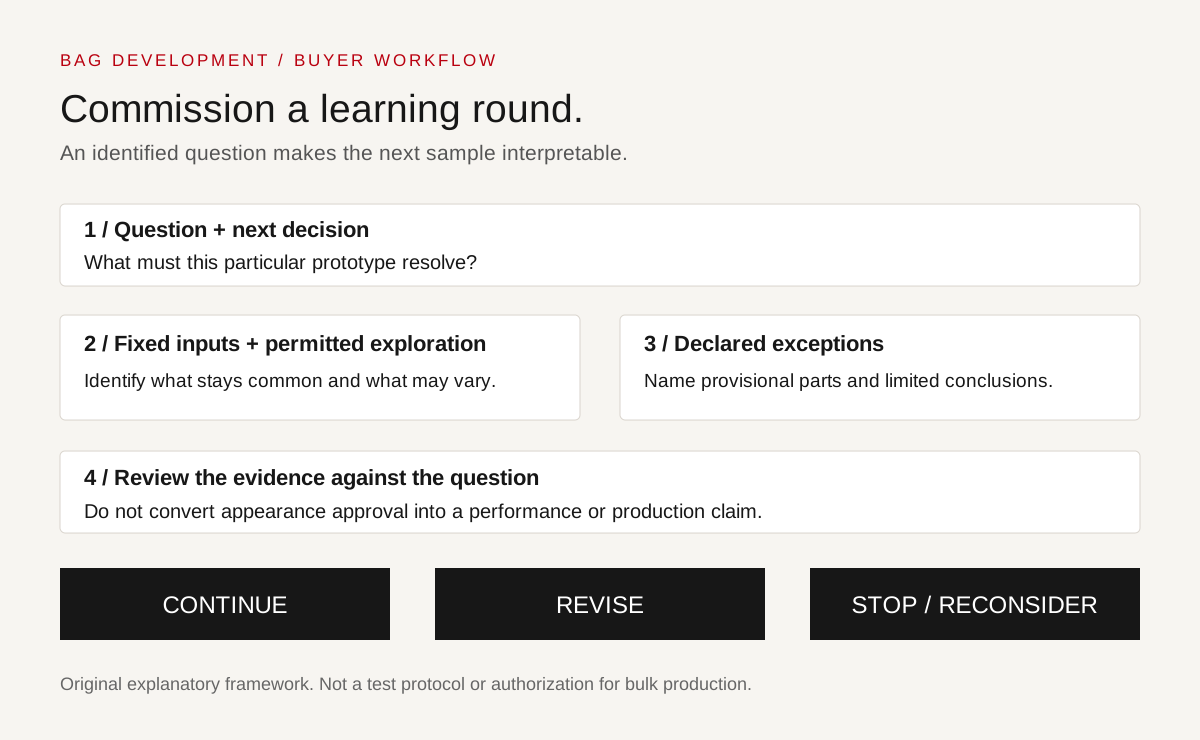
- Question and decision: what must this round resolve, and what decision follows a useful result?
- Controlled starting point: sketch revision, proposed dimensions, reference materials, component identities and agreed fixed features.
- Permitted exploration: features the sample maker may vary, with separately identified options when necessary.
- Declared exceptions: every provisional material, missing part or departure from the intended construction.
- Review record: observations, measurement locations where relevant, intended review contents and the person responsible for each judgment.
- Deliverables and next gate: identified sample, comparison notes, updated files, open questions and the authority to commission another round.
Photograph the identified sample in the agreed review states before altering it. Record an adjusted strap or removed insert so the supplier is not asked to reproduce an unexplained result.
Buy the next answer, not another indistinguishable sample
Before paying for a revision, reconcile the previous result against its question. Was the target missed, was the brief ambiguous, or did a newly identified dependency prevent a valid comparison? Those explanations require different next steps.
| Finding after review | Next-round instruction | Continue or pause? |
|---|---|---|
| The question is answered and the direction remains suitable | Carry forward the specific accepted observations; name the next unresolved question | Continue only within the newly agreed scope |
| The intended question remains open because the sample was unrepresentative | Identify the blocking temporary item and the representative replacement needed | Pause the affected conclusion; quote the corrective round separately |
| Two alternatives changed several things at once | Identify the comparison required and which variables must stay common | Revise the comparison before declaring a preferred material or construction |
| A new preference changes an accepted direction | Record the buyer-requested change and its effect on files, parts and evaluation | Reconfirm scope and charges before proceeding |
| The concept cannot satisfy a fixed requirement on the proposed route | Request the technical explanation and bounded alternatives | Stop or reconsider the concept; do not repeat the same instruction |
Keep development charges separate from component purchases, tooling, testing, logistics and bulk unit prices. Ask what one quoted round includes, which files and physical items will be delivered, what revisions are excluded and what happens to unused sample materials. Do not assume a sample fee buys pattern ownership, unrestricted use rights or an exclusive design. These terms need explicit agreement and appropriate professional review.
Lower initial spend may be sensible when it answers an early layout question without commissioning every final component. It is not sensible when the temporary inputs invalidate the very comparison being purchased. No universal cheapest route or guaranteed saving follows from this framework.
Close the prototype round without releasing production
Finish with a short disposition: what was learned, what remains unresolved, which observations can carry forward, and what the next authorized task is. Withdraw superseded instructions from active use while retaining the development history.
For a China-side bag-sourcing discussion, share the product direction, intended use and contents, destination, proposed quantities, current development stage and the question your next sample should answer through our project contact page. ZWC can discuss supplier coordination and sampling follow-up. Pattern development, specialist design, testing, rights, supplier capability and commercial responsibilities require project-specific confirmation. A prototype enquiry is not an approval to purchase bulk materials or start production.
Primary sources
- SATRA: Testing Luggage, Bags and Leathergoods—public webinar description. Undated public summary checked20October2026. Material and assembled-construction evaluation scopes only; full webinar not viewed, no numerical requirement, product test or SATRA endorsement inferred.
AI assisted with organizing the text, not generating these photographs. Hero: www.kaboompics.com / Pexels; bench detail: Gül Işık / Pexels. Licensed under the Pexels License, resized/compressed. Illustrative stock—not ZWC designs, products, staff, suppliers, sample stages or performance evidence. Material identity and development status cannot be established from these images; no endorsement implied. Workflow is original explanatory vector artwork.