
Quick answer
Before requesting a shoe-factory machinery package, define the footwear construction, bought-in components, operations performed on site and intended product mix. Then connect each operation to equipment, tooling, people, utilities and acceptance evidence. Compare quotations against that same route. A cheaper equipment list is not a cheaper working factory if it leaves an essential process or interface unassigned.
The expensive gap is often between machines
An upper arrives at assembly, but the team has not agreed who supplies the lasts. A sole press is included, but the proposal says nothing about fixtures for the nominated construction. Both machine quotations can look complete while the production route remains incomplete.
These are planning scenarios, not accounts of ZWC projects. They expose the procurement question that matters first: what must enter and leave each operation for the next operation to work? Buying a recognizable set of machines does not answer it.
This guide concerns the specification stage before machinery selection. It does not provide an engineered factory layout, machine settings or safe operating instructions. Construction methods, process parameters and local approvals require appropriately qualified professionals and the actual product evidence.
Start with one defined production route
“We want to make shoes” is too broad for a comparable request for quotation, or RFQ. State the starting product family, its construction and the material direction. Include controlled references and identify which features are still proposals rather than approved requirements.
Decide the factory boundary separately. Will the project receive finished soles and stitched uppers, make uppers from sheet materials, or also produce soles? Each boundary changes what belongs in the machinery package. A CKD assembly project and a factory making its own components should not receive the same assumed scope simply because both sell finished footwear.
SATRA’s May 2019 introduction to footwear production describes the relationship between construction, materials and assembly methods. It is useful technical background, not a current equipment-price guide or evidence of ZWC’s engineering credentials.
Choose a representative starting style, but identify the variants it does not cover. A convenient demonstration shoe cannot establish suitability for every size, material combination or construction you hope to add later.
Use a process-route matrix before a machine list
The following matrix is a procurement worksheet, not a universal manufacturing sequence. Add, delete or change rows with the responsible footwear technologist for the selected construction. Record a revision number so suppliers cannot quietly quote different assumptions.
| Route boundary | Input to define | Output or handoff to confirm | RFQ question |
|---|---|---|---|
| Material preparation | Nominated upper materials and component drawings | Prepared parts accepted by the next operation | Which preparation operations are included or bought in? |
| Upper assembly | Component set, seams and attachments | Upper ready for the nominated assembly method | What equipment, attachments, operator skills and inspection are required? |
| Shaping or lasting, where applicable | Approved upper and compatible last references | Shape and condition required for attachment | Who supplies and verifies lasts, fixtures and size coverage? |
| Sole attachment | Approved upper/sole combination and process specification | Assembly meeting the agreed product criteria | Which preparation, attachment and associated support processes belong in the scope? |
| Finishing and checking | Assembled footwear and approved finish reference | Accepted pairs ready for packing | Which checks, rework routes and finish controls are included? |
| Packing and traceability | Accepted pairs, assortment and packing specification | Identifiable shipment units | Who provides packing equipment, labels and records? |
The important column is the handoff. Ask both neighboring suppliers to acknowledge it. If one assumes a prepared component while the other excludes its preparation, close the gap before comparing totals.
Define output assumptions without promising capacity
A target number of pairs is an input to planning, not proof that the proposed line will achieve it. Specify whether the target concerns assembled pairs, accepted pairs or packed saleable pairs. Those are different measurement points.
List the product mix, size and color changes, available production time, staffing assumptions and planned changeovers. Ask suppliers to distinguish an isolated machine cycle from expected operation output with handling, inspection and interruptions included.
SATRA’s April 2017 article on production processes explains why operation methods and line balance matter. Its historical discussion supports checking the whole sequence; it does not validate a proposed factory’s output or imply that ZWC uses SATRA software.
For each proposed bottleneck, request the calculation basis and a product-specific verification plan. If adding another machine merely transfers the constraint to preparation, staffing or checking, the purchase has not solved the production-system problem. Our supplier capacity verification guide covers evidence for output claims in more detail.
Price the dependencies that are not machines
Tooling deserves its own register. Identify lasts, cutting tools, molds where relevant, attachments, fixtures and gauges by the product revisions they support. Clarify ownership, replacement responsibility and compatibility before release. A photograph of a last does not prove that its shape or size matches your intended footwear.
Separate the equipment quotation from the following dependencies:
| Dependency | Decision needed before purchase | Evidence or responsible party |
|---|---|---|
| Site utilities and services | Required supply, space and connection boundaries | Vendor requirements reviewed by qualified local engineering professionals |
| Safety and environmental provisions | Applicable local approvals and protective systems | Responsible local specialists; not an assumed machinery-supplier sign-off |
| Consumables and spare parts | Initial requirements, replacement route and exclusions | Itemized supplier scope and availability confirmation |
| People and training | Skills needed at launch and training deliverables | Named training scope, language and competence assessment responsibility |
| Software and documentation | Licenses, access, backups and usable manuals | Contract deliverables and buyer access arrangements |
| Installation and ramp-up | Who installs, adjusts, supports and resolves interfaces | Written responsibility matrix and escalation route |
Do not treat this table as utility sizing or compliance advice. Quantities and technical requirements must come from the selected equipment and qualified project review. Compare total scope, not an invented universal cost per production line.
Agree how a package becomes an accepted system
Before an order, separate factory acceptance testing at the equipment supplier from site acceptance after installation. FAT and SAT serve different checkpoints; agree what each must demonstrate, the materials used, who witnesses it and how unresolved items are handled.
An empty-running video can show movement. It cannot establish acceptable footwear output using your materials and assortment. Likewise, a successful demonstration of one machine does not settle the interfaces between multiple suppliers.
Keep the acceptance plan bounded to the product route and contracted scope. Define the evidence needed before shipment, installation completion and production handover. Assign responsibility for trial materials, tooling, operator preparation and defect decisions. Technical acceptance criteria must be set by competent responsible parties; this article does not supply numerical limits or test certifications.
Pause procurement when the route still depends on guesses
Hold an equipment order when:
- The initial construction or make-versus-buy boundary is unresolved.
- Quotations use different component conditions or product references.
- No party owns a critical handoff, fixture or local utility interface.
- Output is supported only by a machine-speed claim or unrelated demonstration.
- Installation, training, spare parts or acceptance responsibilities remain outside the agreed scope.
A bounded first-stage package may be preferable to buying a full mixed-product line at once, provided its interfaces and later expansion limits are explicit. Expansion capacity is not automatically available just because additional floor space exists.
Send a route brief, not a shopping list
For a China-side machinery-sourcing discussion, share the starting shoe construction, references, bought-in components, on-site process boundary, product mix, output assumptions, site constraints and current decision. Mark unknowns clearly.
ZWC can discuss the sourcing and coordination scope described in its factory setup and production-line consulting service. Supplier availability, engineering involvement, installation support and delivery obligations require project-specific agreement. This is not a blanket turnkey-factory or production-capacity guarantee.
Use our project requirements form to explain the brief, or contact ZWC on WhatsApp. The useful next step is a controlled process scope and responsibility list—not an immediate promise that a machinery package can make every shoe.
Primary sources
- SATRA: Starting in footwear production, May 2019. Rechecked 12 October 2026; historical technical background, not current market data.
- SATRA: Developing efficient production processes, April 2017. Rechecked 12 October 2026; qualitative operation-planning background only.
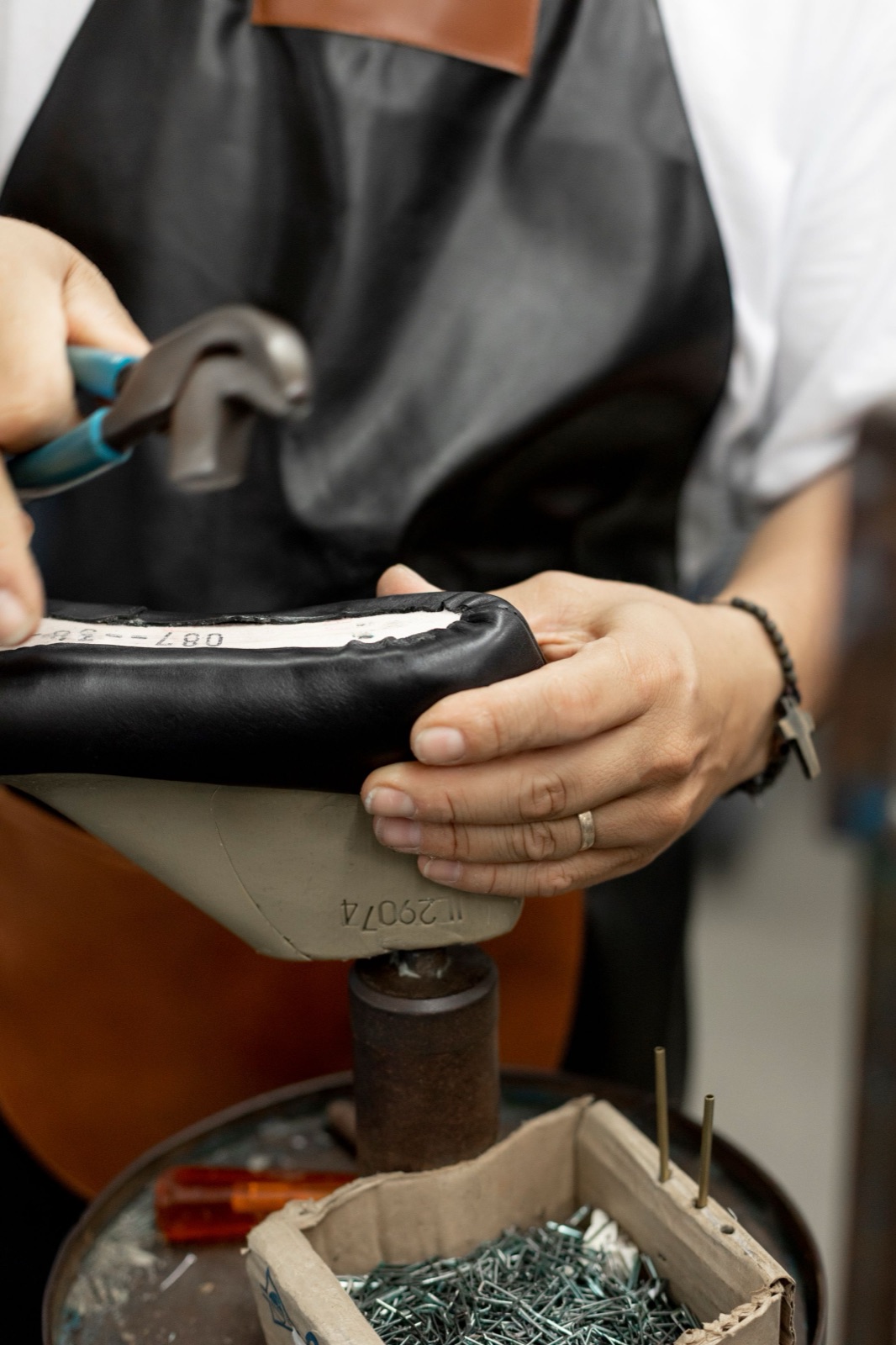
AI assisted with text drafting and organization, not photography. Real stock photography: Fernanda Simões and Rachel Claire / Pexels, under the Pexels License. The hero shows hand work on a last; the supporting image is a decorative display of vintage forms. Neither depicts a ZWC factory, customer project, recommended industrial layout or evidence of machine capacity, safety compliance or tooling suitability.