
Quick answer
Ask the contracted supplier to identify what leaves its site, who performs the work, what inputs that party receives and who accepts the returned uppers before shoe assembly. Connect every transfer to the style, size, side, material lot and document revision. Separate a physical count from workmanship acceptance and from the buyer's commercial decision. An outsourced operation is not automatically a problem; an unassigned interface is a question that a low stitching price cannot resolve.
Price the transfer, not just the sewing operation
A stitching offer can appear clear until the buyer asks who prepares the panels, supplies the lining, checks the returned work or replaces missing pieces. If those tasks fall between two quotations, the quoted pair price does not describe the same work.
This guide is for ordinary private-label footwear buyers discussing a proposed production arrangement. It is an original procurement-question framework, not a factory audit, sewing instruction or assessment of any photographed workshop. It supplies no stitch setting, strength requirement, defect allowance or approval for protective, medical or performance footwear.
Keep three decisions separate: whether the proposed external operation is acceptable within the buyer's sourcing arrangement; whether its identified output meets the product requirements; and who may release that output to the next operation. The actual parties must agree responsibilities and obtain appropriate technical or contractual review for their project.
Describe the input and output states precisely
“Upper stitching” is not a complete work package. The public ICSAS footwear-training document distinguishes preparation of upper parts from upper assembly, with the work depending on the model and material. That historical process description is useful context, not a mandatory production sequence for every shoe or a subcontracting standard.
Ask the supplier to identify the actual delivery state at each boundary. Are materials supplied as sheets, cut panels, prepared components or another defined state? What should be returned: a stitched subassembly, an upper with lining, or a different agreed output? Which preparation and subsequent work remain elsewhere?
Do not infer these answers from a machine photograph. Likewise, a stitched upper is not a finished shoe. SATRA's May 2019 production article discusses footwear's shape, varied materials and connected manufacturing processes. Its mention of keeping handed leather components together supports asking about pair identity; it does not approve the buyer's particular material, fit or assembly arrangement.
Build one transfer record for the actual order
Use the following worksheet to structure supplier clarification. Fill it with actual codes, records and responsible people. It is not evidence that a proposed stitcher has passed any assessment.
| Handoff question | Identify before dispatch | Confirm on receipt | Keep pending when |
|---|---|---|---|
| Which products are included? | Order, style, size, colour, side and active revision | Returned scope matches the dispatched scope | A similar style name stands in for exact identity |
| What is being supplied? | Named materials, component states, lots and permitted substitutions | Actual returned components and declared exceptions | The quoted input state is unclear |
| How are matched parts kept together? | Pair/bundle identity and separation rules appropriate to the product | Matching identity and quantity reconciliation | Lots, sizes or left/right parts cannot be traced |
| Which work is included? | Preparation, stitching, accessories and other expressly included operations | Completion against the agreed output state | An essential operation is excluded by both parties |
| Which reference controls? | Current specification, sample and applicable review criteria | Returned work assessed against those same references | Superseded instructions remain active |
| Who decides what happens next? | Dispatch, receipt, technical review and release owners | Attributable acceptance, hold or other disposition | A delivery receipt is treated as product approval |
A transfer can contain more than one status. For example, the receiver may confirm the count while holding the workmanship decision. Make that limitation explicit rather than signing a general “received and approved” message.
Reconcile quantities without hiding replacement work
Record the quantity and unit at dispatch and return: pieces, uppers, pairs or another agreed unit. They are not interchangeable. State whether the transfer covers complete matched sets or individual components, and whether samples or retained references are included in the count.
When a discrepancy appears, separate missing items, work awaiting review, rejected output, work in progress and approved replacements. Do not add them into a single “balance” that hides what is physically available. Ask for the relevant record before assigning a cause or agreeing the next quantity.
If replacement panels are proposed, identify their material and lot references and the affected pairs or bundles. The responsible product team should decide what matching and assembly review is needed. This article does not establish that a replacement is equivalent because the colour name is unchanged.
Agree where the first returned work will be reviewed
Before volume is transferred, ask what representative returned work the relevant product and quality personnel need to assess the handoff. Name the style and sizes represented, input revisions, completed operations and any temporary parts. Let the appropriate technical owner define the actual evaluation and acceptance criteria.
The review should expose the boundary with the next operation. If the assembly team needs a particular upper state or reference, record that requirement before the external work is released. A visually tidy seam alone does not establish that the intended shoe can be assembled or that the finished product will perform as required.
Keep observations attributable. A photograph can help locate an issue, but should identify the item, revision and review question. It should not become a public accusation against a supplier or a substitute for examining the actual work. Retain the relevant pieces and records where practical, with access controlled by the project.
Map a change across both sides of the boundary
| Proposed event | Clarification before more work proceeds | Relevant decision owner | Hold condition |
|---|---|---|---|
| Pattern or specification revision | Affected panels, bundles, existing work and required new references | Buyer/product owner with supplier coordination | Only one site has received the revision |
| Material or component substitution | Exact changed reference and scope of renewed assessment | Responsible product/technical owner | Visual similarity is the only justification |
| Different stitching site or further external work | Actual proposed party/site, task, records and review implications | Authorised sourcing and product parties | The process changes without the agreed review |
| Returned work does not meet an agreed requirement | Observed facts, affected quantity, containment and correction proposal | Named review/release owners | Unreviewed work is mixed back into released bundles |
| Replacement or rework is proposed | Work scope, inputs, traceability, review and separately stated charges | Actual commercial and technical approvers | A revised price silently authorises a product change |
These are enquiry and hold questions, not contract clauses or a universal inspection method. A commercial contact's agreement to a charge does not replace the relevant product approval. Nor does an internal quality finding by itself settle legal liability.
Compare complete offers and keep the approval boundary visible
Request dated offers against the same work-package revision. Separate supplied materials, preparation, stitching, handling, transfers, review, replacement/rework assumptions and exclusions. Record the quantity basis, currency and timing dependencies without inventing a standard minimum or lead time.
Compare who provides the same completed state, not simply who has the lower operation charge. If one proposal includes preparation and transport while another excludes them, show the missing work before calling it a saving. Ask how a changed mix, partial return or further revision would be quoted; no universal price advantage follows from outsourcing.
For a footwear sourcing discussion, share the product reference, intended use and destination, size/colour quantities, upper-development status, proposed input/output states and open handoff questions. ZWC can discuss supplier enquiries and coordination within an agreed scope. Actual site capability, subcontracting arrangements, technical assessment, rights and commercial responsibilities require project-specific confirmation.
The upper-development comparison addresses the earlier choice of development work. This article addresses an external production transfer after its scope is identified. Use the golden-sample guide for controlled references; a reference package does not itself authorise every site or transferred batch.
Primary sources and limits
- ICSAS: The Romanian Qualification Framework and initial qualifications from the footwear sector, section 2.2, page labelled 7. Historical training context with references checked in April 2020; read 8 November 2026. Preparation/upper-assembly distinction only, not current Chinese rules or a purchased method.
- SATRA: Starting in footwear production, Peter Allen, May 2019; read 8 November 2026. Historical manufacturing and handed-pair context only. No SATRA membership, testing result or endorsement of ZWC is claimed.
AI assisted research organisation and drafting, not photography. Both matrices are original blank buyer worksheets, not client transfer records, measured savings or a qualified product review.
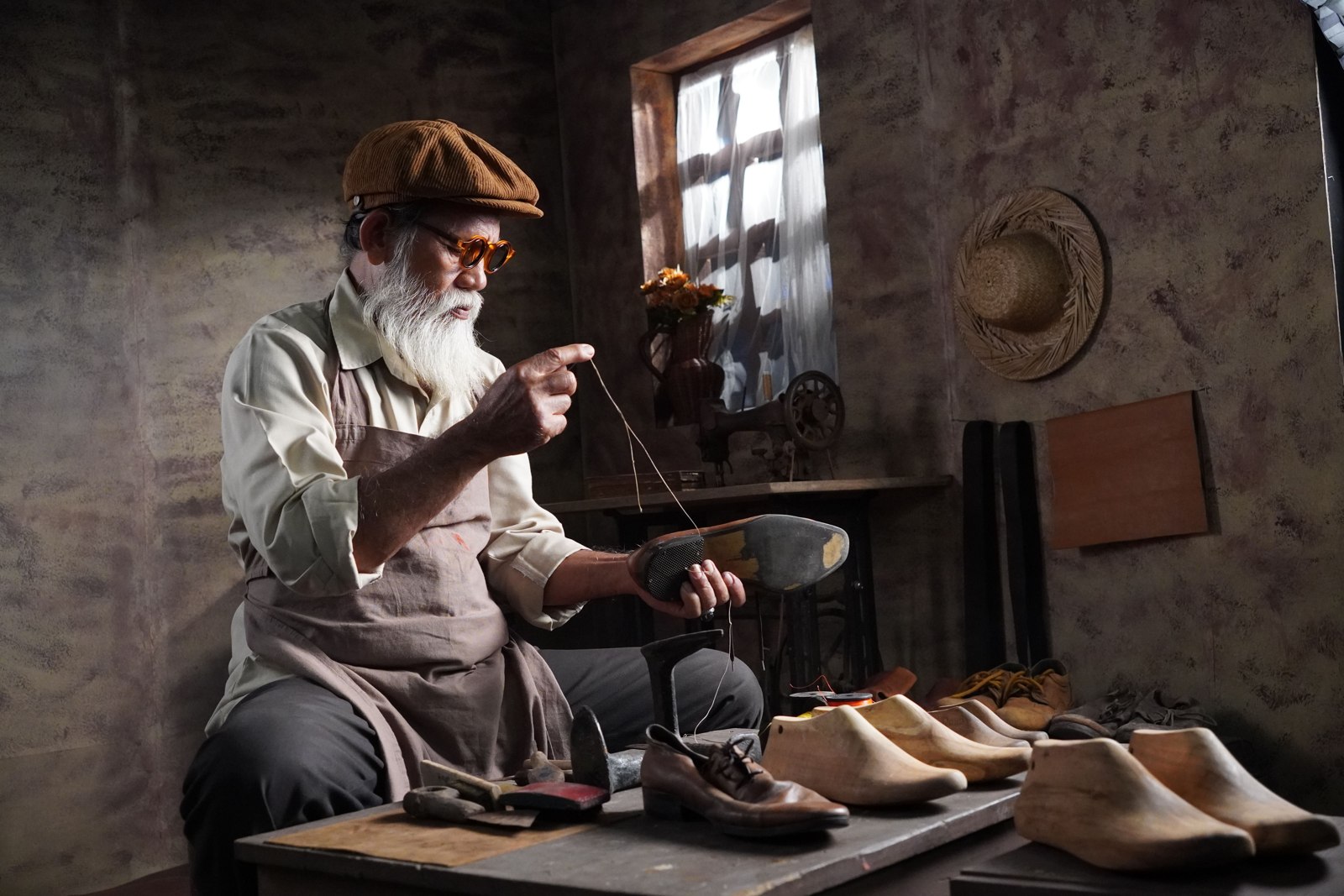
Hero: Jaya Santoso / Pexels; supporting photograph: Michael Burrows / Pexels, credited above, a declared reuse from our apparel size-set guide. Both Pexels License, full-frame resized/compressed only. Historical shoe-workshop and clothing-template illustrations, not ZWC staff, suppliers, outsourced sites, approved methods or product assessments. No fault or endorsement by depicted people or incidental brands implied. The photographs are not a sequence of one product or evidence of any subcontracting arrangement.