
Quick answer
A CKD shoe shipment is not ready merely because every component name appears on a packing list. Before release, the buyer should verify that the correct revision of each component is present, quantities reconcile by size and colour, left and right parts form usable pairs, the parts remain compatible when assembled, and the packing sequence supports the destination factory’s actual workflow. The strongest evidence is a controlled bill of materials (BOM), a size-and-colour reconciliation, approved reference samples, traceable packing records, and a small pilot assembly using production-intent components. This turns “all parts shipped” into a more useful decision: “the destination line can assemble saleable pairs without avoidable shortages, mismatches or undocumented substitutions.”
Who this guide is for
This guide is for footwear brands, importers and overseas factories buying complete knock-down shoe kits for local assembly. It is especially relevant when uppers, soles, insoles, laces, accessories and packaging are sourced from several production steps or suppliers before being consolidated.
The exact component list depends on the shoe construction and commercial agreement. A stitched leather shoe, cemented casual shoe and injection-moulded sandal do not share one universal CKD checklist. The controls below are therefore a decision framework, not a product specification.
Component completeness is not kit readiness
A shipment can be numerically complete and still fail at assembly. Common causes include a left/right imbalance, mixed revisions, an outsole that does not match the approved last or upper, colours that drift across lots, size labels that do not match the physical parts, or packaging that forces the destination team to sort thousands of loose components before production.
Start by defining the release unit. For many projects, the useful unit is one finished pair in a specific style, colour and size—not one carton of uppers or one total quantity of outsoles. Every reconciliation should roll up to that unit.
The CKD release control table
| Release decision | What to verify | Practical evidence |
|---|---|---|
| Correct component | Part name, material, colour, size, side and approved revision | Controlled BOM, approved sample or signed specification, supplier lot record |
| Pairability | Left and right quantities form complete pairs in every size and colour | Size/colour/side reconciliation, counted sample cartons |
| Compatibility | Upper, last-related dimensions, sole, insole and accessories work together | Pilot assembly record, photos of key stages, approved reference pair |
| Appearance consistency | Production lots are compared with the approved colour and finish reference | Controlled sample comparison under agreed viewing conditions; deviation record if needed |
| Quantity readiness | Good units meet the order requirement by release unit | Reconciliation sheet showing ordered, inspected, rejected, reworked and released quantities |
| Packing usability | Cartons and inner packs follow the destination assembly sequence | Packing instruction, carton map, size run and component-set identification |
| Traceability | A nonconforming part can be linked to its supplier or production lot | Lot codes, carton identifiers and receiving records |
| Change control | No material, construction or supplier substitution is hidden | Approved change request or a clear “no change” confirmation |
Build the reconciliation from the BOM
The BOM should be the single working list of what belongs in one pair. It should identify the component, revision, colour, size range, left/right requirement, units per pair and any approved alternate. Vague descriptions such as “black sole” or “standard lace” are not sufficient when multiple versions may exist.
For each line item, calculate the base requirement from the order quantity and the number of units needed per pair. Any contingency quantity should be explicitly agreed in the contract or purchase specification; there is no universal extra percentage that is correct for every component or destination process.
A useful reconciliation separates:
- ordered quantity;
- received or produced quantity;
- quantity rejected or held;
- quantity successfully reworked;
- good quantity released for shipment; and
- any buyer-approved contingency.
Do not allow totals to hide a size shortage. Ten extra size 42 outsoles do not repair a shortage of size 39 left outsoles. Reconcile by style, colour, size and side wherever those attributes affect assembly.
Run a pilot assembly before shipment release
A pilot assembly is the most direct way to test whether individually acceptable components work as a system. The sample should use production-intent parts drawn from the lots planned for shipment, not only development samples kept in the sample room.
Before the test, agree which destination operations are being represented. Then record:
- the component lot and revision used;
- whether identification and size markings correspond;
- how the upper, insole and sole align during the intended process;
- whether accessories and packaging are complete and practical;
- any adjustment, rework or substitution required; and
- the release decision and responsible approver.
The pilot should answer a narrow commercial question: can the planned kit be assembled by the intended process without an unapproved workaround? It does not replace production validation, laboratory testing, destination-factory training or market-specific compliance review.
Control substitutions before they enter the cartons
CKD projects are vulnerable to “small” substitutions because the final assembly happens elsewhere. A different lace tip, foam density, colour batch, adhesive system or packaging insert may appear harmless at the component source but create a problem later.
Require proposed changes to be documented before packing. The record should state what changed, why, which orders and lots are affected, what compatibility evidence exists, and who approved the decision. If approval is still open, identify and hold the affected cartons rather than mixing them into released stock.
Pack for assembly, not only for freight efficiency
The cheapest-looking packing arrangement can create expensive sorting and line stoppages at destination. The packing plan should reflect how the receiving factory stages production. Depending on the project, that may mean pair-level kits, clearly separated left/right components, size-run cartons, or station-based packs.
Carton and inner-pack identifiers should be understandable without relying on supplier memory. At minimum, the receiving team needs to distinguish the purchase order, style, colour, size, component, side where relevant, quantity and lot. Exact label fields must be agreed for the project and destination requirements.
Before final sealing, perform a controlled carton check against the packing instruction. Photographing a few open cartons can support the record, but images alone do not prove the quantity or condition of every carton.
A practical pre-shipment release checklist
- The BOM revision matches the buyer-approved specification.
- Approved references for construction, colour and finish are available to the verification team.
- Quantities reconcile by style, colour, size and left/right side.
- Held or rejected stock is physically separated from released stock.
- Production-intent components have completed the agreed pilot assembly.
- Every substitution or deviation has a documented disposition.
- Packing supports the destination factory’s receiving and assembly sequence.
- Carton identification and lot traceability are complete.
- Open issues have an owner and written buyer decision before shipment.
- The final release record identifies what was checked, when, where and by whom.
Red flags that justify a hold
Pause shipment release when the supplier cannot identify the active BOM revision, totals only reconcile at whole-order level, left/right parts are stored together without reliable identification, production lots differ from the approved sample without a decision record, or the pilot build requires improvised adjustment.
Another warning sign is evidence that exists only in chat messages. Important approvals should be transferred into a controlled project record so the buyer, sourcing team and destination factory are working from the same decision.
What this verification cannot prove
Pre-shipment CKD verification reduces avoidable assembly risk, but it cannot guarantee sell-through, final-product compliance, destination-factory workmanship or performance over the product’s service life. Required testing, product safety assessment, labelling and legal compliance depend on the product and destination market and should be confirmed with qualified specialists.
Next step
If you are planning a CKD footwear order, send ZWC Sourcing your target shoe construction, size range, destination assembly process and current BOM. We can review the information needed to create a practical supplier, inspection and shipment-control plan. Any service scope, testing requirement and acceptance standard should be agreed in writing before the order begins.
Related ZWC resources:
- CKD Shoe Supplier in China
- How to Write a China Purchase Specification
- Pre-Shipment Inspection Checklist for China Sourcing
- Contact ZWC Sourcing
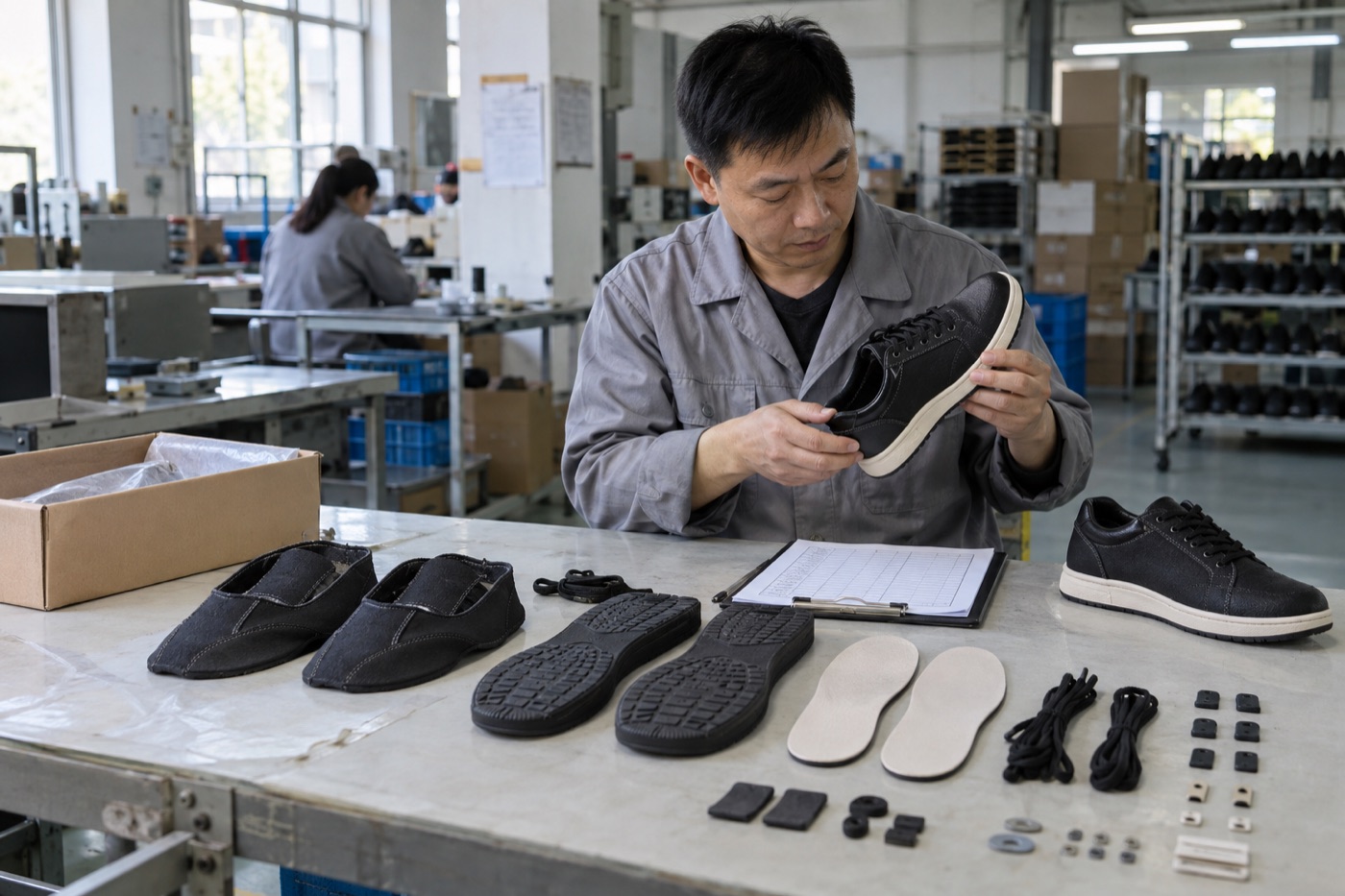
AI assisted with research organization, drafting and creation of the illustrative hero image. Buyer-specific technical, legal and commercial decisions still require verification for the actual product and order. The image is illustrative and does not depict a named ZWC client, supplier or verified project.