
Quick answer
Do not approve a PU sole's storage or durability claim from an unworn shoe, a purchase date or a generic material label. Connect the identified component and material revision to its production date, documented history, representative assessment and a named technical decision. Separate component deterioration from attachment failure. This guide organises the evidence request; it supplies no universal shelf life, accelerated-test conversion, storage setting or product-safety approval.
Unworn stock can still leave an unanswered age question
A supplier offers unused sole units from an earlier production run. The price is attractive and the tread looks familiar. The buyer still needs to establish what those units are, when they were made and whether the available evidence represents them. An absence of wear is not a dated material record.
This is a hypothetical purchasing situation, not a ZWC customer case. It applies to ordinary footwear component sourcing and inventory decisions. It is not guidance for selecting protective footwear, diagnosing a consumer's damaged boot or releasing a product for a safety-critical use. Those decisions require appropriate product-specific expertise.
SATRA's historical failure discussion describes moisture-related deterioration of a PU component as a possible explanation in a reported footwear case. Its current public TM344 catalogue describes conditioning susceptible materials before mechanical assessment. These sources justify asking a material-specific ageing question; neither establishes how long your unidentified stock will remain acceptable.
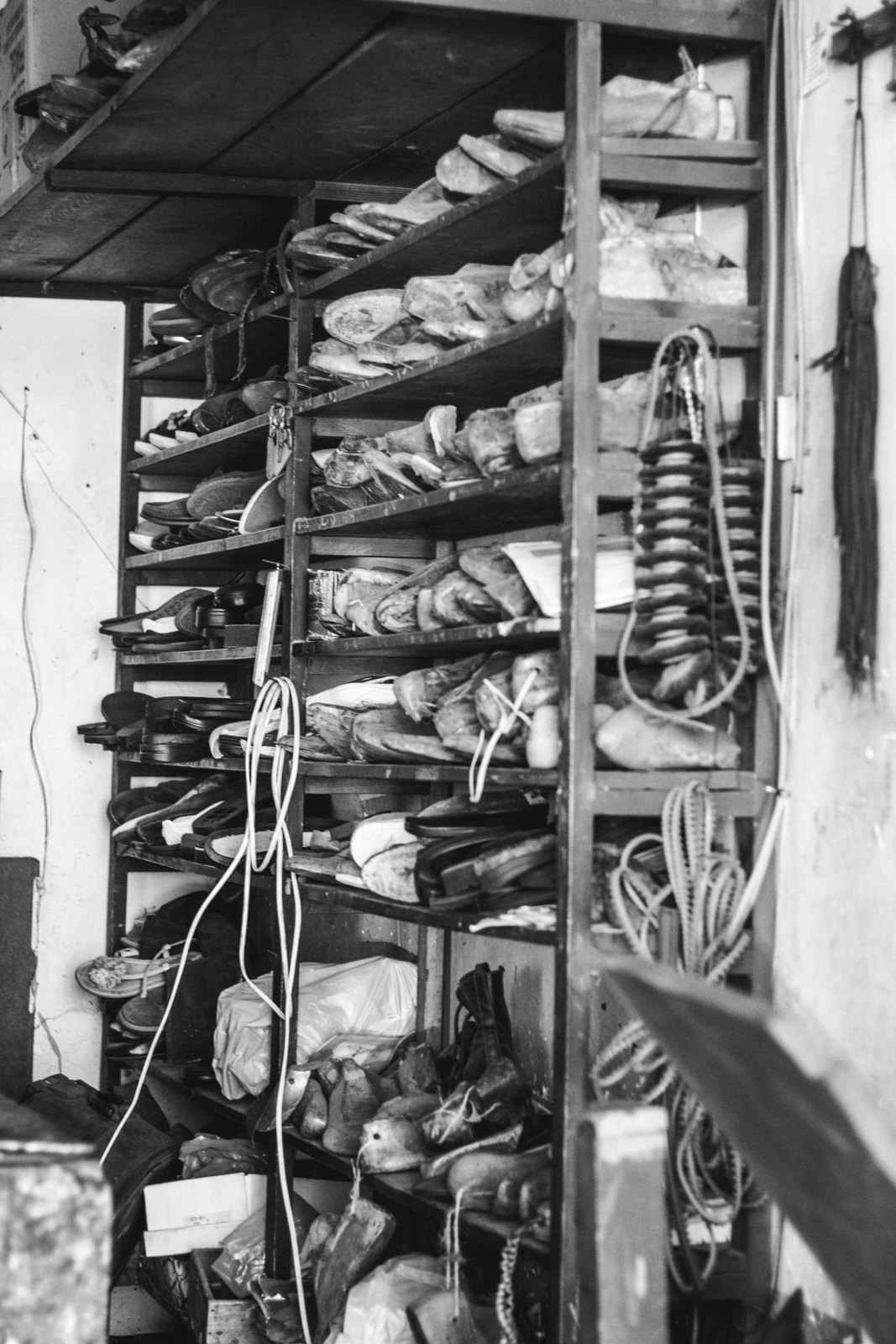
The photographs illustrate a workshop and retail stock context. Their footwear materials, production dates and storage conditions are unknown. Neither is a photograph of PU hydrolysis, a tested lot or ZWC premises.
Identify the component before discussing its age
Start with the part that carries the claim. Is the supplier discussing a midsole, an outsole, a combined bottom unit or a PU-coated upper? Record its component code, drawing revision, size and side coverage, material reference and the producing party. A finished shoe can contain several different materials; a claim about one does not automatically cover the others.
Ask which date starts the supplier's stated storage period. An invoice, assembly date, shipment date and component-moulding date describe different events. Keep them separate. If the component date is not available, mark it unknown rather than replacing it with the most recent commercial document.
Then identify the claim itself: remaining stock suitability, a proposed storage statement, resistance to a named deterioration mechanism, or a broader durability promise. Write down the intended product and use covered by that wording. A commercial warranty and a technical prediction should have separate records; one is not automatically evidence for the other.
Build the evidence chain, leaving missing links visible
Use this original worksheet for each identified lot or proposal. It is a procurement register, not a laboratory protocol or an industry-mandated acceptance checklist.
| Link in the claim | Record to request | What the record does not establish alone | Hold the claim when |
|---|---|---|---|
| Material and component | Exact reference, revision, source and part boundary | A generic PU label does not identify every formulation or interface | The report and offered component cannot be connected |
| Time origin | Component production date or bounded production period, plus assembly and receipt dates separately | Recent receipt does not make the component newly moulded | The claimed period uses an unexplained starting event |
| History | Recorded locations, transfers, packaging and available environmental records | A tidy shelf photograph does not reconstruct prior exposure | Missing periods are silently described as controlled storage |
| Assessment | Sample identity, lot, condition, method/version, results and stated limitations | A report for another revision does not release this lot | Representativeness or the relevant assessment question is unresolved |
| Decision | Responsible technical reviewer, accepted scope and unresolved conditions | A purchase reservation is not technical acceptance | Sales wording is stronger than the documented conclusion |
The history record may be incomplete. Separate actual observations and dated records from a supplier's retrospective statement. Do not manufacture temperature or humidity figures to fill a blank. Ask the responsible specialist how the uncertainty changes the assessment or the permitted commitment.
Read an ageing report as a scoped result
The public SATRA catalogue displays a February 2022 revision for TM344. Its description links conditioning with subsequent mechanical evaluation and comparison specimens. The older 2021 failure article refers to an earlier edition. Record the method and edition actually used in a report; do not copy an old citation into a new purchase specification without review.
Ask an appropriate footwear technologist or laboratory to define which assessment addresses the actual material, construction and claim. Purchasing staff can check whether the report identifies specimens and limitations without inventing the technical procedure. The full paid method was not purchased or reproduced for this article.
A useful review asks: what component was sampled, from which lot, at what age and condition, for which question? What did the result cover, and what remained outside it? A mechanical result after a stated conditioning programme is not automatically a calendar-year guarantee for every warehouse, climate or use pattern. Any claimed prediction needs its own documented basis and qualified interpretation.
Likewise, distinguish visible sole damage from a confirmed cause. A separated bottom may involve an attachment interface, component deterioration or another issue. Keep observations, proposed explanations and an expert's findings in separate fields. A photograph can document an observation, not settle the diagnosis by itself.

Keep the technical decision separate from the stock purchase
Use a second original register to limit the next commercial step. It deliberately gives no age limit, test interval or passing threshold.
| Situation | Evidence question before commitment | Bounded commercial action to consider | Keep unresolved |
|---|---|---|---|
| Earlier stock is offered | Are lots, quantities, dates and relevant assessment connected? | Request a conditional quotation for identified lots | Unknown history is not an approved remaining life |
| A fresh run uses a changed material | Which revision and claim does existing evidence represent? | Separate changed development from the repeat price | Familiar geometry is not unchanged material evidence |
| Storage advice is proposed for buyers | Does the wording match the identified product and reviewed evidence? | Hold unsupported product-copy claims for revision | Generic care text is not a universal guarantee |
| Damage is reported | What is observed, what goods are affected and who will investigate? | Preserve traceable records and agree an investigation scope | Do not assign a cause or release other stock from photographs |
Counted inventory, acceptable inventory and commercially allocated inventory are different quantities. Agree who can reserve stock and who can authorise its use. Keep lots distinguishable while questions remain; a discounted balance should not inherit a blanket approval from a different shipment.
LOWA's own care guidance also rejects the idea that care makes every shoe last indefinitely and discusses ageing of a cushioning component. That is named-manufacturer context, not evidence about another supplier's PU system. Do not transfer its repair arrangements or product advice to unrelated footwear.
Close one claim, not every future shipment
Record the reviewed component and lot, the actual evidence, its limits, the permitted wording and the next action's owner. Revisit the connection when the material, source, component, relevant history or intended use changes. Do not invent a universal retest schedule from this register.
The separate reorder continuity guide decides whether inputs can be repeated, replaced or retired. This article examines the time/history/evidence basis of an ageing claim. The construction comparison addresses assembly-route decisions, not remaining storage life.
For a sole-sourcing discussion, share the component reference, intended footwear and market, quantity and size allocation, available dates and reports, and the specific unanswered claim. ZWC can discuss supplier comparison and follow-up. Laboratory work, technical acceptance, supplier capability and contractual responsibilities need separate confirmation. No test service, shelf-life prediction, diagnosis or guaranteed durability is promised.
Primary sources
- SATRA public TM344 catalogue, displayed revision February 2022; read3November2026. Public scope only, not the full purchased method or a prescribed acceptance programme.
- SATRA historical footwear-failure discussion, July/August2021; read3November2026. Case-specific explanations and old method citations are not universal life limits or current legal guidance.
- LOWA care guidance, undated current public page read3November2026. Named-brand material-ageing context only; no care recipe, repair promise or numerical lifespan transferred.
AI assisted research organisation and drafting, not photography. Workshop: Noemí Jiménez / Pexels; retail stock: Meruyert Gonullu / Pexels. Both Pexels License, full-frame resized/compressed only. Material, age, deterioration mechanism and storage conditions are unknown; neither is a tested lot, ZWC supplier, project or endorsement. Tables are original procurement worksheets, not measured results or technical approval.