
Quick answer
Compare two identified transformer designs against the same approved duty, not copper and aluminium as isolated materials. Ask for winding-by-winding material declarations, comparable loss and thermal evidence, connection details, physical interfaces and explicit commercial differences. If the project specification fixes the conductor, obtain approval before evaluating an alternative. Keep technical acceptance with qualified project professionals; a purchasing comparison cannot establish interchangeability, compliance or service life.
A copper premium does not identify what the premium buys
One offer says copper, another aluminium. The purchasing temptation is to treat the price difference as the cost of upgrading the metal. That leaves a more important question unanswered: what else changed in the proposed transformer? A different design may change the dimensions, losses, connections or documentation behind the offer. A price comparison cannot tell you whether those changes suit the project.
This guide addresses a conductor alternative within an already defined distribution-transformer enquiry. It is not a material ranking, a design calculation or advice to change an installed unit. Start with the RFQ data-pack guide if the equipment family and duty remain unsettled. Large power, control and specialist transformers need their own evaluation rather than borrowed conclusions.
Material properties are not a completed transformer design
Eaton's September 2016 distribution-transformer reference explains that its aluminium-wound designs use a larger conductor cross-section than comparable copper-wound designs. It shows why copper alone does not establish lower losses: the manufacturer designs the complete unit around the required performance. Its discussion also distinguishes winding geometries and connection environments. These are manufacturer-specific explanations, not approval of another supplier's design.
Hammond Power Solutions separately describes copper and aluminium coil construction alongside cooling, insulation and clamping arrangements. That is a useful reminder to evaluate the assembly, not proof that any two products are equivalent. Neither source establishes a universal price premium, life expectancy or preferred conductor for your installation.
Do not turn a historical manufacturer's comparison into today's China quotation. Do not compare a bare conductor sample with a completed transformer. The procurement task is to identify the proposed difference and obtain evidence for the actual alternative—not to resize windings or prescribe joints.
Separate a fixed requirement from an allowed alternative
Ask the project engineer or approving authority whether conductor material is mandatory, preferred or open to a proposal. Record the answer and its document reference before inviting substitution. A technically plausible alternative may still fall outside an owner's specification, contract or approval route.
If alternatives are allowed, request an identified base offer and a separately identified alternative. Give each its own drawing revision, data schedule and price. Require the supplier to declare the material of each relevant winding rather than accept an ambiguous “copper transformer” label. Keep internal winding material distinct from external terminal and cable-interface requirements.
An unapproved alternative can be researched without being purchased. Label it accordingly. A buyer's acceptance of an indicative price is not the technical owner's acceptance of the changed design.
Compare the two designs row by row
Use the following worksheet after the common duty has been agreed. Complete a base-offer column and an alternative-offer column for each row, with document references and unresolved differences. The table organizes evidence; it does not set engineering values or require every test for every product.
| Comparison row | Ask both suppliers to identify | Hold the comparison when |
|---|---|---|
| Design and material identity | Offered model, revision, construction and material of each relevant winding | A material claim cannot be tied to the offered configuration |
| Duty and loss basis | Approved rating and service basis; no-load and load-loss information with stated measurement/reference conditions | Different load points or conditions are presented as equivalent efficiency evidence |
| Thermal and insulation basis | Proposed insulation system, cooling arrangement and applicable thermal evidence | A general material statement substitutes for design-specific evidence |
| Mechanical verification | Applicable verification scope and the configuration covered by supporting records | A report from another design is offered without an accepted coverage explanation |
| Connections and interfaces | Internal connection declaration, external terminal requirements and approved installation interfaces | Compatibility is assumed from conductor colour or a catalogue photograph |
| Physical delivery | Outline, mass, handling arrangement and included accessories | A changed envelope or delivery state has not been reviewed |
Ask the qualified reviewer which documents are sufficient, which need clarification and which gaps require additional work. “Both meet the same standard” is not a complete response if the applicable edition, product scope or offered variant is unidentified. The article does not determine the standards or destination approvals for your project.
Keep losses, purchase price and operating assumptions separate
A difference in quoted efficiency is useful only when the figures answer the same question. Record the stated load point and reference conditions; ask the technical owner to reconcile differences. Keep no-load and load-loss data separately visible. Do not choose a design by adding unlike figures or transplanting a catalogue example into a site calculation.
If operating cost matters, obtain a project-specific evaluation from the responsible professionals using the accepted designs, expected loading and energization pattern, energy-price basis and evaluation period. These inputs must come from the real project. An equipment premium is not automatically a recoverable investment, and a lower purchase price is not automatically the lower operating cost.
For purchasing, make exclusions visible alongside the equipment price: alternative-design documentation, agreed verification, revised interfaces, packing and delivery. Ask who pays if an alternative changes an already planned interface. Keep currencies, quotation dates, quantities and delivery terms aligned. Do not enter an invented saving into an approval paper simply because one metal has a familiar market price.
Decide what can proceed and what cannot
| Finding | Next purchasing action | Required decision owner |
|---|---|---|
| Specification fixes copper or aluminium | Retain the compliant base offer; identify any proposed departure separately | Owner or authority responsible for the specification |
| Alternative is allowed but performance data are not comparable | Request a reconciled response; do not rank the premium as a verified saving | Qualified technical reviewer |
| Alternative changes dimensions or connections | Obtain an accepted interface review and revised cost boundary | Project technical and installation owners |
| Both designs are technically accepted on a documented basis | Compare the complete commercial offers and their remaining risks | Procurement with the authorized commercial approver |
| Evidence is missing or outside the supplied configuration | Pause the affected commitment; record the missing deliverable | Named acceptance authority, not the salesperson |
Approval should name the accepted configuration and any conditions. Keep that record attached to the final order. If the supplier later changes the design, ask whether the earlier evidence still covers it; a retained metal label does not settle that question.
Do not request an energized demonstration, open equipment to identify metal or improvise a field test. Verification methods, safe access, acceptance criteria and installation remain the responsibility of qualified professionals and the applicable project authorities.
Bring the alternative and the unresolved question
For a China-side sourcing discussion, send the application, destination, approved specification status, identified base and alternative offers, quantity and approval authority. Explain whether the unresolved issue is material identity, document coverage, an interface change or commercial scope. Avoid posting confidential infrastructure drawings in public comments.
See ZWC's manufacturer-scope checklist and supplier-mapping approach, or contact ZWC to discuss the sourcing scope. Category fit and supplier capability require confirmation. This guide does not promise transformer design, certification, laboratory testing, utility approval or installation services.
Primary sources
- Eaton: Copper vs. Aluminum Conductor — TC202003EN, effective September 2016; two-page original checked 19 October 2026. Manufacturer-specific distribution-transformer mechanism, not current prices or proof for another supplier.
- Hammond Power Solutions: Commitment to Excellence — undated manufacturer page, coil/core/insulation sections checked 19 October 2026. Manufacturing-scope context only; not independent comparative testing or a ZWC relationship.
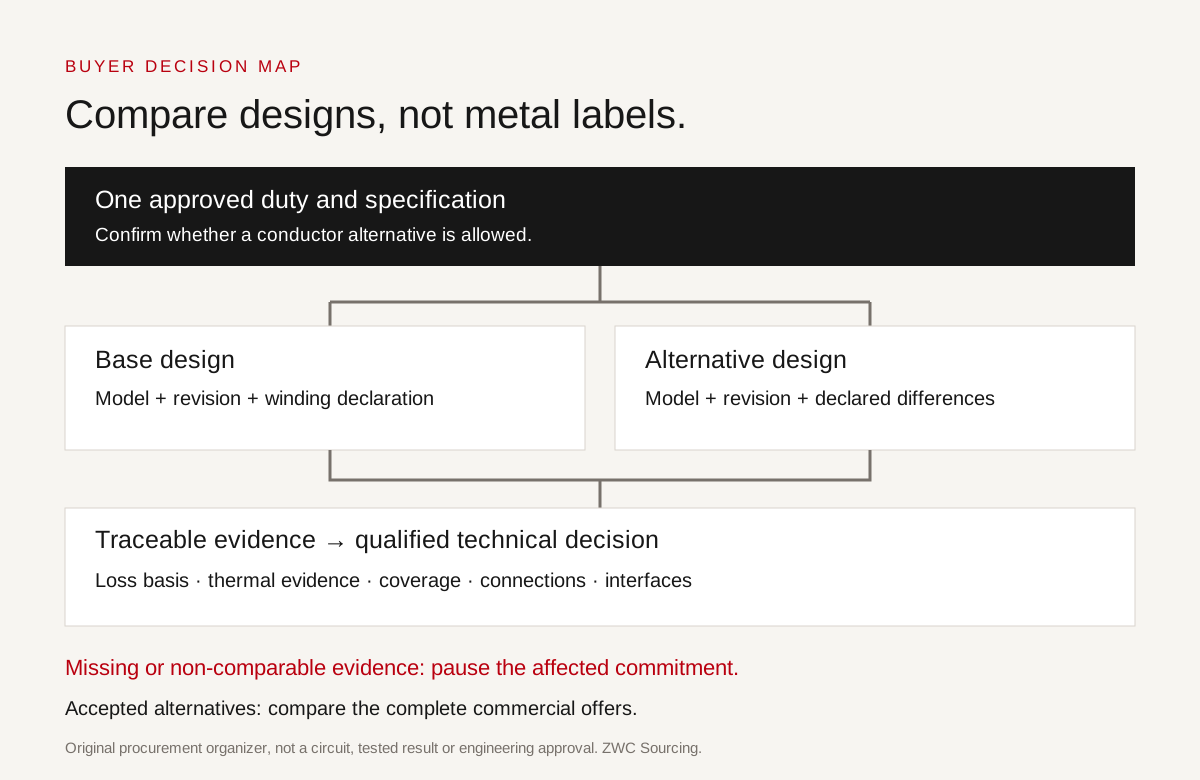
AI assisted with organizing text, not generating these photographs. Hero: Moses Cursor Ssebunya / WordPress Photo Directory, CC0, resized/compressed. Conductor detail: Fluppe37 / Wikimedia Commons, CC BY 4.0, resized/compressed. Both are illustrative contexts, not ZWC products, sites, suppliers, tested designs or endorsements. The exterior photograph cannot establish winding material. The workflow is original explanatory vector artwork.