

Quick answer
Use China's transformer manufacturing bases to decide where to investigate, not whom to approve. First distinguish the equipment family, then connect each dated regional source to a named company, producing site and visit objective. Hengyang and Haian provide useful but different official leads. Neither a cluster designation nor a published expansion story establishes that a particular factory can accept your design, reserve a production slot or meet your delivery date.
A famous manufacturing base can still be the wrong trip
A buyer can spend several days visiting a well-known electrical manufacturing region and still return without answering the project's critical question. The itinerary may include a corporate showroom, an unrelated product line and a new building whose commissioning status was never confirmed. None necessarily resolves who will build the proposed transformer.
The useful starting question is narrower than “Where are China's best transformer factories?” Ask: Which location can provide the missing evidence for this equipment family and this purchasing decision? A regional search should reduce wasted introductions and travel, not replace technical qualification with geography.
This guide uses two selected official regional case files, checked on 21 October 2026. It is not a complete national map, a market-share ranking or an approved supplier list. The named companies are source subjects, not claimed ZWC partners. Their mention does not establish availability, access or a recommendation to buy.
Two regional leads and what they actually establish
Keep a short source record beside the travel shortlist. Preserve the publisher, publication date, product wording and the specific inference you are making. A broad regional description and a named manufacturer's production example have different evidential limits.
| Regional case file | What the official publication says | Useful search direction | What remains unproved |
|---|---|---|---|
| Hengyang, Hunan; provincial industry department, 29 July 2026 | The account identifies Hengbian within the Hengyang–Changsha–Zhuzhou–Xiangtan ultra-high-voltage transmission and transformation equipment cluster, and describes coordination with component, processing and logistics activities. | Investigate an appropriately scoped transmission-equipment or supporting-process lead, then identify the actual entity and site. | Which plant would execute the proposed order; relevant design coverage, current access, production availability and project acceptance. |
| Haian, within Nantong, Jiangsu; Nantong tax authority, 27 July 2026 | The account discusses Jiangsu Dinghong Power's epoxy-resin dry-type transformers and packaged substations in a data-centre power-supply context, alongside Haian tax-service activity. | Investigate that named dry-type or packaged-substation product lead, if it matches the engineer-defined enquiry. | Exact offered model, producing address, complete package boundary, destination suitability, test coverage and present delivery commitment. |
Sources: Hunan industry department's Hengyang account and Nantong tax authority's industry-chain account. These are dated public accounts, not independent product audits. We do not carry their growth, efficiency or sales figures into a forecast for your order.
The contrast matters. A transmission-equipment cluster is not a substitute for a dry-type product enquiry. Equally, one dry-type producer's reported activity does not describe every transformer manufacturer in Haian. The correct next action is a targeted evidence request, not a region-wide quality assumption.
Separate the product family before drawing the route
Put the equipment family at the top of the shortlist: distribution transformer, large power transformer, control transformer or a defined packaged assembly. Ask the project's qualified electrical professional to confirm the intended duty and the boundaries of supply. Do not infer them from the word “transformer” in a directory.
For a packaged substation, identify whether the conversation concerns the transformer alone or an assembly with additional equipment and interfaces. For a component search, state that it is a component enquiry rather than a complete-unit procurement. These distinctions change which people and operations you need to meet; they are not permission to choose an engineering design yourself.
If the family or technical ownership is unresolved, start with the distribution-transformer RFQ data-pack guide. This article addresses the next, different question: whether a regional lead justifies a particular site visit. Do not transfer a delivery expectation or test assumption between product families.
Turn the regional lead into a visit decision
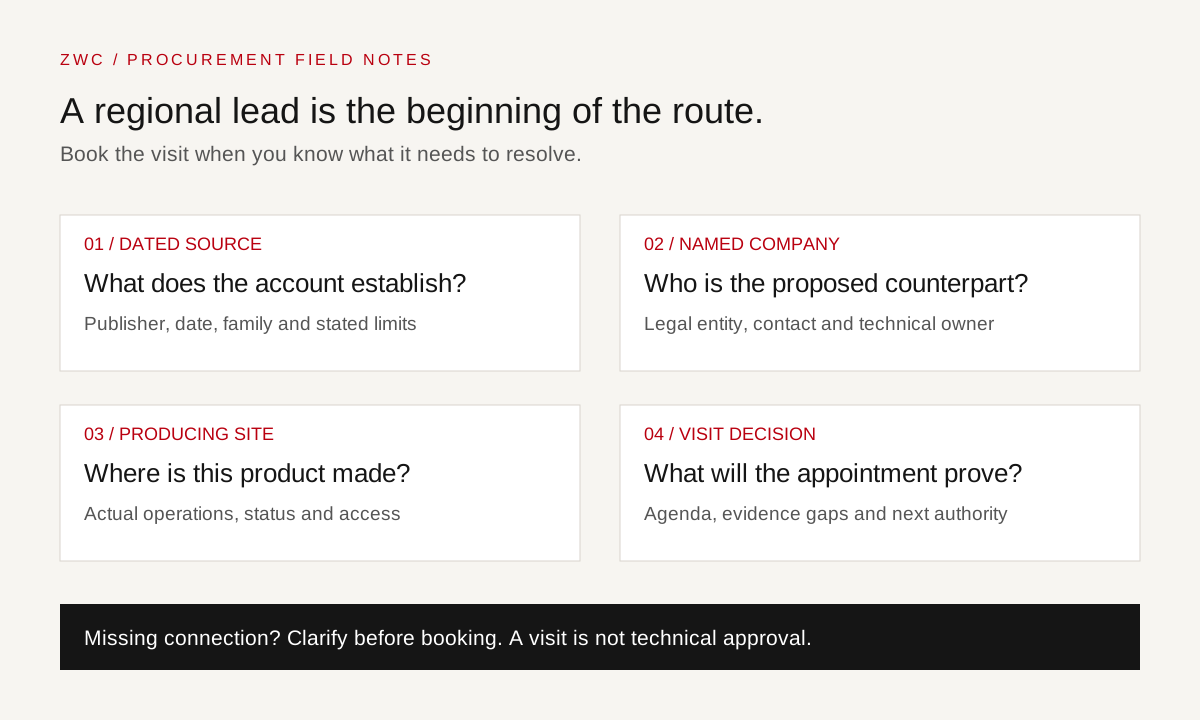
Send the following register before booking a multi-city route. Complete one record per proposed company and producing site, not one record per city. “To be confirmed” needs an owner and a reply date; it is not a positive qualification result.
| Decision field | Evidence to request before travel | Travel decision |
|---|---|---|
| Source-to-company link | Original dated regional source, exact legal name and direct confirmation of the contact's relationship to that entity. | Keep an unconnected directory entry as a lead only. |
| Company-to-site link | Proposed producing address, the operations performed there and which location the invitation actually covers. | A headquarters meeting can be useful, but label it as such rather than a factory verification visit. |
| Site-to-product link | Relevant product-family examples and a proposed agenda showing the operations or records that can be reviewed. | Defer a production-verification trip if the offered family is made elsewhere and no access is arranged. |
| Current operating status | Clarify whether the site is operating, being expanded, under construction or awaiting commissioning; request current supporting information. | Do not count announced future facilities as today's available production route. |
| Decision owners | Named commercial contact, qualified technical counterpart and authority for access, documents and any later acceptance. | Resolve missing decision-makers before treating travel as a technical approval meeting. |
| Dispatch boundary | Identify who will assess the proposed unit's transport envelope, factory exit and onward shipment arrangements. | Escalate unresolved route constraints to competent logistics and engineering specialists; a nearby port is not a transport approval. |
Request a written agenda that connects each appointment to a question. “Meet sales” may clarify commercial scope. “Review relevant production and traceable records” has a different purpose and may require advance permissions. Do not assume permission to enter restricted areas, photograph equipment or inspect another customer's documents.
An expansion announcement needs a present-tense question
Read dates carefully. An investment agreement, construction start, equipment arrival and commissioned production line are different events. When a supplier relies on an expansion story, ask which existing or new site would perform the proposed order, what remains incomplete and who owns the transition.
Do not invent a commissioning conclusion because a planned opening date has passed. Obtain an updated explanation. If production is moving between sites, identify which records, tooling, processes and acceptance arrangements apply to the actual offer. A new building's appearance does not resolve those questions.
This is also where travel costs can be controlled without lowering the qualification standard. Close identity, product-family and access gaps remotely first. Combine appointments only when each has a defined purpose. A shorter itinerary with the right technical counterpart can be more informative than touring several unrelated showrooms; no fixed saving is assumed.
What a useful visit should leave behind
The output is a revised shortlist, not a souvenir photograph. Record which proposed operations were actually seen, what was only described, which documents refer to the relevant product and what could not be reviewed. Attach each open question to an owner and next decision.
Keep three outcomes separate: continue technical evaluation, request missing evidence before further commitment, or remove the lead from this project's shortlist. A visit does not by itself approve design, certification, testing or shipment release. Physical access and technical acceptance are separate decisions.
For the broader company-and-process identity checks, use the Yueqing electrical supplier-screening guide. For a China-side search discussion, share the application, destination, engineer-approved specification status, quantity, relevant product family and the precise question a visit must answer. ZWC can discuss a supplier-search and coordination scope; access, category capability and responsibilities require project-specific confirmation. Engineering selection, safe working arrangements, testing and final acceptance remain with the appropriate qualified professionals and responsible parties.
Primary sources
- Hunan Provincial Department of Industry and Information Technology, 29 July 2026: selected Hengyang cluster and supply-chain context, not a current order-capacity certificate.
- State Taxation Administration, Nantong, 27 July 2026: named dry-type and packaged-substation example with Haian context, not technical suitability or supplier approval.
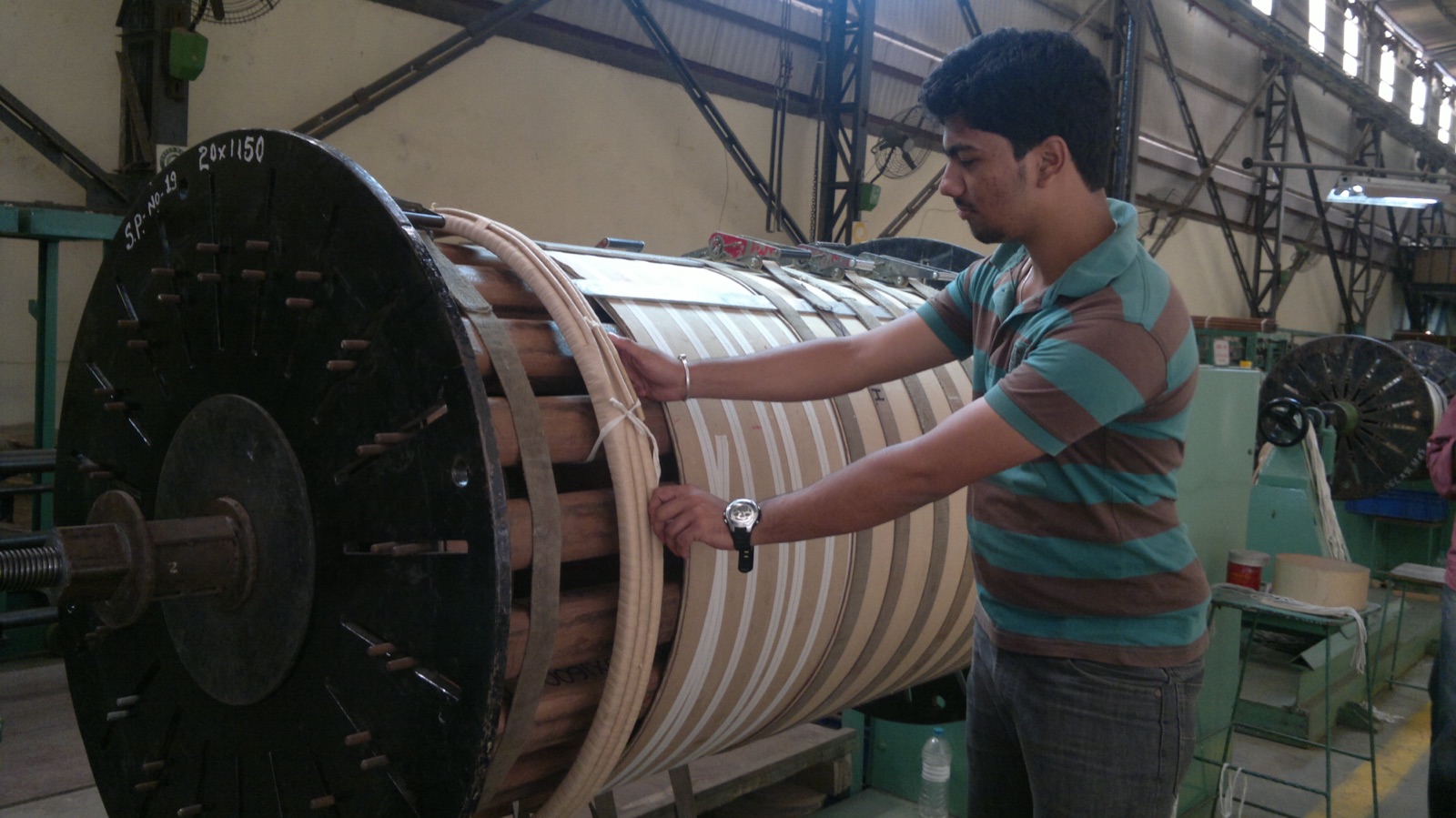
AI assisted with organizing text, not creating the photographs. Hero: Mr Dr3igeteilt / Pexels, Pexels License, resized/compressed. Second photograph: Shriram / Wikimedia Commons, CC BY-SA 3.0, resized/compressed under the same license. Both are historical or generic context, not either named regional case, a producing factory being recommended, an offered product or ZWC project; no affiliation or endorsement implied. The visit workflow is original explanatory SVG artwork.